|
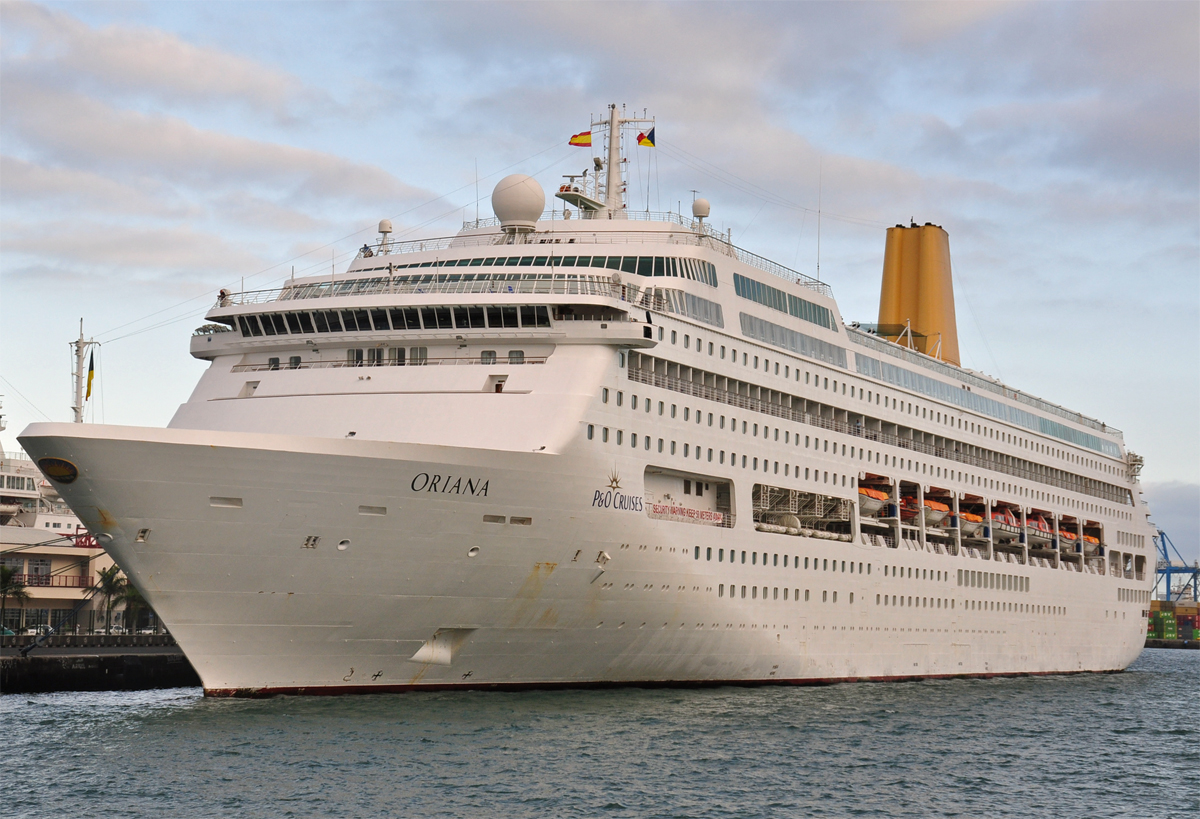
NOT ARCADIA
According to Greek
mythology Arcadia is a land of milk and honey where all your wishes would be
likely to be granted, but according to the UK newspaper the Guardian, for
150 Indian crew members of the P&O cruise ship Arcadia this has been
anything but the case. In oil industry parlance they have been NRB’d. The
letters stand for the words “Not Required Back”, and are applied to
contractors who maybe raise their heads above the parapet to complain about
something or in some other way disrupt the smooth running of an offshore
installation.
In the case of the Arcadia there was a problem with tipping a while ago, and
I must say that despite my investigation into the way cruise ship tipping is
conducted I still don’t understand it. The closest I can get to an
explanation is that in most cases, although not explicitly stated as an
option, a percentage is added to the cruise ship passenger’s bill for
service – gratuity. And, one assumes, this is passed on to the waiters and
cabin stewards, whose wages otherwise are likely to be insufficient to
ensure survival even in India.
Because the system did not seem to be working on the Arcadia back in mid
2011 150 Indian crew members protested and held a demonstration on the
quayside in Seattle for a period of about an hour and a half. The Captain
and the P&O UK office undertook some negotiations with the protesters and
agreed to look into the problem, and also agreed that there would be no
recriminations or sanctions against the protesters. But sadly in this day
and age even a ship captain’s word is not good enough, and before Christmas
Carnival Cruises, the owners of the Arcadia sent every one of the crew
members who had protested an NRB letter, and also stated that they would not
be employed again on any of the company ships.
THE ROCK
It’s full steam ahead for
the salvors of the Costa Concordia, who only the other day were pictured
removing the rock from the hole in the hull, essentially the cause of the
trouble. It is reported that it may find its way onto the island of Giglio,
where it could become a monument. But a monument to what?
Under the best circumstances it might become a memorial to those who lost
their lives in the disaster, which occurred six months ago last week, and as
a result relatives of those who had lost their lives have journeyed to the
island for a memorial service. It is still difficult to believe what
happened, and the initial report from the Italian investigators said nothing
we did not know already.
THE MASTERS RESPONSIBILITY
There follows a quotation
from the MAIB report, published in June 2012 into a accident involving the
Clipper Point and the port of Heysham in May 2011
“While the master’s responsibility for the safety of the vessel, his
passengers and crew is absolute, he can not operate alone. Vessel operators
and port authorities have similar, if less clearly defined, responsibilities
for equipping the master with the tools, rules and infrastructure that are
needed for him to be able to operate safely.”
I think this is a statement, which should be understood by employers and
port operators, as well as shipmasters, who believe that they have to take
risks to fulfill the commercial requirements imposed on their vessels.
It came about due to an accident to the Clipper Point in May 2011 when the
vessel entered the port of Heysham in high winds and while attempting a turn
to port to back up to the linkspan hit a ship and the quayside, and holed
its steering gear compartment. There were no injuries. The fact that the
accident occurred in Heysham, a British port, resulted in the investigation
despite the fact that the ship is register in Limassol.
The Clipper Point is a large modern cargo ferry running between Heysham on
the west coast of UK and Warrenpoint on the east coast of Northern Ireland.
The port of Heysham is a small facility with an extremely large tidal range,
and just room in the main part of the harbour for a ferry to turn through
180 degrees and back up to the linkspan in the easterly end.
The report describes in detail the control stations on the ship, one
positioned in the centre of the pilot house, and another on each of the
bridge wings, although they are not outside of course. The central control
station is provided with pitch controls for both propellers, controls for
the high lift rudders and also for the bow thrusters, however the readouts
on the bridge wings were more limited than those on the centre console.
Additionally to change from one control station to another all the controls
had to be in the same position, otherwise the transfer could not take place.
I have written at length about the activities of offshore vessels and the
making or not of a close approach, and of course if they choose not to make
the approach they are still on location, but ferries are different. At the
end of each voyage they must enter harbour and manoeuvre into a position
where they can unload and load again, and at that time the master has to
make a decision as to whether the task can be accomplished without damage to
their vessel or injury to the personnel.
Under ideal conditions there is room in Heysham harbour for a ferry to
enter, to make the turn and then to back up to the linkspan, but there have
been a number of minor incidents, and complaints had been made by May of
2011 about the practice of berthing general cargo ships on the south quay,
thereby restricting the space left in the harbour for the ferries to swing.
After one such complaint when a master had said that the stern of his vessel
had passed within three metres of one of the ships berthed on the south
quay, the harbour master had viewed a related video and pronounced that in
fact the distance was at least 9 metres.
There was also much concern over wind speeds and constant disagreements
between the harbour and the owners of the Clipper Point, Seatruck, as to the
windspeed in the harbour. This led to the shipowners installing their own
anemometer at the entrance. The company had also provided guidance to its
masters which suggested that entry into the harbour should be delayed if the
wind speed exceeding 29 knots, but routinely masters failed to follow this
advice. Even though they were aware the company did nothing. At this
windspeed the force on the hull of the Clipper Point exceeded 34 tonnes. The
harbour had carried out a risk assessment and their risk register cited two
sets of guidance neither of which had been written, and the availability of
a tug, the Sea Trojan, built in 1964 with a bollard pull of 14 tonnes, and
for sale at the time.
On the morning of the accident the master of the Clipper Point decided to
enter, despite the fact that the windspeed was between 27 and 34 knots,
there were two ships berthed on the south quay and one of the ship’s
bowthrusters was out of service – as it had been for seven months. Yes, it
was a poor decision, but as the MAIB point out, he was not getting any help.
SOMALI PIRACY
Yet another sad piracy
story is that concerning the Malaysian owned Albedo with a crew of 23 from
Bangladesh, Iran, Pakistan and Sri Lanka. The ship was captured in November
2010, but the company have been unable to raise the necessary ransom which
has varied between $8 million and $2.85 millon.
According to the on line “Somalia Report” the crew have now been taken
ashore and are being guarded by many armed men. Meanwhile some of the cargo
from the ship, which apparently consists of building materials has been
taken ashore and is being sold.
According to the same report there are now disagreements between the pirates
as to the size of the payment that would be acceptable, and after a campaign
in Pakistan a businessman has agreed to top up the ransom. But so far
nothing has happened. Things are not getting any better.
THE LEIV EIRIKSSON CONSORTIUM
The Seabrokers monthly
newsletter Seabreeze, reports that the Leiv Eiriksson is due back from the
Falkland Islands at the beginning of next year, and is to undertake 15 well,
plus 18 optional wells.
It is to be supported by the two Eidesvik vessels, the Viking Athene and the
VS 493 Avant the Viking Lady – pictured right by Jan Plug. I could be wrong,
but is this the first time that an all aft supply vessel has been hired to
support a semi-submersible? It had to happen. As soon as it became
unnecessary for ships to be discharged tied up stern too offshore
installations, the all aft ship became a possibility. Of course there was a
forerunner. The Oil Challenger was an all aft support vessel, built to haul
pipe to the Viking Piper, back in the 1970s. It was not a success in the
role.
ELECTRIC SHIPS
You may remember that I
mentioned the ITS Conference which took place in Barcelona at the end of
May.
There was some interesting stuff, and although I admit to being a bit of a
petrolhead, I found myself taking in a paper by a Canadian, Claude Messiaen,
and a Dutchman, Martijn Berkhoff about hybrid battery propulsion systems.
One of their points was that some ships have a range of power requirements,
typically in the offshore industry anchor-handlers. So why not have
batteries which can be used to supplement the basic power requirement at
times which a lot of bollard pull is required, or where power is required to
drive cargo pumps. They also pointed out that modern Lithium-Ion battery
storage systems are extremely efficient with only a limited weight penalty.
Of course such systems also require efficient use of power on board ship. I
still get told off for leaving the lights on in my home due to a habit
formed over 20 years of seafaring when the energy seemed to be unlimited.
But finally they described a ferry which is being built to operate somewhere
in Norway will be a genuine zero emission ship. It will be powered only by
electric motors, using electricity stored in the battery system, and –
here’s the killer – it will be recharged from a wind powered generator
overnight.
One assumes that on nights when there is no wind they will just plug it into
the mains.
iNFORMATION ABOUT THIS NEWS LETTER AND SHIPS AND OIL LTD
This newsletter expresses the views of the author Victor Gibson about marine
events which are considered to be worthy of interest. It is meant to be a
five minute read. Sources of information include:
International Tug and OSV Magazine
Maritime Bulletin
The Tugs, Towing and Offshore Newsletter.
The Nautilus Telegraph
The Nautical institute Magazine Seaways
The BBC Home Page
The Somalia Report
The MAIB Website
The website contains comprehensive information about many offshore vessels
and approaching 10,000 images. Since June 2012 the following company
information has been updated as follows:
Acergy
Acomarit
Active
Adams Offshore
AET Offshore
Alam Maritim
Allied Marine
Alpha Logistics
Picture of the Day included photographs of the following:
Polarcus Amani by Paul Moar
Leiv Eiriksson
North Rankin B by Nic Reid
Magne Viking Alistair Morton
Maersk Frontier by Scott Vardy
Castoro 7 by Nigel Sly
Geoholm by Tony Broadie
Greatship Asmi by Mike Prendergast
Normand Atlantic by Phil Tweddle
SHIPS AND OIL OFFERS THE FOLLOWING PUBLICATION FOR SALE ON ITS WEBSITE:
THE HISTORY OF THE SUPPLY SHIP £37.50 inc P&P anywhere
SUPPLY SHIP OPERATIONS £27.50 inc P&P anywhere
RIGMOVES £5.75 inc P&P anywhere
SEE THE WEBSITE FOR MORE INFORMATION.
Buy all three books for the bargain price of £52.50
This newsletter has been compiled using one of the Word Templates – it has
not been easy I can tell you. However if you would prefer not to receive
further editions please email me vic@shipsandoil.com .
And just as a footnote, could Brazilian seafarers stop sending me their CVs!
Vic Gibson. June 2012.
If you would like to
receive News and Views as a PDF - with photos -
email me.
FOR INDEX OF NEWS AND VIEWS CLICK
HERE |


_small.jpg)

.JPG)