|
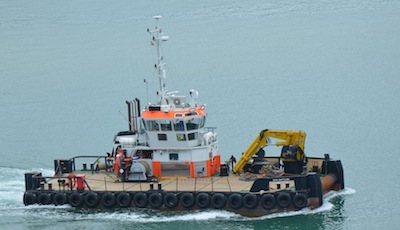
GOING FOR A FISH SUPPER
Many
seafarers distrust small craft, and maybe those they trust least are
inflatables which can be lethal if not operated with great care. Sometimes
personnel are thrown out of them and are cut to pieces by the propeller,
sometimes someone fails to hold onto the upturned hull which sadly seems to
have been the case recently when the captain of the GPS Battler lost his
life.
The GPS Battler is part of the GPS fleet, an organization with a large
number of tugs, barges and other craft, mainly focused on aspects of civil
engineering in the marine environment, based in Chatham in Kent. It had been
engaged in assisting with dredging in Menorca and was on its way to Northern
Spain when it stopped at Almeria for engine repairs.
The captain and three other crew members had been ashore for a take away
using their inflatable and were on their way back to the vessel when they
were overturned by a large wave in the entrance to the harbour. It appears
that two of the crew members managed to hold onto the FRC, a third was
thrown a lifebuoy, but that contact was lost with the captain, whose body
was pulled from the water by a passing police launch.
The accident occurred in the middle of August and was reported by the Uk
newspapers, but not apparently by the maritime press. Hence there are
questions which are unanswered. Top of the list might be, what sort of
accommodation is provided on this extremely small vessel for an ocean going
voyage? The vessel details show a good photo of the wheelhouse, and the
engine but nothing else, and there is no further information in this regard.
Was the ship at anchor or alongside somewhere? Did anyone
THE KORT NOZZLE
Thumbing through my ‘in tray’ I found an
occasional newsletter from Robert Allen, the well known Canadian tug
designers and wondered why I had kept it. Inside I found an extremely
interesting article by the current Robert Allen about the Kort nozzle, for
which his father had negotiated a licensing agreement back in 1964. The
device itself had been invented by a German engineer Ludwig Kort back in the
1930s, and the first use of the Kort nozzle in North America was said to
have been on the tug Kam back in 1939. But most interestingly, back in 1962
Robert Allen got a contract for four tugs, and advised the client of the
advantage of the Kort nozzle, particularly for log towing. Subsequently two
of the tugs were fitted with Kort nozzles, and two had open screws. The Kort
nozzle tugs outperformed the other tugs by much as 25% in bollard pull and
their speed was significantly greater. Hence Kort nozzles were later fitted
to all four tugs. Although it was common in the early days to fit what might
be known as ‘steering nozzles’, which are still often seen on lifeboats, it
became more common to fit fixed nozzles with a single or multiple rudders.
THE
TRINITY II ACCIDENT

The Trinity II from
the ‘Marine Traffic’ website.
The
Trinity II was a liftboat, one of two hired by Geokinetics to act as a
collecting point for some seismic work being undertaken in the south of the
Gulf of Campeche, some 15 miles from the coast in 84 feet of water. The
process being carried out was for a number of chartered vessels to lay
cables containing geophones on the seabed, and then for one of them to fire
of an air gun. The resulting seismic information would be collected on board
the liftboats. Geokinetics were working for PEMEX the Mexican state oil
company.
The Trinity II was a small craft, capable of moving from place to
place by means of its own propulsion, and then able to jack itself out of
the water on its three legs. There were two legs at the bow and one at the
stern, all 145 feet long. It had tankage for water and fuel in the hull, and
a deck house on three levels which offered a navigation bridge,
accommodation and recreation spaces for the four crew and six contractors
who were employed by Geokinetics. The liftboat carried the following
lifesaving equipment, three lifefloats which were buoyant ovals with netting
in the middle, one rescue boat (Although listed in the report there is no
further mention of this equipment), three lifebuoys, two 25 person liferafts
and one EPIRB (Emergency Position Indicating Radio Beacon).
The timeline for the event was as follows. All in 2011:
Late August. The Trinity II is located about 15 miles North of Frontera in
the Gulf of Campeche in 84 feet of water and starts work.
September 4th. The marine weather forecast indicated the possibility of a
low pressure system forming nearby. The master and the navigator discussed
the possibility of moving the vessel closer to the coast, but decided not to
carry out the move due to the time involved.
September 5th. There is an increase in wind speed and sea state.
1200. September 6th. The sea state has become such that the vessel can no
longer be moved. Specifically it can not undertake the transit from the
elevated to the afloat status.
Evening. September 6th. The vessel is jacked up further from the sea surface
three times. This now the only option for the crew apart from evacuation.
The precise extent of the jacking operations were not recorded.
September 7th. The vice president of Trinity Liftboats calls the master to
discuss the situation. The master also speaks with the president of Trinity
and the Geokinetics project manager in Frontera. The project manager tells
him that PEMEX can send a helicopter from Ciudad de Carmen to evacuate the
crew if necessary. The Mermaid Vigilance is instructed to stay in the area
and act as a standby vessel “to assist if necessary”. This information
conveyed to the Trinity II master.
PM. September 7th. The crew of the liftboat note that the windspeed has
increased to more than 50 mph, and the NHC have determined that this is a
tropical storm, named “Nate”. The stern leg is now sinking deeper into the
seabed, probably due to wave action on the underside of the hull.
Evening September 7th. The master has determined that it is time to evacuate
the Trinity II, and conveys this information to Geokinetics in Frontera. The
master of the Mermaid Vigilance is requested to close up with the liftboat,
but replies that he may be unable to do so, being unable to turn in the
adverse weather.
Night September 7th. The master of the Mermaid Vigilance reports that he
will be unable to assist the Trinity II. He says he will be unable to turn
his vessel due to the sea state, the vessel has sustained storm damage and
he has an injured crew member in board. He returns the vessel to port.
Early September 8th. The master of Trinity II gathers all personnel and
discusses the possibility of abandoning ship. Also during this period of
darkness in increasingly difficult weather conditions the master is in
frequent contact with the president of Trinity liftboats by the satellite
phone. They discuss the means by which additional air gap can be gained, but
nothing is actually done.
Early Morning. September 8th. The Trinity II stern leg penetrates a further
six feet into the seabed. The master attempts to level the hull by lowering
it on the forward legs, but this action is unsuccessful. Discussion takes
place between the president of Trinity Liftboats and the master, and the two
consider the possibility of the stern legs breaking off. According to the
master, the president tells him to inflate one of the liferafts. The
president later denies giving this instruction.
0600. September 8th. Geokinetics in Frontera receives another request that
personnel be evacuated from the vessel. Geokinetics contact the PEMEX
“Control Marino”, which monitors and directs all PEMEX chartered vessel
movements in the Gulf of Campeche. Control Marino dispatches Isla del Toro
and Bourbon Artabaze in the direction of the Trinity II. Their ETAs are 1400
and 1500 on 8th.
Morning September 8th. All personnel muster wearing lifejackets. They have
collected food, bottles of water and the flares in preparation for
abandonment. The AB and others are sent to inflate the starboard side
liferaft. They place the container on the deck, tie the painter onto the
handrail and inflate it. The high wind immediately carries it away, breaking
the painter.
1225 September 8th. The stern leg breaks off after the impact of several
large waves resulting in the stern descending towards the sea. The master
orders abandon ship, and broadcasts a ‘Mayday” on the ship’s radio. The
personnel grab their supplies and head for the main deck. The master returns
to the bridge to recover the EPIRB, but is unable to do so due to the
possibility of being hit by the crane. A wave crashes into the port side
liferaft canister, and it inflates on the deck. The crew push it over the
side, but despite it being tied on to the rail by its painter, the wind and
waves carry it away and it is soon out of sight.
Two of the contractors return to the upper deck and recover one of the three
lifefloats and pass it down to the people on the main deck. Shortly
thereafter the hull is hit by several large waves, and the master, believing
that capsize is probable, orders everyone to abandon. None of the prepared
supplies are taken although they do take extra lifejackets and a lifebuoy.
The master has a waterproof radio which he loses as soon as he enters the
water.
The 10 crew members remained in the water for three days while the
authorities searched for them, and three of them died at sea. The fourth
died in hospital after they were recovered. Subsequently Australia’s Seven
network presented a lurid programme accusing the master of the Mermaid
Vigilance of “murder and cowardice”, and the families of three of the dead
men sued Geokinetics, Trinity and Mermaid Australia. The Australian TV
regulators upheld a complain by Mermaid and it appears that Geokinetics
settled the court case. More on this case at www.shipsandoil.com/Features/1features.html
THE GORA

It is
distressing that we frequently read reports of the poor to criminal
treatment of seafarers, and sometimes I wish I could do more than just write
about it.
The Marine and Coastguard Agency in UK visit and inspect ships in British
ports and detain those with certain failures or deficiencies Often the crews
of these ships are living in some distress, and in some cases the
deficiencies are sufficiently serious for the ships to be detained for
extended periods, sometimes resulting in the ship and the crew being
abandoned.
So now we
come to the GORA a Liberian registered bulk carrier which was
detained in Leith. The crew were existing in appalling
conditions and had not been paid for some months, and as has become common
in these cases a representative of the ITF was trying to sort out the problem of their
wages. The British MCA publishes a
monthly report on the detentions and the reasons for them. The MCA
inspectors who visited the Gora recorded 41 deficiencies of which 15 were grounds for detention.
These were:
ISM Code not as required, ventilators, air pipes and casings corroded,
insufficient provisions, provisions expired, galley and food handling room
damaged, signs of vermin, echo sounder inoperative, MF and HF radio
installation inoperative, certification defective, fire dampers inoperative,
emergency generator not as required, lifesaving appliances not as required,
rescue boat not ready for use, fire detection inoperative.
The ship was released on 30th June, but that is probably not the end of the
Gora story.
OPERATING MANUALS

Some time
ago when writing a safety case for a mobile unit I had cause to look for the
specification of a new lifeboat. I discovered that even though the thing had
cost the owners $250,000 there was only a general manual available for
several different types of boat. I also had to write a description of a new
well monitoring system, which probably cost millions, and found that there
was no manual at all, just a Powerpoint presentation.
I had cause to think of these failings when reading a CHIRP report which is
a document intended to circulate narratives about accidents and near misses,
in the hope of giving mariners the opportunity of learning from the mistakes
of others.
This particular copy of the report concentrates on failings in operating and
maintenance manuals which still seem to be as extensive as they ever were.
Even though there is extensive regulation and guidance on what should be in
place.
A contributor states “I lay the blame entirely at the feet of the
classification societies who issue type approval for machinery without
bothering to examine the manuals for the quality of their content, in many
cases they do not appear to have tested the equipment either.”
The report ends as follows: “The issue over poorly written, inaccurate or
incorrect instructions in manufacturer’s operations and maintenance manuals
is a major concern that has been with the industry for over 10 years; little
progress has been made.”
INFORMATION ABOUT THIS NEWSLETTER AND SHIPS AND OIL LTD
This newsletter expresses the views of the author Victor Gibson about marine
events which are considered to be worthy of interest. It is meant to be a
five minute read. Sources of information include:
International Tug and OSV Magazine
The Tugs, Towing and Offshore Newsletter.
The Nautilus Telegraph
The Nautical institute Magazine, Seaways
The BBC Home Page
The MAIB Website
gCaptain
World Maritime News
The Siberia Times
The Scotsman
The Ships and Oil website contains comprehensive information about many
offshore vessels and approaching 10,000 images.
People have continued to send pictures of the day for which I am very
grateful. The photos brighten the days of our hundreds of visitors as they
sit at their desks – I have noticed that our numbers are considerably
reduced at the weekends. By the way I have been told that a number of
subscribers to the newsletter send it on to others – if you are one of the
others email me for your own copy! I have had one or two requests, but have
not always been successful in sending the newsletter. Maybe their systems
reject PDFs.
Just at the moment the website is going through some changes have reached
the maximum size available on its original server. Hence our service
provider has moved it to another server. But some aspects of the old
programme are not supported. Hence I have had to go through he process of
learning some new stuff, always a painful business. The site may also be
going to take on a new look altogether, but I am waiting for an instruction
book.
I have also been on holiday so there have been no company updates recently.
Recent Pictures of the Day in August include:
Sea Brasil
Skandi Aukra
Ocean Shield
Caledonian Vanguard
Skandi Admiral
SHIPS AND OIL OFFERS THE FOLLOWING PUBLICATION FOR SALE ON ITS WEBSITE:
THE HISTORY OF THE SUPPLY SHIP £37.50 inc P&P anywhere
SUPPLY SHIP OPERATIONS £27.50 inc P&P anywhere
RIGMOVES £5.75 inc P&P anywhere.
Buy all three books for the bargain price of £52.5
If you would prefer not to receive further news letters please email me vic@shipsandoil.com
.
Vic Gibson. August 2014.
To view earlier News and
Views Click Here.
If you would like to
receive News and Views as a PDF - with photos -
email me.
|


_small.jpg)

.JPG)