|
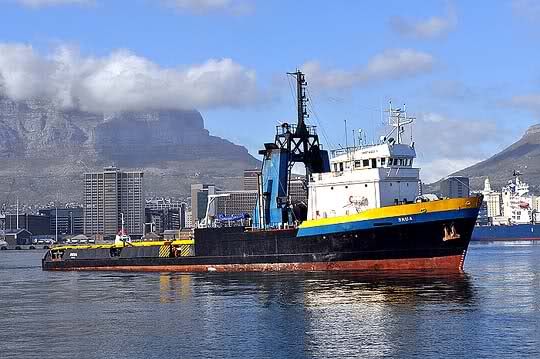
GOODBYE OIL HARRIER
I was
informed by a number of sources that the venerable Oil Harrier, then the
Skua has gone to the breakers. I was mate of this vessel when it was brand
new in 1976, and looking back it was useless, even though in this photo it
looks quite the part.
It was the first OIL ship to be provided with controllable pitch propellers
which avoided the almost unendurable delay when one wanted to go from ahead
to astern, but apart from that it was extremely difficult to work because of
the small size of the work drums. Our baptism on this brand new craft was to
go out to lay anchors for some Sedco rig on the location of the Magnus
Field. The thing was provided with chain chasers, the latest thing at the
time, and we all struggled with them, mainly tending to bring back the
anchor to the rig after laying it. We on the Harrier had the additional
problem of having to connect up the wire from the second drum half way
through the run, or disconnect when going the other way. Unusually the ship
was provided with storage reels for wire underdeck, but similarly to the
main work drums they could not store much wire, and it was difficult to get
the leads right.
At one point we were weathered off and while dodging took a wave straight
through one of the bridge windows, leaving us with nothing but the steering
(Fortunately). We ran before the weather off the Northernmost of the North
Sea charts, while fixing the broken window using some blankets, a profiled
engine room floor plate and some wood out of the dry store. Once we’d fixed
it we went back to work. All the same I was sorry to see it go.
PIRACY OR NOT
I have
just returned from holiday in India where it was being reported that an
Indian tanker with 140,000 tonnes of Iraq¡ oil on board had been detained by
the Iranian revolutionary guard, and forced to berth in Bandar Abbas. The
Iranians claim that they had detected pollution problems, but the Indian
press think that it is something to do with the fact that an Iranian ship
has been detained in Mumbai for two years. Is it then acceptable for one
regime with a problem to capture a ship owned by another, in retaliation for
some problem or other? The ship held in India is there due to a financial
problem, actually nothing to do with that country, and the Indians have
allowed crew changes to take place. One assumes that it has a writ nailed to
the mast. But what of the Desh Shanti, the Indian ship? More on this story
later.
UMAN ERROR AND HEAVY
WEATHER DAMAGE
In January
1993 the tanker Braer left Mongstad loaded with 84,000 tonnes of Norwegian
crude, bound for Quebec. The ship headed out into the teeth of southerly
gale and made slow progress towards the Atlantic. During the 4th January the
officers noticed that some pipes which were stowed on the afterdeck had
broken free and were hammering back and forth across the deck as the ship
rolled. The captain was informed but he decided that nothing should be done
until the weather improved. Later in the day the boiler which generated the
steam for heating the heavy fuel used by the main engine failed, resulting
in a decision to put the main engine on diesel. Early on 5th the main engine
stopped. The fuel had been found to be contaminated, and the engineers had,
for hours, been trying to clear the diesel settling and service tanks of
water. The engine problem turned into an emergency as the ship drifted
towards the southern tip of the Shetland Islands, and at 1119 the ship
grounded at Garths Ness. The water was found to have entered the fuel tanks
through vents damaged by the loose pipes on the afterdeck.
On 11th November 2006 the 74,000 dwt tanker FR8 Venture shipped two large
waves over the bow, which resulted in the deaths of two ABs and serious
injuries to one ordinary seaman. The ship had been engaged in ship to ship
transfers in Scapa Flow and, on completion of the work, headed out into the
Pentland Firth while the crew were still securing the deck. The event was
investigated by the UK Marine Accident Investigation Branch which not
surprisingly determined that the deck should have been secured before the
ship left sheltered waters. The owners subsequently modified their
Operations Manual to ensure that the decks of their tankers would be secured
or unsecured in such a manner that the crew would be, as far as possible,
protected.
The captain of the FR8 Venture is now aware that he should not have left
sheltered waters before securing the deck and has probably never let
anything like that happen to him again, and that the masters of other
vessels of the same company have taken some notice of the change to the
Operations Manual. However, one would think that the ability to deal with
heavy weather would be one of the skills necessary to command a ship. After
all, it is something seafarers have to deal with throughout their working
lives, and if shipmasters do not have the skills to safeguard their crew and
to minimise the possibility of damage to their vessels, is survival only due
to luck?
It is likely that the approach taken to adverse weather differs between
those in command of small ships, and those in command of large ones. Small
ships will not survive adverse weather unless they are kept watertight and
weathertight, and this knowledge is a considerable incentive for the
captains and the crews. Large ships, and most tankers are large, some of
them very large, may be relying on their shear size to see them through.
The FR8 Venture and the Braer were included here to illustrate the fact that
in both cases a specific approach to adverse weather would have prevented
the accidents. It is pretty obvious that if the captain of the FR8 Venture
had considered the possibility of waves climbing over the bow of the ship,
he would not have left shelter while the crew were still securing the
anchors. The MAIB also suggested that possibly there would still have been
scope for him to turn away from the weather until the work was completed.
One must assume that he thought that his ship was sufficiently large for it
to be unaffected by the five metre seas running outside in the Pentland
Firth. The terrible environmental effect of the grounding and break-up of
the Braer at Garths Ness could have been prevented simply by ensuring that
the steel sections on the afterdeck had been properly secured. The report
into the incident also suggests that they could possibly have been
re-secured if the vessel had been hove too on a heading which would have
allowed the crew to gain access to the area. Not to have taken this action,
in the words of the investigators, “suggests a fundamental lack of basic
seamanship”
And this is probably the point. One could look upon adverse weather as an
act of god, visited on the ship as it goes about its lawful business,
ploughing a furrow through the ocean between the port of departure and the
destination, in which case the only thing to do is to press on at best
speed. Or else the occasional storms which beset any ship on passage could
be looked on in the same way as sandbanks or islands, or port approaches.
These things require positive action such as alterations of course or
reductions in speed. And here it has to be faced. The captain will just have
to fill in the form, to let the charterers know why the date and time of his
arrival is going to be different from that estimated at the time of
departure.
In the words of SOLAS Regulation 10-1.
The master shall not be constrained by shipowner, charterer or any other
person from taking any decision which, in the professional judgement of the
master, is necessary for safe navigation, in particular in severe weather
and in heavy seas.’
This written for Safety at Seas International in 2008.
PETROBRAS AND DP THE HERCULES 265
s.jpg)
This is a
photo of a few odd ships on hire to Petrobras, courtesy of Jan Plug.
I have been in correspond-ence with a deck officer working on a ship hired
to them who told me that they have a rule that all ships working for that
company must be on DP if within the 500 metre zone of any of their offshore
installations. Surely not all these ships are fitted with DP!
This might mean therefore that all ships fitted with DP must be on DP if
within the 500 metre zone. My correspondent was really complaining that this
rule does not offer much scope for training ‘on the sticks’, as we used to
have it.
Of course if the ship moved outside the 500 metre zone then the DP system
might not have time to register trends in the environmental conditions, and
hence there would be problems when closed up to the installation.
But if the DP operators on the bridge do not have the necessary skill to
drive the ship should the DP fail there must be an increased risk of
collision. On at least one occasion where the DP has failed the operator has
switched the system to joystick, and this secondary system has taken
immediate action to restore the heading resulting in the stern of the ship
whacking into one of the legs of the rig.
When considering such problems never forget that old Petrobras maxim, ‘No
situation is so bad that it can’t get worse’.
RAMCO
CRUSADER

The former Seaforth
Crusader.
The Ramco
Crusader sank the other day off Brazil with no loss of life. It was in its
way a historic ship. There follows an excerpt from ‘The History of the
Supply Ship’.
Probably within days of the arrival on the scene of the first of the
Maersk R class the Norwegian designers were sharpening their pencils to see
what they could do with a larger hull and four big engines. Ulsteins drew
the UT708 and the Maritime Engineering developed the ME303. Seaforth
Maritime who might always have been the most innovative of the British
companies commissioned UT708s from Norway and ME303s from Korea, and while
the former entered service almost seamlessly the Korean built ships, arrived
with something of a fanfare, and rumours of building problems and
difficulties with the equipment echoed round Aberdeen.
One thing that everyone understood as soon as they saw the new ships was
that the ME303 was extremely large, almost a different type of ship from its
forbears. The 14,000 bhp was not that different from that available to the
last of the Maersk Rs and the winch was made up of one tow drum and one
workdrum, both of moderate size. But the accommodation seemed to be vast,
and the bridge with its sofas, sinks, tea making spaces and toilets took the
watch-keeping areas to a whole new level of luxury. Visitors looked down
from the bridge onto the after deck and had to strain their eyes to see what
was going on.
INFORMATION ABOUT THIS NEWLETTER AND SHIPS AND OIL LTD
This newsletter expresses the views of the author Victor Gibson about marine
events which are considered to be worthy of interest. It is meant to be a
five minute read. Sources of information include:
International Tug and OSV Magazine
The Tugs, Towing and Offshore Newsletter.
The Nautilus Telegraph
The Nautical institute Magazine Seaways
The BBC Home Page
The MAIB Website
gCaptain
World Maritime News
The Ships and Oil website contains comprehensive information about many
offshore vessels and approaching 10,000 images.
People have continued to send pictures of the day for which I am very
grateful. The photos brighten the days of our hundreds of visitors as they
sit at their desks – I have noticed that our numbers are considerably
reduced at the weekends.
However, this being summer not much work has been done on the detail of the
website, but I expect that full services will be resumed in September when
the holidays are over. That being said I have received some great photos
recently so please keep sending them guys. They will all be published in
time.
Recent Pictures of the Day include:
Haewene Brim
World Diamond
Botica
SHIPS AND OIL OFFERS THE FOLLOWING PUBLICATION FOR SALE ON ITS WEBSITE:
THE HISTORY OF THE SUPPLY SHIP £37.50 inc P&P anywhere
SUPPLY SHIP OPERATIONS £27.50 inc P&P anywhere
RIGMOVES £5.75 inc P&P anywhere.
Buy all three books for the bargain price of £52.5
Vic Gibson. June 2013.
To view earlier News and
Views Click Here.
If you would like to
receive News and Views as a PDF - with photos -
email me.
|


_small.jpg)

.JPG)