|
SO GOODBYE TO THE
TYPHOON
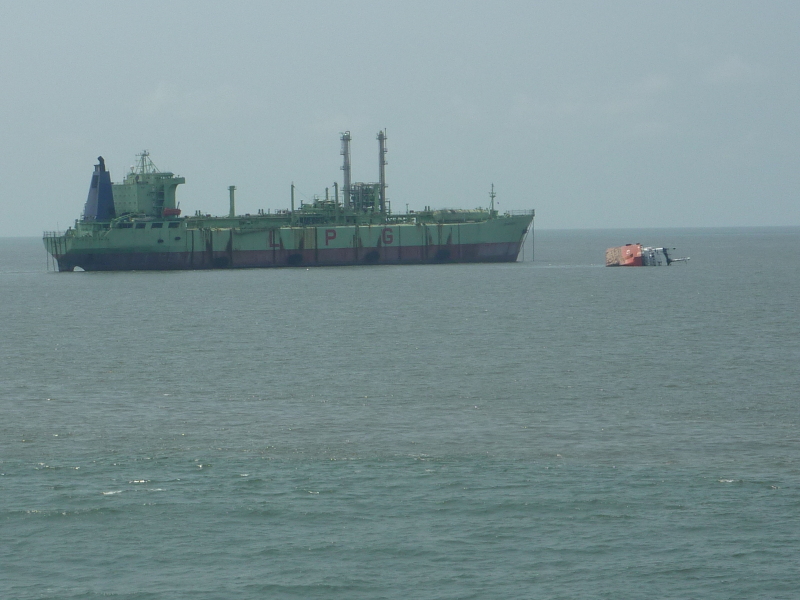
A press release apparently from the
Nigeria Maritime Administration and Safety Agency reported in early November
that the tug Gudri had sunk in the Bonny Channel. It had been involved in
some way with the grounding of the LPG vessel Symphony which had occurred on
3rd November. There had been some Nigerian officials on the tug, which sent
out a distress message, and they and the crew were rescued by a patrol boat.
There were no casualties – apart from the ship.
Back in the earlier days of North Sea oil exploration we all did some
exciting stuff and one of the moments of excitement I remember best was
being instructed to go to the aide of the semi-submersible Pentagone 84
which had broken two anchor wires in extreme weather, when I was master of
the Star Polaris. We left Aberdeen and tacked our way north keeping the
weather off the bow, and arrived at the rig to find that the Typhoon was
already on the tow wire holding the rig in position, head to wind riding the
crests and disappearing in the troughs.
We recovered one of the anchor wires onto what were then our extremely high
capacity work drums, gave the end back to the rig and reran the anchor. Once
the rig was re-secured the Typhoon was able to go on its way. Regular
visitors to my website will know that I have always held the Tempest and
Typhoon in great affection so it is sad to see this one meet its end. It is
rumoured that the former Tempest is on its way to, or has reached, the
breakers.
THE END OF THE PRESTIGE BUSINESS
The trial of the Master, the Chief
Engineer and the Spanish head of the merchant navy concluded the other day.
We will all remember that the Prestige broke up off the coast of Spain in
2002 after being refused a port of refuge by the Portuguese, French and
Spanish governments and as a result 77000 tonnes of boiler fuel was
deposited on the Atlantic coast of all three countries. Poor Captain
Mangouras, now 78 received a suspended 9 month sentence for failing to obey
Spanish government instruction to take the ship into deeper water. He of
course suggests that the environmental considerations had neglected to
prioritize the safety of his crew. ‘They sent us in a floating coffin to
drown’ he said. The Spanish government had previously failed in its attempt
to claim damages from the ship’s classification society, ABS.
THE
PERILS OF PODDED PROPULSION

The aft driving
position of a ship fitted with azimuthing propulsion. It can be seen that to
go astern the pods have to be rotated
The UK
MAIB (Marine Accident Investigation Bureau) has recent resurrected the
unfortunate accident of the Skandi Foula, in its second 2013 digest, and in
addition the industry has identified a couple of other incidents where
collisions resulted from mechanical failure. All of them in one way or
another seemed to be related to lack of familiarity with aspects of the
ship’s mechanical systems.
The Skandi Foula event concerned the operation of the azmuthing main
propulsion by the Chief Officer, who was apparently recently appointed to
the ship, and although he was familiar with the operation of the azimuthing
propulsion in what was described as the ‘semi-automatic’ mode, he was not
familiar with the fully manual operation of the system.
He chose to angle the thrusters in a way that when the power was applied to
the appropriate control as well as moving the vessel forward the heading of
the ship would be altered in the same direction. ie, if power was increased
on the starboard thruster the ship’s head would move to starboard.
The Chief Officer had been unable change the heading as required using the
bow thruster and so he increased the thrust to one of the aziprops. However
the change in heading was insufficient, and the increase in speed to more
than four knots made the bow thruster ineffective (my assumption). The Chief
Officer put the main propulsion to full astern which would require the
initiation of an additional generator by the power management system, but by
the time it had started up the generator and put it on line, the ship had
collided with the OMS Resolution.
There have also recently been failures of control systems on other support
vessels. In one case a generator failure resulted in the shutting down of a
bow thruster and one of the aziprops. The captain was apparently unable to
control the vessel with the remaining systems and collided with another
vessel. In yet another case a generator failure resulted in the CP
propulsion resetting itself to the default full astern, resulting in the
vessel colliding with the harbour wall.
These misfortunes have resulted in the companies involved changing their
procedures to make sure that sufficient power is available for all possible
activities during port operations.
Now here’s the question. These requirements are so basic that it is
difficult to believe that the appropriate pre-departure arrangements were
not made. The MAIB report does not tell us what the ‘semi-automatic system’
for directional control of a vessel fitted with azimuthing propulsion was,
but it seems likely that either the joystick or the autopilot offered the
best means of their collective operation.
And of course it might have been one of these system which was being used
when the other unnamed vessel lost a generator resulting on one of the
thrusters and one of the azimuthing propulsion units shutting down. Given an
omnidirectional thruster aft and a bowthruster many shipmasters would have
no problem at all in controlling the direction and speed of their craft. In
fact some might prefer it.
And as for the failure of the CP system in the full astern position. Back in
the day we understood that this was a common default setting for this form
of propulsion, on the basis that most ships spend nearly all their time
dashing between places, so in the event of a CP failure it would be best for
them to come to a halt as soon as possible. But in the early years of the
development of marine support to the offshore industry it was common for
ships to present themselves stern on to offshore installations, and so the
default position for CP failure was altered to neutral.
Apart from a lack of preparation for the maneuvering activities which are
honestly difficult to forgive, surely the guys out there need some
assistance with the operation of the azimuthing propulsion. Some of these
systems cannot be put in the astern mode, and rely on the pod rotating to
provide the astern power, and all of them probably work better when the
vessels are out there under the crane, than in the provision of forward
motion and directional control in port.
Actually there are ships which recently entered service with such poorly
designed driving positions that not all the individual controls can be
operated at the same time. The assumption is made by the designers that some
form of collective stick will be used.
Added to all these systems is Voith Schneider propulsion with which a few
offshore vessels are now fitted. This is probably the simplest to use, if
the modern design follows the traditional Voith control systems. I was once
Mate of an Isle of Wight ferry fitted with VS propulsion, having two rotors
at the stern and one at the bow. There was central control station at which
the helmsman was situated and one on either bridge wing. To change the
heading one turned a horizontal wheel on top of the station, to move forward
one rotated a wheel on the side of the station in the fore and aft line, and
to move bodily sideways one rotated a wheel in the athwartships line on the
front of the station. It was therefore possible, for instance, to move
forwards and sideways at the same time. It seems so simple.
The MAIB made four recommendations about the Skandi Foula accident of which
the last was this:
The port authority for this harbour had no procedures in place to ensure
appropriate levels of ship-handling competence for vessels moving within the
harbour; it assumed that ship managers would ensure appropriately trained
personnel would be in control of their ships. Harbour authorities have the
powers to demand ship-handling competence standards and, as part of their
risk assessment and compliance with the Port Marine Safety Code, should
mandate the level of ship-handling competence applicable to all vessels
operating within their port confines.
Interesting, but surely to demand ship-handling competence we would be
entitled to ask for some guidance and training, and it seems likely that
representatives of the port in question, which must surely be Aberdeen will
be visiting vessels and asking for the appropriate guidance, and proof of
the levels of competence of the drivers.
THE DANNY FII UPDATE
This
month’s copy of the Nautilus Telegraph reports that despite the fact that
the report on the loss of the Danny FII in 2009 has not been made public
they have managed to obtain copies of some of the key sections.
The report suggests that the ship was probably lost due to water entering
the hull due hatches being opened to facilitate cleaning operations. It also
suggested that there had been a loss of stability due to the consumption of
3000 tonnes of fodder consumed by the 18,000 cattle and 10,000 sheep on
board. This is an amazing number of animals in one place never mind in the
holds of a ship.
However Nautilus observes that the Danny FII had been detained by port state
controls on a number of occasions during the previous four years and had
changed classification societies three times in 2009.
These changes of class highlight the anomalous relationship between
shipowners, insurers and the classification societies. Despite the fact that
class is supposed to inspect and report on behalf of the insurers it is up
to the ship owners which classification society they use, since they pay for
the facility. There is something wrong with that.
WRECK PHOTOS

A Wreck of the Scilly Isles
Photographed by John Gibson.
I search
diligently for good marine news, but there isn’t much. However the saving of
the Gibson photographic archive for the Greenwich Museums could be said to
be such. The archive was auctioned at Sotherbys and made £122,500.
John Gibson (No relative) started photographing wrecks off the Scilly Isles
in 1869, and the family tradition continues to the present day. Hence the
archive contains photographic records of over 200 wrecks. Famous wrecks
included that of the steamer Schiller in 1876 with the loss of 300 lives.
There might be some who would wonder why so many ships ran aground on the
Scilly Isles and off the Lizard in southwest Cornwall.
Well, most of these wrecks predate the availability of wireless and radar,
so one can imagine the ships sailing in, out of the Atlantic, on many
occasions in reduced visibility, looking for their first sight of land.
They might be lucky enough to see an island and identify it before altering
to starboard out into the channel, but some were required to sail close
enough to land to hear someone with a megaphone shouting to them with their
port of call instructions.
In today’s marine environment, where navigators have GPS available, we can
hardly imagine not knowing where we are, so we have to admire the guys who
were faced with those challenges.
INFORMATION ABOUT THIS NEWLETTER AND SHIPS AND OIL LTD
This newsletter expresses the views of the author Victor Gibson about marine
events which are considered to be worthy of interest. It is meant to be a
five minute read. Sources of information include:
International Tug and OSV Magazine
The Tugs, Towing and Offshore Newsletter.
The Nautilus Telegraph
The Nautical institute Magazine Seaways
The BBC Home Page
The MAIB Website
gCaptain
World Maritime News
The Siberia Times
The Ships and Oil website contains comprehensive information about many
offshore vessels and approaching 10,000 images.
People have continued to send pictures of the day for which I am very
grateful. The photos brighten the days of our hundreds of visitors as they
sit at their desks – I have noticed that our numbers are considerably
reduced at the weekends.
Company pages updated this month are as follows:
Swiber
Swire Pacific
Technip
Tidewater
Topaz Marine
Trico Offshore
Trinity Offshore
Tschudi Offshore
Troms Offshore
Ultrapetrol
URAG
URS
Varada Marine
Varun
Vector Offshore
Vega Offshore
Vestland Marine
Recent Pictures of the Day include:
Island Pride
Serkeborg
Seven Waves
VOS Lismore
Fanning Tide
Petrobras 50
SEE SHIPS
AND OIL OFFERS THE FOLLOWING PUBLICATION FOR SALE ON ITS WEBSITE:
THE HISTORY OF THE SUPPLY SHIP £37.50 inc P&P anywhere
SUPPLY SHIP OPERATIONS £27.50 inc P&P anywhere
RIGMOVES £5.75 inc P&P anywhere.
Buy all three books for the bargain price of £52.5
Vic Gibson. November 2013.
To view earlier News and
Views Click Here.
If you would like to
receive News and Views as a PDF - with photos -
email me.
|


_small.jpg)

.JPG)