|
THE COSTA CONCORDIA
REPORT
I pondered
for some time as to how much of the Costa Concordia Report to include here,
and finally decided to feature my interpretation of the sequence of events.
There is much more elsewhere on the website , and even that is only a ten
page review of the 177 pages of the report.
Click here to go
to the fuller report.
It appears from the narrative in the report that the master had given
instructions that the ship is to head for Giglio, maybe for the benefit of
the Chief Purser, the Catering Services Manager and the ‘Metre’ (actual
position unknown), and at 2103 the ship takes up a course of 279º towards
the island.
At 2134 the Captain arrives on the bridge and instructs the helmsman to put
the steering into manual (from autopilot one assumes), and shortly
afterwards the 1st Officer gives instructions in course headings to take the
ship starboard. Although this is not specifically expressed in the report
one assumes that the alteration was to take the ship clear of the North end
of the island.
At 2138 the Captain is on the telephone to some-one asking about the safe
distance off the island. (the investigation was unable to name the person
being called).
2139 with the ship on a heading of 290º the Captain takes over the watch,
although later narrative in the report seems to indicate some uncertainty in
this area.
2140. The Captain orders an increase in speed to 16 knots and for the course
to be altered ‘easy’ to 310º.
At about 2141 only seven minutes after the Captain’s arrival on the Bridge
he begins to give a succession of helm instructions firstly to turn the bow
away from the island continued (so it seems, although the translation is
confusing) and then to port to stop the stern hitting the rocks. It appears
that during every change of course the ship moved laterally towards the
rocks, and since the Captain sent the Second Mate to the port wing, he was
aware that there was a risk of grounding. Finally when giving orders to put
the rudders to port the helmsman makes an error and puts them to starboard,
but corrects himself and goes hard aport, the correction taking eight
seconds.
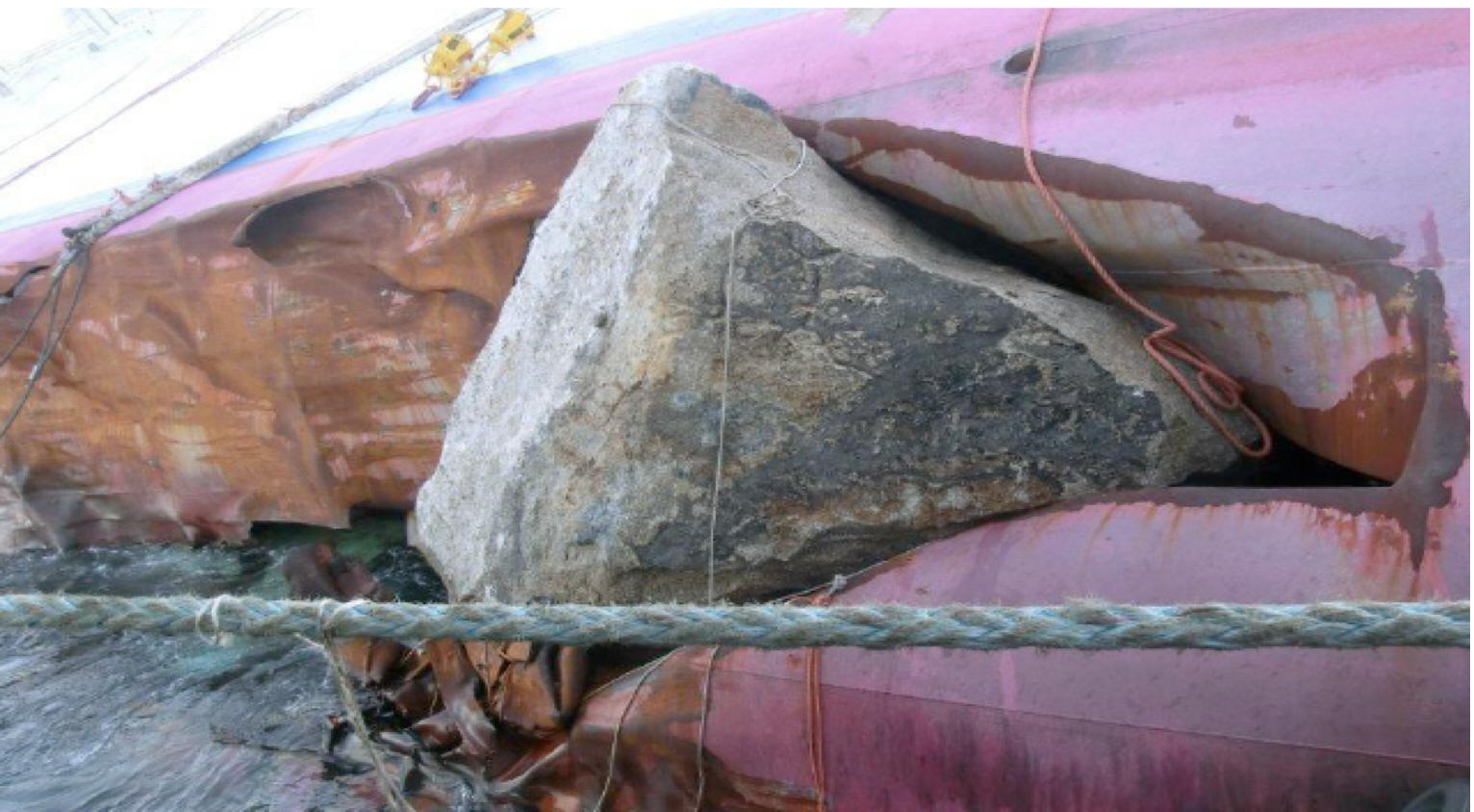
At 2145 the Second Officer warns that the ship has gone aground, and there
is a loud crash. Judging by the photographs and the description of the
damage, the grinding of tortured metal must have gone on for about ten
seconds, and it would only be the distance from the location of the impact
and the enclosed design of the bridge which might have reduced the bridge
team’s understanding of the full extent of the disaster. The ship continues
to move northwards, and within a minute is blacked out.
At 2146 the emergency generator starts up and provides power for 41 seconds.
Within a minute the ship is blacked out, but during that time the master has
given a number of helm orders ending up with the rudders hard to starboard.
And the ship continues to move northward, the speed gradually decreasing.
By 2152 it is evident that serious flooding of a number of compartments has
taken place and this has resulted in the failure of the main engines and
almost all other systems. The emergency generator which has operated briefly
is attended by an Electrician who finds that the automatic switch, which
will start up the generator on main power failure, is disengaged, and
applies a screwdriver to the switch. But a cooling system failure, as far as
I can tell the reason for which has never been identified, results in the
generator stopping.
At 2158 The Captain makes telephone contact with the company Fleet Crisis
Co-ordinator and says according to the report that the ship hit a rock with
the left side towards the stern, reports the dynamics of the casualty, adds
that the propellers were not affected and is being assessed for damages,
also announces that the ship is in blackout and that water is entering the
stern that has reached the main electrical panel.
Obviously this was an optimistic report and in no way really flagged up the
level of the crisis, and the technical staff back in the headquarters
suggest that the ship be taken to anchor by the use of the bowthrusters.
At 2207 there is a conversation between the Civitavecchia Harbour Operations
Room and the ship, which refers only to the blackout and that the situation
is under control. By this time it is evident to the 1st Officer and the
Deputy Chief Engineer that there are probably at least four compartments
flooded. In addition the Italian Search and Rescue services have received
several calls from the relatives of passengers on the ship who have been in
contact to tell them that there is something wrong.
By 2212 with the rudders still hard to starboard the ship’s forward motion
has virtually ceased and maybe as a result, not explicitly stated in the
report, the list changes from ten degrees to port to a list to starboard.
The staff in the emergency generator room have found that they cannot
maintain power using it due to the virtual failure of the cooling system,
and that therefore there can be no provision of power to pumps, steering or
other normally available systems powered from the emergency switchboard.
At 2218 the Captain communicates with the company Crisis Centre again to
tell them that several compartments are flooded and that there is no real
power available from the emergency generator. The report suggests that the
captain believes that there are only two compartments flooded and that
therefore the ship can survive. Hence he has not made contract with the SAR
services. Not only that, at this point the passengers have not been alerted
to the emergency.
By 2228 the Captain has asked for the assistance of a tug, and has made a
more realistic report to the company. It is evident that the water level is
still rising in the lower compartments of the ship, and by now some of the
catering areas have been flooded.
At 2230 the Chief Engineer suggests to the Captain that the ship should be
abandoned.
At 2233 the ‘General Alarm’ is raised, followed by a PA announcement (I
think the report says ‘ads are then issued’) to reassure the passengers that
all is under control. Despite this reassurance some passengers have
apparently already got into the lifeboats.
Possibly the next really salient point in the report is that at 2240 the
ship is resting on the bottom, and at that time a distress message is
broadcast using Inmarsat C.
By 2247 an SAR patrol vessel and a helicopter have been launched, and at
that time the Captain orders the dropping of the starboard anchor, and then
when it stops the release of the port anchor. The Captain has also told the
Coastguard Operations Room that he is continuing to manoeuvre the ship
towards an anchorage, even though he has no engines, no rudders and the ship
is aground.
At 2251 the report states the following: Master informs the bridge to raise
abandon ship order, and then urges it, but when asked to make the
announcement he points out that it should be said, "Let passengers on
shore." rather than that. You can see that there might be a bit of trouble
interpreting the content of the report just from this statement, even though
we think we know what they mean.
At 2257 there are lifeboats in the water, and the ship makes contact with
the ‘SO’ maybe a misprint, they could mean the Coastguard Operations Room
and says they are evacuating as a precaution.
At 2311 the starboard list may be between 20 and 30 degrees and the Captain
in his last call to the company crisis unit describes the situation as being
less serious than the reality.
Up to now most of the content of the report has been taken from the VDR, the
Voyage Data Recorder, but at 2332 even the Second Master who was left on the
bridge to co-ordinate the evacuation, has left. And at 2338 all control of
the evacuation having been abandoned, there were still 300 passengers and
crew on board.
At 0042 with about 80 people still on board the Captain reveals to the
Coastguard Operations Room that he is on shore, and over time and after
further communications at 0146 the report says that the OR contacts the
Master ordering him again to go back on board and provide a situation
report. This ordering back on board was broadcast around the world at the
time and the succinct phrases used were soon to be found on tee-shirts and
being used as ring tones.
In 1973 the use of English was formally adopted as the international
language of the sea by the IMCO, now the IMO. Why then was the adopted
language on the ship Italian and the report translated into English in a way
which is sometimes impossible to understand?
THE MARY ROSE MUSEUM
The Mary Rose Museum
opened its doors on 31st May. It cost £27 million to develop, and may be the
jewel in the crown of the Portsmouth Historic Dockyard. The whole place is a
delight in my view, and even though I lived for much of my early life within
a couple of hours of it, and for one summer actually worked on the Isle of
Wight ferries, I had never visited it. Like many places these days it is not
a cheap day out particularly if you are a family, but even before the Mary
Rose, it would take you a day to see it all. Now in retirement I have
visited it, and would recommend in particular the Warrior, the Navy’s first
steam ship, and if you are going do some reading about British naval history
first.
THE MODEL MEGA BOX SHIP

TThe mega model boxship on the
lake at Timsbury. (Pic from the Warshash site)
I have
always admired the idea of a bunch of model ships fulfilling the roles of
real ships on a lake fulfilling the role of bits of harbours and rivers and
berths. It seems a much better idea that the increasing numbers of
simulators around the world. Of course you can’t really do Bridge Resource
Management training because you can only get a couple of people on the
bridge. But still being able to drive ships on which the various means of
propulsion and control are scaled in accordance with the size of the ship is
great.
In this case the ship is a model of a 13000 teu container ship, of which
there are a few about. According to the press release from the Warsash
Maritime Academy the ship has a single propeller, two bow thrusters, a
single stern thruster and working anchors and cables, and is called
‘Resolution’.
The ship, or is it the model, is 14 metres long and weighs 12.5 tonnes. I
once owned a yacht which was 13.5 metres long, and you could do some damage
with it, but probably not as much as you could do with a real ship, and here
is the advantage. Even when things go wrong nothing much is going to happen,
but even so as he is manoeurving the model I am sure that the driver will
find himself clutching the edge of the space fulfilling the role of the
bridge, and bending it in the direction he or she would want the ship to be
going in. Anyone who has been in control of a ship under way will have done
this.
So good luck to Resolution and all who train in her.
THE JASCON 4

The Jascon 4 from the
WAV website
The marine
fraternity in Nigeria have an inside track to the misfortunes which occur in
the marine environment out there, and are surprised, so it seems when
anything that happens is reported in the world media.
In the last few days the Bourbon Arethuse was attacked by pirates in the
Usari Field. The crew retreated into what was called ‘the citadel’ and the
pirates made off with their personal possessions, but honestly you would
have to search to find anything out about the event.
So, the Jascon 4. It could be that you would miss all the news about this
accident which left the ship overturned and floating after it became
unstable (one assumes) while engaged in tanker heading control offshore
Nigeria. In the accident 11 crew members lost their lives. And at this point
I have to ask whether it will be added to the lengthening list of accidents
uninvestigated by the flag state.
It has surfaced in the news because the cook survived for more than two days
in the hull, floating upside down, and was rescued by South African divers.
What a lucky chap.
There is some talk that the ship sank because of adverse weather, but that’s
what they always say, falling back on an excuse which was only viable when
people were crossing the channel in rowing boats.
INFORMATION ABOUT THIS NEWLETTER AND SHIPS AND OIL LTD
This newsletter expresses the views of the author Victor Gibson about marine
events which are considered to be worthy of interest. It is meant to be a
five minute read. Sources of information include:
International Tug and OSV Magazine
The Tugs, Towing and Offshore Newsletter.
The Nautilus Telegraph
The Nautical institute Magazine Seaways
The BBC Home Page
The MAIB Website
The Felixtowe Dockers Blog
gCaptain
World Maritime News
The Ships and Oil website contains comprehensive information about many
offshore vessels and approaching 10,000 images.
By this month I have done quite a bit of work on the website, since I am
taking a bit of a rest from using the brain. There is more ship information,
slightly more frequent Pictures of the Day, and hopefully a better means of
moving from one page to another, up to now in the News and Views.
People have continued to send pictures of the day for which I am very
grateful. The photos brighten the days of our hundreds of visitors as they
sit at their desks – I have noticed that our numbers are considerably
reduced at the weekends. I have given myself the task of interpreting the
177 pages of the Italian Government investigation into the Costa Concordia
accident and some of the results can be found here. And all of them on the
website.
Recent Pictures of the Day include:
The Loke Viking
The Skandi Achiever
The Lundstrom Tide
The Highland Champion
The Ramform Sovereign
The Ocean Shield
The Noble Paul Romero
SHIPS AND OIL OFFERS THE FOLLOWING PUBLICATION FOR SALE ON ITS WEBSITE:
THE HISTORY OF THE SUPPLY SHIP £37.50 inc P&P anywhere
SUPPLY SHIP OPERATIONS £27.50 inc P&P anywhere
RIGMOVES £5.75 inc P&P anywhere.
Buy all three books for the bargain price of £52.5
Vic Gibson. June 2013.
To view earlier News and
Views Click Here.
If you would like to
receive News and Views as a PDF - with photos -
email me.
|


_small.jpg)

.JPG)