|
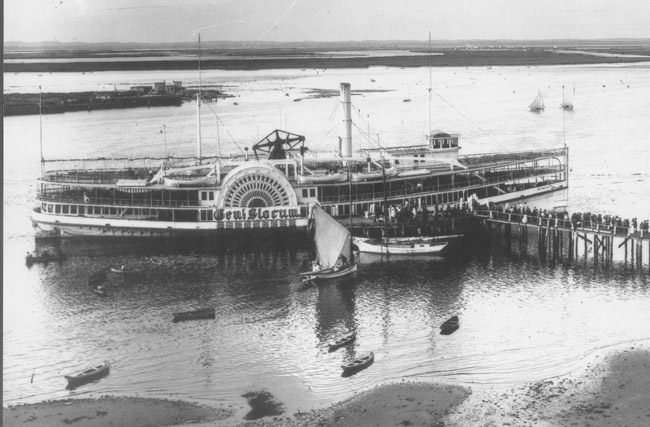
THE GENERAL SLOCUM
DISASTER
It is
relatively unknown that the event causing the largest loss of life in New
York prior to the attack on the World Trade Centre 2001 was the fire on the
steamer General Slocum.
On 15th June 1904 the General Slocum took off on a day trip with over 1000
passengers, mostly women and children from St Mark’s Evangelical Lutheran
Church from the area of New York known as Little Germany. Reports say that
as the ship was passing 97th Street smoke was seen on the lower decks, and
that the first person to tell the master, Captain William Van Schaick that
there was a fire aboard was a small boy. It has been suggested that the
captain took no notice until the fire had gained a hold, and then made a
number of poor decisions intended to beach the ship to save the passengers.
The crew rolled out the fire hoses but found that they were rotten, and in
any case no fire drills had ever been conducted.
With the ship still on the move the flames engulfed the upper decks, and
people began to jump over the side even though most were unable to swim. The
lifejackets were broken out, but many were found to be substandard and
rotten. Mothers who put lifejackets on their children and threw then over
the side were distressed to see them sink immediately.
Other craft in the area were variously reported as being of little use or of
being actively engaged in robbing the floating corpses instead of recovering
the living, and a New York Yacht Club vessel was accused of doing absolutely
nothing, a claim afterwards refuted by the captain who stated in a letter to
a newspaper that his boat had been dispatched and had rescued many people.
1021 people died in the accident. Captain Van Shaick was the last person to
leave the ship which he had finally grounded. He was sentenced to ten years
in prison for his ship’s unpreparedness, and had served four years before
being pardoned on Christmas Day 2012.
WELL INTERVENTION
The Tugs and Towing Newsletter reported in its
last issue that a contract between Aker Solutions and Total had been
terminated. It was for the use of the Skandi Aker, a well intervention
vessel which is owned by DOF and chartered long term by Aker Solutions. For
those not familiar with the process these ships are provided with a derrick
and are operated in dynamic positioning mode. This allows well intervention
for the purposes of maintenance to take place, and avoids the need and
expense of moving a jack-up or semi-submersible over the well. Re-entering a
well is not the simplest task in the world, but it seems to be becoming
common practice, and in addition, according to the Aker Solutions website
the ship is the first with a class notation which will allow it to take
hydrocarbons on board and to carry out well clean-up, flaring the result by
means of a flare boom on the stern. The ship had been hired by Total in
Angola for two years at a cost of USD 250 million, but the contract has now
been terminated since it has only been operational for 37% of the time this
year, since operations were halted at the end of March for repairs and
maintenance. This is not really a surprise, as these offshore vessel become
more and more complex, there are bound to be failures, and this may be one
which we know about.
THE
MARSEILLES DAM ACCIDENT

The Dale L Heller
from the NTSB website – Photo JLYares
Those
of us who have become familiar with the operation of deep sea ships, and
even the use of towing vessels, which connect with inanimate floating
objects and drag them along remain just a bit bemused by the use of tugs
which push rafts of barges along the waterways of the USA. It is not an
activity without incident but seldom do we see full reports of the accidents
involving these tug barge combinations, so the report by the US National
Transport Safety Board, on the allision between the Dale L Heller’s barges
and the Marseilles Dam, is of interest.
The accident occurred on 18th April 2013, when the Dale L Heller pushing a
raft of 14 barges, was on its way down the Illinois River, a water way which
rises in Lake Michigan, and terminates on its confluence with the
Mississippi 333 miles later. The tug with its barges was approaching the
Marseilles Dam on 17th April but difficult condition in the river due to
recent heavy rain made the approach to the Marseilles Canal difficult and so
the Dale L Heller found a place to hold up 0.75 miles above the dam. Another
tug/barge combination, the Loyd Murphy made fast alongside the Dale L Heller
as conditions in the river became more difficult. Later a mooring was found
for the Loyd Murphy, but no suitable safe location was found for the Dale H
Heller, and so it was decided that the only course of action was to take the
tug and its barges into the calmer waters of the canal.
Here it is necessary to describe the set-up at Marseilles. Traditionally
when our forebears were first using rivers as a means of transport they
found that there were deep bits and shallow bits, and in order to deepen the
waterways the dammed them and then provided short canals and locks alongside
the dams. The ultimate manifestation of this process must be the Welland
Canal which allows the vessels navigating in the Great Lakes to avoid
Niagara. At Marseilles a vessel going downstream would pass the five
concrete piles protecting the dam on its starboard side, and the cross
current deflecting the vessel towards the dam would depend on the levels of
water in the river, and hence the number of gates in the dam which were
open.
The dam was provided with eight gates. If all gates were closed there would
be no water flow towards the dam, and so any vessel approaching the canal
would be able to do so with ease, however this would increase the
possibility of the town of Marseilles being flooded, if there was a lot of
water in the river. But if all gates were fully open it would be extremely
difficult for any vessel on its way down river to successfully make their
way into the canal. The gates in the dam were controlled by the US Army
Corps of Engineers, and each could be raised to a maximum of nine feet above
base. Hence if one gate was fully open, it would be described as ‘9 feet of
gate open’ and if all gates were fully open there would be 72 feet of gate
open.
So, on 18th April, with the Dale H Heller and its 14 barges finding it more
and more difficult to hold station in the rising waters of the river, a
conference call was held between the ‘River Industry Action Committee’ and
the ‘Illinois River Carriers Association’, and it was decided that since no
safe haven could be found for the tow they would move it into the canal.
Their decision was in part determined by the weather forecast which
indicated that even more heavy rain was due to fall in the next 24 hours.
But they remained concerned that the current caused by the open gates would
prevent the tug/barge combination from getting past the concrete bollards
protecting the dam. Hence they decided that the Loyd Murphy and two Army
Corps towing vessels would assist with the move. At this time the lockmaster
had 66 feet of gate open, near the maximum then, but he indicated that
during the time that the Dale L Heller and its barges were being manoeuvred
towards the canal he would close 16 feet of gate, which would mean that
there would then be 50 feet of gate open.
The report stated that a number of the parties involved in the conference
call misunderstood the lockmaster, and thought that he had indicated that
there would be 16 feet of gate open, a misunderstanding which was to have
considerable bearing on subsequent events.
At about 1700 the Dale L Heller began pushing its raft of barges which were
three abreast in the direction of the canal, with two of the other tugs
positioned on the starboard side to push the whole setup to port, and one
tug attached at the bow of the group. As indicated, the lockmaster closed 16
feet of gate, and kept his eye on the water level in case the town was to be
flooded.
At 1718, as the groups was approaching the canal, an Army Corps supervisor
on one of the tugs noticed that the water level might overcome the levee,
and communicated this to the lockmaster who said he would open a further 8
feet of gate, but instead of following this agreement he opened the gates to
their original 66 feet open.
At 1733, as the head of the tow was entering the canal, the crosscurrent
began to pull the barges towards the dam. The Army Corps supervisor
communicated with the lockmaster, who agreed to close the gates, despite the
possible danger to the town, but it was too late.
At about 1734 the leading barges contacted the concrete wall on Bells
Island, and several of the barges broke loose. One of them allided with the
concrete plies protecting the dam, and eventually the Dale L Heller lost all
14 barges, with seven of them ending up against the dam and four of them
sinking in that position. The remaining barges were rescued and moved into
the canal.
The damage to the barges was estimated to have a cost of nearly four million
dollars and the damage to the dam to have a cost of between 40 and 50
million dollars. Wow!!

THE SS ST LOUIS STORY

Back in
May BBC website carried a report about the SS St Louis, which in May 1939
had left Hamburg with 900 Jewish passengers aboard bound for Havana, and
eventual on ward travel to the United States.
By this time life was becoming intolerable for the Jewish communities in
Nazi Germany, and so this voyage was intended to provide them with a new
start in life. In order to get to Cuba, the passengers had purchased Cuban
visas at considerable expense, a ploy of desperation since many countries
were closing their borders to Jewish refuges.
The voyage started well and the passengers were politely treated under the
instructions from the master Captain Gustav Schroder. There were dances in
the evening, a cinema and a pleasing variety of food. But when they arrived
at Havana the authorities refused permission for the ship to dock, despite
the validity of the passenger’s visas. And after a week the ship set sail
for Florida hoping to find a port of refuge.
Finally, when the Americans had also refused permission for the passengers
to land the Captain reluctantly set sail for Europe again. But finally the
ship was allowed to dock in Antwerp, and the American Jewish Joint
Distribution Committee supported the distribution of the passengers to
countries other than Germany. However, 254 former passengers were killed as
the Nazis swept over Western Europe.
THE BILLY PUGH

Some time
ago I was asked to contribute to a legal argument as to whether the Billy
Pugh – pictured here – was ‘inherently unsafe’. Some of the answer was as
follows:
As a means of transporting personnel to and from offshore installations, the
technique of transporting them by ship and then transferring them by Billy
Pugh probably has a better safety record than that achieved by helicopter
transport.
However the successful operation of the device does depend on the ability of
the person being transported to hold on firmly, and on the control
throughout by the crane driver. The fact that it is possible for those being
transported to be swung against something and crushed has resulted the
greater use of alternative devices. But there remains some debate as to
whether these are actually safer.
When it comes to ‘inherent’ unsafety one should consider whether a ladder is
inherently unsafe, or whether a car is inherently unsafe.
For getting to the deck of an offshore installation the Billy Pugh has a
place amongst the means available. It would be less safe than a set of
stairs, but only if the means of transfer from the boat was safe, and more
safe than a vertical ladder. And under some circumstances more safe than a
helicopter. But regardless of all else, it is very frightening.
Photo Tony Poll.
INFORMATION ABOUT THIS NEWSLETTER AND SHIPS AND OIL LTD
This newsletter expresses the views of the author Victor Gibson about marine
events which are considered to be worthy of interest. It is meant to be a
five minute read. Sources of information include:
International Tug and OSV Magazine
The Tugs, Towing and Offshore Newsletter.
The Nautilus Telegraph
The Nautical institute Magazine, Seaways
The BBC Home Page
The MAIB Website
gCaptain
World Maritime News
The Siberia Times
The Scotsman
The Ships and Oil website contains comprehensive information about many
offshore vessels and approaching 10,000 images.
People have continued to send pictures of the day for which I am very
grateful. The photos brighten the days of our hundreds of visitors as they
sit at their desks – I have noticed that our numbers are considerably
reduced at the weekends. By the way I have been told that a number of
subscribers to the newsletter send it on to others – if you are one of the
others email me for your own copy! I have had one or two requests, but have
not always been successful in sending the newsletter. Maybe their systems
reject PDFs.
Just at the moment the website is going through some changes have reached
the maximum size available on its original server. Hence our service
provider has moved it to another server. But some aspects of the old
programme are not supported. Hence I have had to go through he process of
learning some new stuff, always a painful business. The site may also be
going to take on a new look altogether, but I am waiting for an instruction
book.
As a consequence of the above there have been no company updates during
June.
Recent Pictures of the Day in June include:
EDT Jane
North Cruys
Sea Brasil
Deep Energy
Bourbon Petrel
SHIPS AND OIL OFFERS THE FOLLOWING PUBLICATION FOR SALE ON ITS WEBSITE:
THE HISTORY OF THE SUPPLY SHIP £37.50 inc P&P anywhere
SUPPLY SHIP OPERATIONS £27.50 inc P&P anywhere
RIGMOVES £5.75 inc P&P anywhere.
Buy all three books for the bargain price of £52.5
If you would prefer not to receive further news letters please email me vic@shipsandoil.com
.
Vic Gibson. June 2014.
To view earlier News and
Views Click Here.
If you would like to
receive News and Views as a PDF - with photos -
email me.
|


_small.jpg)

.JPG)