|
THE NOBLE PAUL ROMERO
EVENT
Apart from
a fairly vague report in the Malta press we know nothing about what happened
to the Noble Paul Romero earlier this month. It was lying alongside
undergoing maintenance when it began to sink, and all hands were evacuated.
The newspaper had obtained a photo of a whole bunch of people in hard hats
sitting on the quayside. It seems likely that there were apertures into the
rig open to the sea and that it kept taking on water until the rig was
settled on the bottom and the water inside was level with the water outside.
It seems probable that at the very least sensitive systems were damaged by
immersion in seawater.
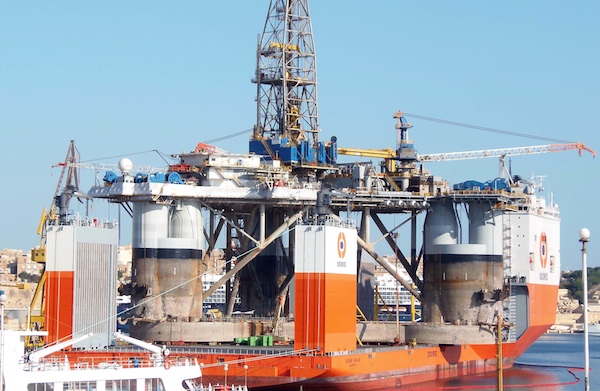
There-after it appears that the rig was refloated in some way and mated with
the brand new Dockwise Vanguard which then returned to the harbour with the
rig on the deck. It now appears that rather than taking the rig somewhere,
the ship which is the latest and greatest in the Dockwise fleet and could be
a contender for the position of most unusual ship afloat, is being used as a
drydock to allow repairs to be carried out. This is not a bad plan if one
thinks about it, since the rig was already under repair it is reasonable to
assume that there is a sufficient level of expertise on the island to do
what-ever is required to return it to service.
The Noble Paul Romero is an interesting unit, originally being a
submersible, intended to rest on the seabed in extremely shallow water, and
now modified to be capable of anchoring in about 5000 metres of water. This
photo shows the original and new structure very clearly.
INCIDENTS ON DP DRILL SHIPS
The US
Coastguard recently issued a safety alert concerning the loss of position
and subsequent emergency disconnect on DP drill ships in the Gulf. One of
them was the result of adverse weather, causing the ship to lose station.
The possibility of thunderstorms with high winds had been forecast well
before the incident but despite this no preparations were made. As a result
when the storm hit only half the available generators were on line, so that
when the DPO ordered a large heading change with a high rate of turn the
ship was unable to respond. In other incidents when the crew were attempting
to put a repaired thruster back on line, rather than this happening the
electrical disturbance resulted in the failure of all thrusters. The only
possible action then was EDS.
LIFEBOATS ON OFFSHORE
INSTALLATIONS

A lifeboat evacuation
station on a semi-submersible.
In an
industry which is fixated with acronyms, lifeboats have not escaped, and
since the most commonly installed are totally enclosed, to cope with the
possibility of fire on the sea surface they are known as “TEMPSC” (Totally
Enclosed Motor Propelled Survival Craft), although in this article they will
continue to be called “lifeboats”, because, let’s face it, that’s what they
are. In addition to the Piper Alpha disaster in 1988 the siting and
operation of these craft have been influenced by the loss of the Alexander
Keilland in Norwegian waters in 1980 and the Ocean Ranger offshore Canada in
1982.
In all cases the existing lifeboat systems were found wanting. On the
Alexander Keilland four of the lifeboats were lowered to the water without
problems, but in the extremely rough seas prevailing at the time, the crews
found it impossible to release the falls, and as a result the boats were
thrown against the rig structure and suffered damage. The Ocean Ranger
capsized in hurricane force winds off the coast of Newfoundland, with the
loss of the lives of all 82 personnel on board. Although there were no
witnesses to the evacuation efforts on the rig, one of the boats got away
but was seen to be damaged during the time that efforts were being made to
recover the survivors to the Seaforth Highlander. Unfortunately before
anyone could be rescued the boat capsized and everyone was lost in the
freezing water. At Piper Alpha no boats got away. Almost as soon the
accident occurred the communications were destroyed, and so no formal
evacuation processes were put in place, however a number of recommendations
regarding evacuation means were made by the court of enquiry.
The failure of the survivors to release the boats from the falls on the
Alexander Keilland has resulted in the almost universal adoption of on load
release gear. The related IMO resolution requires the designers to put in
place some sort of safety system which will ensure that the boats are
actually in the water before release can take place, but as all readers of
this article will know, the inadvertent release of one or both ends of
lifeboats while still in the stowed position, or on the way down, has
resulted in many accidents and a number of fatalities.
In Canada the authorities have concentrated on the means of ensuring that
the boats, if used, will not be set back against the structure and as a
result the “PROD” (Preferred Orientation and Displacement System) is an
essential component of all lifeboat systems there. The PROD system consists
of a very long fibreglass pole from the end of which a wire is attached to
the bow of the related boat. When the boat is stowed the prod is vertical
and as the boat is lowered the prod takes up a horizontal position and bends
as the boat enters the water. When the falls are released the boat is pulled
away from the installation.
The on-load release gear continues to create problems, the only real
solution to which seems to be to improve training. The SOLAS regulations
require that the capacity of lifeboats be determined using a weight per
seafarer of 75 kilos, but the HSE in UK carried out a study which determined
that the average weight of an offshore worker was in fact 89 kilos. In the
Gulf of Mexico the average weight of an offshore worker may be as much as 95
kilos. Also in UK, the regulations require that there be sufficient boats
for 150% of the personnel on board, and in Norway capacity for 200% is
required. While this has not resulted in problems for many production
platforms, which have, over the years, shed personnel, the change has
created difficulties for the operators of mobile units They have seen their
numbers on board rise steadily as more and more specialists are employed,
and as limitations on working hours have been implemented. These factors
have resulted in the installation of higher capacity lifeboats. Of course we
should note that because of the possible dangers from accidental release,
boats are never filled, so no-one actually knows whether the personnel
assigned to a particular boat will fit in it.
Probably the only other major change in recent years has been the
introduction of the free fall lifeboat. The first lifeboat of this type was
installed on a ship in 1961, but it was not until the 1990s that the system
achieved widespread use in the offshore industry. The free fall boat
overcomes two of the challenges to successful evacuation, the first is the
possible set-back caused in adverse weather and which devices such as the
PROD are intended to overcome, and the second is the limited capability of
the coxswains.
People outwith the oil industry may be surprised to learn that lifeboat
coxswains on offshore installations are very unlikely to have any marine
qualifications or even a marine background. In the UK they will have been on
a course which has a total duration of 29 hours, although OPITO (the
Offshore Petroleum Industry Training Organisation) the developers of the
course requirements, would suggest that this is only a starting point, and
that the course should be supported by constant training and exercise. But
then one would have to ask how this could be achieved if there is such a
lack of confidence in the means of deployment, and of course in some seas of
the world, if there was very little likelihood that the boat could be safely
recovered.
Of course, the disasters already mentioned have resulted in many
improvements to the safety of offshore installations which will limit the
possibility that evacuation will be necessary. And in any case there are
helicopters, and the means of personnel transfer to support vessels, which
would probably be used before anyone even thought about getting in the
boats. So, finally, should it be assumed that the SOLAS regulations are
adequate, and that the coxswains despite their limited training, will manage
in the very, very unlikely event that the boats would have to be used, or
should the industry continue to search for a better means of evacuation,
regardless of the likely cost? Even though formal risk assessment techniques
now indicate that may be pointless to provide offshore installations with
lifeboats, or in fact any means of waterborne evacuation, the answer to both
parts of the question would appear to be “yes”.
THE HERCULES 265

More from
the Gulf of Mexico. The Hercules 265 was involved in work on a gas well 55
miles offshore Louisiana on 23rd July when it lost control of the well,
which ignited.
News reports say that the rig was preparing the well for production when
control was lost. The good news is that the 44 crew members all evacuated by
lifeboat and there were no injuries. There was also minimal pollution,
overflights only identifying a slight sheen on the water surface which soon
dispersed.
By 26th July the well had ceased to flow, probably due to blockage by
sediment, and crew members were returned to the rig to evaluate the damage.
The operators have hired another jack-up to drill a relief well, one assumes
just to be safe, to be safe.
It appears from other photos in the press that the derrick and the
cantilever have been completely destroyed, and for the benefit on non oil
industry people, this sort of rig is positioned next to a small platform and
the derrick over out over it, and positioned precisely by hydraulic jacks.
The BOP is on the surface under the drill floor rather than being on the
seabed which is the case for semi-submersibles. This makes jack-ups more
vulnerable to blowouts – in my view.
A
SUPERYACHT INCIDENT

The Jemasa. Hakvoort (The Builders) photo.
You could
hardly make it up, but never-the-less the Telegraph recently reported on a
fatal accident which occurred to the Jesama in Phuket, Thailand.
Like many vessels the Jesama was provide with docking stations on the wings
of the bridge, which could be deselected, probably from the main console in
the wheelhouse. However, in order to close the cover on the docking stations
it was necessary to put the main engine controls to full ahead. At this
point it would be unnecessary to go on, but I will.
A crew member was tidying up on the wing of the bridge, and assumed after
eye contact with the master that the console had been disconnected. The blue
light, which he thought provided confirmation, was out. However actually the
light which indicated that the console was live was yellow, and difficult to
see in bright sunlight.
The crew member put the engine controls to full ahead to close the console
and the ship took off at high speed. Despite the fact that the master
immediately cancelled the order, three of the mooring lines parted and two
people standing on the quayside were hit by flying debris. One, a sixteen
year old girl, died of her injuries five days later in hospital.
The accident was investigated by the Maritime Authority of the Caymen
Islands, where the yacht was registered, and they made a number of
recommendations to reduce the possibility of similar events in the future.
It is sad that a life was lost due to a completely loony installation, which
could have been made safe in a number of ways.
INFORMATION ABOUT THIS NEWLETTER AND SHIPS AND OIL LTD
This newsletter expresses the views of the author Victor Gibson about marine
events which are considered to be worthy of interest. It is meant to be a
five minute read. Sources of information include:
International Tug and OSV Magazine
The Tugs, Towing and Offshore Newsletter.
The Nautilus Telegraph
The Nautical institute Magazine Seaways
The BBC Home Page
The MAIB Website
gCaptain
World Maritime News
The Ships and Oil website contains comprehensive information about many
offshore vessels and approaching 10,000 images.
People have continued to send pictures of the day for which I am very
grateful. The photos brighten the days of our hundreds of visitors as they
sit at their desks – I have noticed that our numbers are considerably
reduced at the weekends.
However, this being summer not much work has been done on the detail of the
website, but I expect that full services will be resumed in September when
the holidays are over. That being said I have received some great photos
recently so please keep sending them guys. They will all be published in
time.
Recent Pictures of the Day include:
Noble Paul Romero
Malaviya Nine
Aker Wayfarer
Petrobras XII
Fairmount Alpine
Thialf
West Aquarius
Dockwise Vanguard
SHIPS AND OIL OFFERS THE FOLLOWING PUBLICATION FOR SALE ON ITS WEBSITE:
THE HISTORY OF THE SUPPLY SHIP £37.50 inc P&P anywhere
SUPPLY SHIP OPERATIONS £27.50 inc P&P anywhere
RIGMOVES £5.75 inc P&P anywhere.
Buy all three books for the bargain price of £52.5
Vic Gibson. June 2013.
To view earlier News and
Views Click Here.
If you would like to
receive News and Views as a PDF - with photos -
email me.
|


_small.jpg)

.JPG)