|
THE SCRAP HEAP
It seems
weird that at the time when I wrote the last news letter there was little
sign that all was not well in the oil business, but now the price of the
black stuff has plunged and the industry is, in general, announcing drastic
steps in order to maintain its competitive state. I used to claim that the
business was more motivated by the quarterly share price than anything else,
but I was wrong. It is motivated by the hourly price and so we see that oil
companies are cutting their staff, and rig owners are reducing their fleets.
Transocean, the world’s biggest rig owner has said that they are going to
scrap seven rigs. But one of them is the JWMclean which was once the Zapata
Ugland built in 1974. That is 40 years ago. To put this in perspective back
in those days the average merchant ship was given a shelf life of about 10
years (Since I wrote this the number has increased to 12).
Mariners
may also remember that at various times it has been customary for ship
owners to operate their fleets at a loss, since this did two things. One was
that they did not have to lay up the ships which could be more expensive
that continuing to trade them, and secondly they retained their skilled
staff. Why then don’t the rig owners do this? If they did the oil companies
could hire rigs at a very moderate price and so carry out exploration and
development for a minimal outlay. Then when times changed and the oil price
increased again (as it surely will) they could let the wells flow. There are
two reasons, one is the aforesaid share price and the other is the fact that
rig owners will not on any account operate their rigs at a loss, for fear of
what they would call “ a train wreck”.
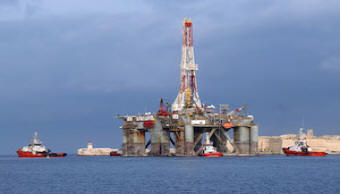
And how do we know that the Atwood Southern Cross is not going to work?
There are no anchors on the bolsters, and no visible anchor chains. It has a
drilling mast, rather than a derrick, now the least efficient method of
drilling, and apparently no pilot house, since the towmaster seemed to be
standing on the helideck. And with two boats – not enough evacuation seats.
(See over)
THE NORMAN ATLANTIC
Well, at least the Captain of the ferry which
was on its way from Patras to Ancona had learnt one thing. It is not a good
idea to leave your ship before all the passengers have been rescued, and
despite the apparent chaos on board after the fire started, he has been
praised for being last off. This ship is Italian, and so based on the very
poor report of the Costa Concordia disaster we can’t expect to learn much,
but initial reports indicate that the organisation of the evacuation was
limited to non existent. According to some passengers they did not hear any
alarms, receive any advice as to what to do next, and that once on deck they
suffered from the cold, somewhat ironic considering that the ship was
burning beneath them. Others had complained that the lifeboats did not work,
and that only one had been launched, but looking at the photos it is likely
that what they had available were liferafts which would be connected to the
deck by a chute. This is the latest thing in passenger evacuation systems.
Apart from the fact that the Italian Navy say that there were 80 people
rescued who were not on the passenger list, those who think it would be
possible to evacuate a large passenger ship today will take away the fact
that casualties have been limited to maybe 10 people. On the other hand
maybe 36 hours was too long to evacuate about 400 people.
MORE ABOUT LIFEBOATS

A Conventional
Semi-submersible Evacuation Station.
Some of my
small readership will remember that I had promised a further article about
lifeboats, to help them to judge whether they are a good thing or a bad
thing.
Most recently in our minds will be the boats of the Deepwater Horizon which
got away without major problems so it seems. Fortunately, the lifeboats were
secured on either side of a pier sticking out forward from the main deck.
There were two further boats similarly positioned at the aft end, but no-one
could have got to them. They were lowered away before everyone had got in
and so one of the davit launched liferafts was also used, and finally a
couple of people jumped from the deck into the sea. Despite the fact that in
emergencies the actual evacuation process often results in injuries, this
was not true in the Deepwater Horizon case. Maybe because the sea was
completely calm at the time. At least there was something in their favour.
Everyone who left the rig were picked up by the supply ship the Damon B
Bankston.
Similarly, in 1988 nearly all of the crew of the Ocean Odyssey were able to
evacuate by lifeboat in a blowout situation. There was sufficient warning of
the impending disaster the crew to go to the boats and get in and then wait
for further instructions. The loss of well control had been going on for
days, so there were no surprises, however during the final moments four
drill crew were still trying to reduce the gas flow on the Drill Floor, and
the Radio Operator was still in the Radio Room, having been sent back to
send a Mayday by the Captain. Seamen who were part of the deck crew laid out
survival suits at the evacuation station for the personnel who were still on
the Drill Floor, which was just as well. There was an explosion which
prompted the coxwains of the lifeboats to start their descent without any
specific instructions. Afterwards the four drill crew members found the
survival suits, put them on and jumped into the sea. Everyone, except the
Radio Officer who was the one fatality, were rescued by a BUE UT 704 which
was on the location at the time.
So much for the good news. Maybe the single accident which has motivate
thinking about lifeboats on offshore installations was the loss of the Ocean
Ranger on the Canadian Grand Banks in 1982. This is a harrowing story, which
is of benefit to all who work on mobile units in the retelling. In the final
minutes of the disaster, as the rig gradually began to sink by the head in
mountainous seas, it seems likely that the two lifeboats at the after end
were launched.
One was
never seen by the ships on the location, and so was probably broken up
during the descent. The other was damaged but was able to get alongside the
Seaforth Highlander, the rig’s standby vessel. But it seemed that too many
people inside it released their safety belts and stood up, reducing the
stability of the craft and causing it to capsize. Distressingly the thirty
or so people who were in the boat were all lost.
The loss of all 84 crew of the Ocean Ranger caused the regulators in Canada
to take steps to improve the chances of survival, if it became necessary to
launch the lifeboats during an emergency. And this, in turn, resulted in the
development of a very unusual evacuation system apparently fulfilling the
ultimate requirement which is to allow the people to get off the rig without
having to enter the water. The operators of the Hibernia platform spent
$11,000,000 in the development of the GEMEVAC system, as a means of
fulfilling Canadian regulatory guidance. This was a sort of cable car which
would traverse the distance between the platform and a standby vessel on a
wire, thereby reducing the risks which would relate to the deployment of a
lifeboat by conventional means. However, it suffered from two major failures
during 1998. In the first the gondola fell to the deck of the platform, in
the second the gondola fell into the sea. Fortunately there was no-one on
board on either occasion. The operators of the platform quite rightly, said
that they still conformed to regulatory requirements, and GEMEVAC seems to
have been quietly kicked into touch. Nevertheless the mark of the Ocean
Ranger remains in the evacuation systems of all rigs operating in Canadian
waters. This is the PrOD (Preferred Orientation and Displacement) system
which consists of a very long fibreglass pole from the end of which a wire
is attached to the bow of the lifeboat. When the boat is stowed the Prod is
vertical and as the boat is lowered the PrOD takes up a horizontal position
and bends as the boat enters the water. When the falls are released the boat
is pulled away from the installation.
Lifeboats are still a headache for the operators of oil rigs. In recent
times they have had to accept that the average offshore worker is no longer
a slim 75 kilo youth, which is the standard used for boats in the marine
industry. And one has to face it, even when offshore workers were younger
and slimmer there was not much chance of getting the designated number of
people, for which the boats designed, into them. Today it is accepted that
the average offshore worker in a 97 kilo 50 year old, who is going to take
up a lot of room in his survival suit. Oh yes, the survival suit! If we are
to accept that it may be necessary for people to evacuate from oil rigs, it
is necessary in many climates to provide them with survival suits, so that
if they enter the water they have a chance of survival. In the case of the
Ocean Ranger, the bodies seen in the sea were clad in a variety of clothing
from pyjamas to helicopter flight suits. Firstly because proper survival
suits were not provided, and secondly it appears that no precautionary
muster of the personnel on board was carried out.
The large person problem has been addressed mainly be fitting bigger boats
and in nearly all cases they face away for the structure by being installed
on either side of a pier sticking out from the forward and after ends, as
was the case on the Deepwater Horizon. Most mobile units are provided with
boats for 200% of the crew since this is a regulatory requirement in a
number of countries. In UK it is only required that offshore installations
be provided with boats for 150% of the crew, unless it is identified that
there are areas which are normally manned but from which the crew working
there would have a problem getting to the central mustering area. In these
situations they should be provided with their own muster area and boat, or
boats.
Well, I could go on, and if you are getting the impression that we have only
scratched the surface you are right, And as a final cautionary tale I was
told by someone who was there, that in the Gulf of Suez some years ago a
helicopter fell into the sea. There were several jack-ups in the area and
all attempted to launch a lifeboat. None was successful!
THE SHELL PRELUDE

The Shell Prelude, from their
website.
The BBC
reported during December that Shell had launched its FLNG Floating
Production and Storage unit the Prelude. This turns out to the largest hull,
and therefore the largest ship, ever to take to the sea. It is the means by
which Shell are going to extract and liquify natural gas from under the sea
125 miles off the northwest coast of Australia.
In some ways it is quite like existing FPSOs only bigger. It will be secured
to the seabed by a turret, said by the list of figures to be 93 metres high,
and therefore will be able to weather vane in accordance with the prevailing
environmental conditions.
Other figures for us to goggle at is its weight 200,000 tonnes and its
length 488 metres. Hence it is nearly half a kilometre long. When it comes
to offloading it is expected that conventional LNG carriers will tie up
alongside to load with the products which it will have stored in its tanks.
At the moment the hull is still in the Samsung shipyard in South Korea since
there is much still to do. There are a large number of production modules to
be installed on the deck, each one weighing about 5000 tonnes.
There may be people who wonder of all this is going to be viable with a
reduced oil price, but actually it may well be that by the time this thing
gets out there all will be fine on the price of oil front. And from a marine
point of view there is interesting stuff to be done. This vast craft has to
be anchored in 250 metres of water which should provide work for some
extremely large and powerful anchor-handlers, and then the LNG carriers have
to moor up alongside the mother ship in a seaway. This could be brown
trousers time for some shipmasters.
TIDAL ENERGY.

Bluewater Tidal Energy Field.
Considering the number of years we have been discussing and reading about
tidal energy it is amazing that there are not a lot of systems out there
lighting the lamps in the more remote areas of the UK.
And only the other day we learnt of yet another scheme for providing power
from the seas backed by a number of companies including Bluewater, Damen and
Vryhof. Well, these guys are big hitters so there is the possibility that at
last something is going to work.
One of the problems is that the stronger the tide, and therefore the more
effective any generating system is likely to be, the more difficult it will
be to moor to the seabed. This could be why Vryhof are one of the companies
involved, who for those who don’t know is a manufacturer of very high
holding power anchors.
Another possible advantage of this system is that the At least part of it is
above the surface, which apparently provides a dry storage areas for some of
the electrical bits which would be vulnerable if submerged and a hull which
is floating could be towed out to the location and anchored.
The test system is to be located offshore the island of Texel, and it will
provide power for the island.
Back in the day I used to take a stall for my marine consultancy at
alternative energy shows, but no-one ever consulted me about installing
these sort of things in the sea. It could be that the job looks easy, but it
isn’t. It requires marine expertise
INFORMATION ABOUT THIS NEWSLETTER AND SHIPS AND OIL LTD
This newsletter expresses the views of the author Victor Gibson about marine
events which are considered to be worthy of interest. It is meant to be a
five minute read. Sources of information include:
International Tug and OSV Magazine
The Tugs, Towing and Offshore Newsletter.
The Nautilus Telegraph
The Nautical institute Magazine, Seaways
The BBC Home Page
The MAIB Website
gCaptain
World Maritime News
The Siberia Times
The Scotsman
Pravda
The Ships and Oil website contains comprehensive information about many
offshore vessels and approaching 10,000 images.
People have continued to send pictures of the day for which I am very
grateful. The photos brighten the days of our hundreds of visitors as they
sit at their desks – I have noticed that our numbers are considerably
reduced at the weekends. By the way I have been told that a number of
subscribers to the newsletter send it on to others – if you are one of the
others email me for your own copy!
There have been a few company updates, but I have lost track of them. This
is at least in part due to the fact that I have been reorganising the
distribution of the companies on the site, and presenting the information is
a slightly different way. I have had to try one of two different
presentations, but seem to be on the edge of the capabilities of my
programme. But I’ll get it all sorted in 2015.
Recent Pictures of the Day include:
Petrobras 43
Pacific Vulcan
FPSO Girassol
Harvey Supporter
Drillship at dawn.
SHIPS AND OIL OFFERS THE FOLLOWING PUBLICATION FOR SALE ON ITS WEBSITE:
THE HISTORY OF THE SUPPLY SHIP £37.50 inc P&P anywhere
SUPPLY SHIP OPERATIONS £27.50 inc P&P anywhere
RIGMOVES £5.75 inc P&P anywhere.
Buy all three books for the bargain price of £52.5
If you would prefer not to receive further news letters please email me vic@shipsandoil.com
.
Vic Gibson. Decemberr 2014.
To view earlier News and
Views Click Here.
If you would like to
receive News and Views as a PDF - with photos -
email me.
|


_small.jpg)

.JPG)