|
MORE FROM THE U.S
WATERWAYS
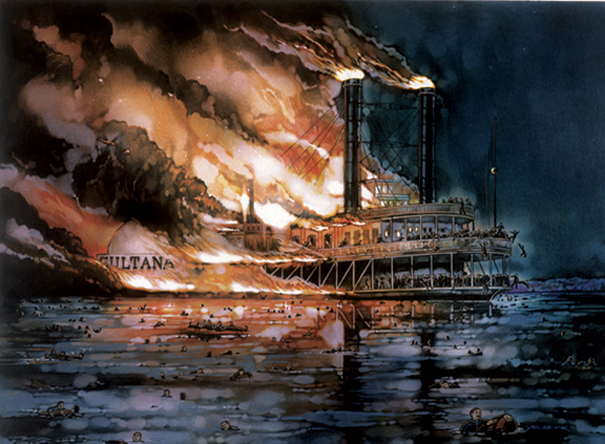
In any
competition for the seriousness of marine disasters the Titanic always comes
up top of the list, and so it was a surprise to me to find out during some
research into how sternwheel paddle steamers manage to change direction, I
found the Sultana disaster. The Sultana was one of the many side wheelers
operating on the Mississippi offering a service between St Louis and New
Orleans. It was part owned by master Captain J.Cass Mason. At Vicksburg, he
was approached by a Colonel Hatch with an offer to supply him with a large
number of passengers who were POW Union soldiers being repatriated to the
North. Colonel Hatch guaranteed the Captain 1400 passengers at the price of
$10 for each officer and $5 for each enlisted man. The Captain agreed to the
job, but first went on the New Orleans.
On leaving New Orleans steaming northward on April 21st 1865 one of the four
boilers sprang a leak, and the ship limped into Vicksburg for repairs. The
Captain was faced with the prospect of having to wait a number of days for a
substantial repair to be carried out, which would ensure that the 1400
passengers would go to another ship. And so her persuaded the repair man on
the job to patch the boiler, which only took one day.
The ship was only licensed to carry 460 passenger and crew, but left
Vicksburg with about 2100 former prisoners on board, who crammed into every
possible space and deck area of the ship. It fought its way north against
floodwaters which in some places had broken the banks of the river, arriving
at Memphis in the evening of April 26th,, where it stopped briefly to unload
a cargo of sugar. At 0200 on April 27th 1865, seven miles north of Memphis
three of the boilers exploded, depositing almost all the passengers into the
water. All were debilitated from their time in prison, and so found swimming
difficult, and it was an hour before another ship arrived on the scene and
started to rescue survivors. In the end more than 1700 people were lost, 200
more than were lost from the Titanic.
SHORE LEAVE
Over the years I have been writing this
newsletter I have on occasion lamented the fact that it has become less and
less possible for seafarers to get off their ships in port. In some places
of course even if the ship is tied up, what it is tied up to is some
distance from terra firma. And in other places even if the ship is in port
and alongside no-one would want to venture down the gangway. But this still
leaves quite a few places where it would be refreshing to be able to walk
ashore and enjoy a different environment, a possibility often prevented by
the lack of suitable identity documentation. Well, The Numast Telegraph
reported this month that their General Secretary attended a meeting in
Geneva where the unions the owners and the ILO made some progress with the
development of a Seafarer’s Identity Document (SID), which it is hoped will
overcome current problems with visas, repatriation, transit and shore leave.
Fingers crossed then!
A SWING ROPE ACCIDENT
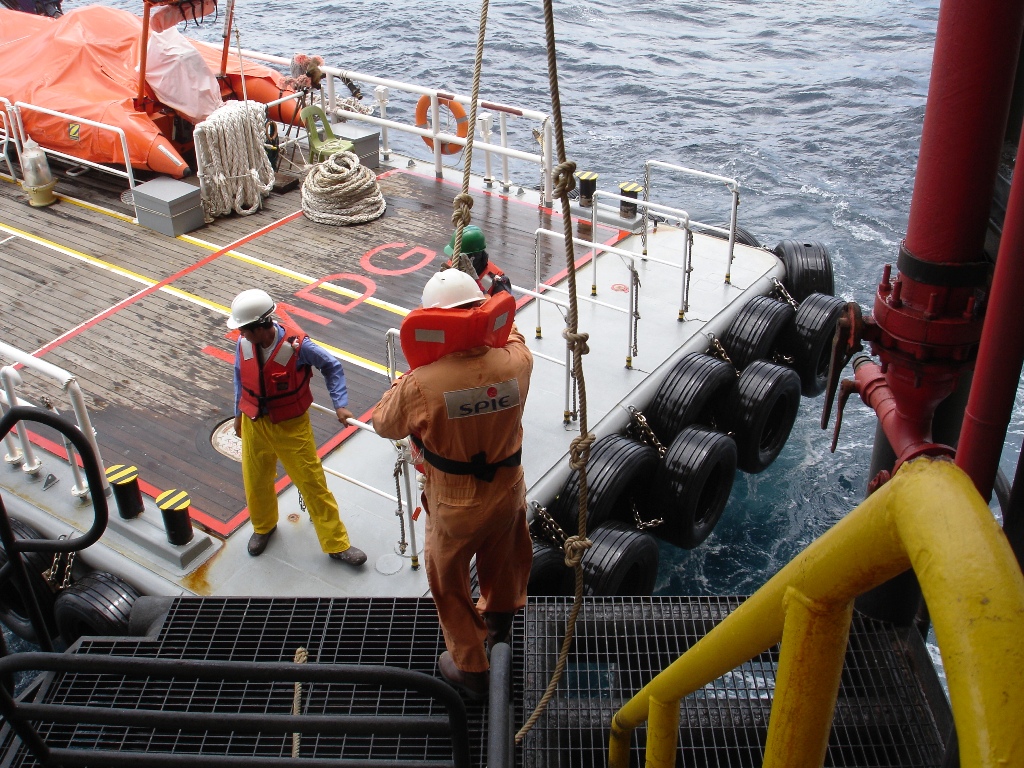
A Swing rope in
operation. Photo: Derek Latter.
It seems
to be one of those things that accidents in the marine world get a lot more
coverage than good news. Of course shipowners produce press releases which
are for the most part extremely boring, except for those for passenger
ships, which offer all that stuff which amaze us. How did they get a
climbing wall onto a ship? And so on.
So it’s back to the accidents again, and in the offshore business again,
about an accident in the Gulf of Mexico which occurred on 16th February
2011. I have chosen it because it sheds some light on the very unusual
business that the offshore oil industry is, and to an extent on how the U.S
Coast Guard view ship command.
This is an article about people using a “swing rope”. Actually the report
calls it a rope swing, which it is, but I’m going to stick to the former
title. So one of the things which go on in the Gulf of Mexico is the
maintenance of unmanned platforms by groups of workers who are housed either
on shore if the platform is very close to the beach, or on a platform in the
vicinity of the worksite which is provided with living quarters. The men are
transported to the worksite either by helicopter, or else by what is known
as the “field boat” which is either a small supply ship or a crew boat. And
now we get to the nub of the business.
If a boat is used for the transport, the workers have to transfer from the
platform to the deck by stepping across, just as you would to get in a
rowing boat on the local boating lake (In my case the one in the Retiro, the
park in the centre of Madrid). But the small ship, of what ever sort is held
in position by the man at the controls, and the people step across, holding
onto the “swing rope” which is intended according to some, to provide a
safety system. It is not, apparently, something one holds onto to swing
across a gap between the ships and the platform deck.
So having said this we go back to February 13th 2011 when the field boat,
the Starfleet Patriot, was delivering a group of workers to an
unmanned platform. The deck to which the men were attempting to access was
about ten feet above the sea – yes - the “Plus Ten Deck”, and the deck of
the ship was about five feet above the sea. The seaman on the deck hooked
the swing rope with a boat hook and handed it to the first man who was to
get onto the platform. On the controls of the Starfleet Patriot was Captain
Cameron Hudson, the Mate of the ship. He was apparently designated as
Captain because that was how he was qualified, but he was not actually the
Captain. The Captain was Byron Trosclair. The disembarkation process was
difficult because not only was the Plus Ten Deck five feet above the level
of the deck, the ship was kept about five feet away from the platform, so
that it was necessary for the workforce to grab the swing rope, and take a
leap across, swinging upwards to get onto the catwalk. It was difficult to
do this and the guys going to work kept asking for the ship to be moved
closer. The ship was not moved closer.
On the morning of 14th February the Starfleet Patriot was again
tasked with the job of taking workers from the accommodation platform to the
work platform, and once more the workers asked the man on the controls who
was again Captain Hudson to move the ship closer and again the ship was not
moved closer. So the guys going to work were being asked to swing across a
gap with the sea a few feet below them, and did it virtually under protest,
which one could understand. They had signed up to weld, pipe fit, clean and
paint, not to engage in some sort of Tarzan act.
So the next morning during the same disembarkation process a man called
Joseph Bruno complained to the master of the ship, Captain Byron Trosclair,
that he lacked upper body strength and that he needed the ship to be closer
to the catwalk, because he did not feel safe swinging across. Captain
Trosclair said that he did not want to damage the tyres and chains of the
ship. But on the evening of 15th February, apparently in response to the
complaints from the workers, the oil company Dynamic/Apache had a higher
platform known as a “swing platform” or “jump platform” to be installed on
the ship (the names say it all really), which is a platform three or four
feet above the deck which would make the transfer easier.
So we get to February 16th 2011. The sea was choppy with waves of one or two
feet, and once more Captain Hudson was at the controls, which just for those
who are not familiar, will have been at the after end of the wheelhouse
overlooking the afterdeck and at the stern would be the swing platform. Next
to him overlooking the afterdeck was the master, Captain Trosclair. A number
of the workforce made the transfer and then it came to Mr Bruno’s turn. He
climbed up onto the swing platform but had difficulty holding onto the rope,
and apparently it was obvious that he was afraid to make the jump. So he
signalled to the man on the controls to back up closer to the platform, as
did other workers who were still to make the transfer. However the ship was
not moved closer. Mr Bruno attempted the swing and fell into the sea.
Thereafter the Starfleet Patriot drifted about 80 feet downwind while
the casualty was pulled out of the sea. He had been in the water for about
30 minutes, and it was found, when he was recovered, that he had died.
As it turned out Mr Bruno had died of a heart attack, but nevertheless the
US Coast Guard took Captain Trosclair to court to have his marine licence
revoked for firstly, not conducting a proper transfer operation, (when it
had been time to take the body of Mr Bruno ashore the ship had easily been
put alongside the platform), and secondly even though the ship had conducted
training in the use of its “man overboard platform”, no attempt had been
made to carry out a rescue.
Despite his defence which was that when he was not on the controls he was
not the master, and that when Mr Bruno fell into the water the guys on the
platform had shouted over to the ship that they would rescue him, the court
found that Trosclair had been the master, being in overall charge and that
it was an unassailable requirement that a ship, from which someone had
fallen overboard, was required to attempt a rescue.
What an amazing number of questions this accident raises to those who are
looking at it from the outside, rather than being used to the process, as
workers in the GOM obviously are. Why should any workers be required to
hazard themselves on their way to do the job? How could two people on the
same ship be called “Captain”? Was there no-one in charge on behalf of the
owners of the platform? And finally, how is it that the whole process has
not been investigated by the BSEE, who had recorded it as a fatality in
2011?
THE VIC 32
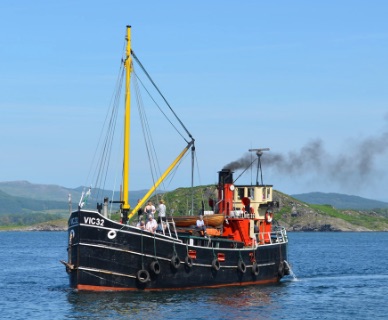
The VIC 32 from its website.
Readers of
this newsletter will be aware by now that I have serious doubts about the
ability of those in charge of the increasingly large passenger ships to
actually keep the passengers on board safe, but nevertheless I am
occasionally attracted by the possibility of a voyage of some sort.
In Scotland there is the possibility of a trip on the VIC 32 which is a
former Royal Navy “Victualling Inshore Craft”, one of many built in the
Second World War to support the fleet in the lochs and harbours in the North
of Scotland. The design follows that of the traditional Scottish “puffer”, a
small ship powered by a steam engine which in its original form exhausted
the steam used up the funnel. Hence the name. By the 1940s the engine reused
the steam and so they did not puff any more.
Today the VIC 32 is one of the half dozen or so puffers left in the UK of
the 106 built during the war, mainly at small shipyards in England. And it
is the only one on which you can take a trip, usually round the Scottish
islands on the west coast.
Over the weekends the crew carry out maintenance and “coal ship” with the
seven tons of coal required to keep it going for a week, and you join on
Monday morning as some port in Scotland. There are 12 berths, including two
doubles and eight twins, and according to the website the 12 passengers dine
at a single table, one assumes in the middle of what used to be the hold. It
sounds like fun, and obviously the seagoing public thinks so. Even at £750
per person there are currently only four places left this summer.
THE EUROPEAN SPIRIT.
The
gCaptain website very recently featured what might be a press release from
Teekay, the Vancouver based tanker operator which contains a two minute
forty second video of its ships the European Spirit on a voyage.
The video shows the ship leaving a port, probably in the USA and then
features some of the crew members doing their work. The cook prepares food,
the engine men are seen in their control room and a couple of people are
seen on the bridge. A watchkeeper, a man at the helm, and the Captain
talking to the pilot.
It occurred to me that the film was not taken while the ship was on a
voyage, it was taken before and during the departure from a port, and
probably the film cameraman got off the ship with the pilot.
Why would this be? It would be because the ship was not going to be back in
port for some weeks, and indeed at the time of writing this the AIS shows it
to be sailing north at 12 knots off the coast of Baja California, its last
port of call being Punta Arenas at the southernmost end of Chile.
My point is that it is very difficult to describe the boredom involved in a
long ocean voyage, particularly for the bridge watch-keepers who can spend
eight hours a day staring out to sea without seeing anything, but sea. If
the video had been extended for one minute of a view of the sea, how many
people would have lasted until the end of it?
.
INFORMATION ABOUT THIS NEWSLETTER AND SHIPS AND OIL LTD
This newsletter expresses the views of the author Victor Gibson about marine
events which are considered to be worthy of interest. It is meant to be a
five minute read. Sources of information include:
International Tug and OSV Magazine
The Tugs, Towing and Offshore Newsletter.
The Nautilus Telegraph
The Nautical institute Magazine, Seaways
The BBC Home Page
The MAIB Website
gCaptain
World Maritime News
The Siberia Times
The Scotsman
Pravda
US National Transport Safety Board Reports
The Ships and Oil website contains comprehensive information about many
offshore vessels and approaching 10,000 images.
People have continued to send pictures of the day for which I am very
grateful. The photos brighten the days of our hundreds of visitors as they
sit at their desks – I have noticed that our numbers are considerably
reduced at the weekends. By the way I have been told that a number of
subscribers to the newsletter send it on to others – if you are one of the
others email me for your own copy!
So company updates this month are:
Sea Mar In
Secunda
Southern States
Tidewater
Trico Marine
Zapata Gulf
Astromaritima
BOS
Bourbon Maritima
CBO
Delta Logistics
DOF Brasil
Finarge Brasil
Gulf Trinidad
Odekole International
Radam Maritime
Sea Trucks Group
South Patagonia Services
Siem Brasil
Ultrapetrol
Vega Offshore
WSut
Recent Pictures of the Day include:
VOS Fabulous
Red7 Alliance
Deepsea Aberdeen
Olympic Zeus
SHIPS AND OIL OFFERS THE FOLLOWING PUBLICATION FOR SALE ON ITS WEBSITE:
THE HISTORY OF THE SUPPLY SHIP £37.50 inc P&P anywhere
SUPPLY SHIP OPERATIONS £27.50 inc P&P anywhere
RIGMOVES £5.75 inc P&P anywhere.
Buy all three books for the bargain price of £52.5
If you would prefer not to receive further news letters please email me vic@shipsandoil.com
.
Vic Gibson. March 2014.
To view earlier News and
Views Click Here.
If you would like to
receive News and Views as a PDF - with photos -
email me.
|