|
GLOSSARY OF TERMS
Many of
the readers of this site are not mariners and there are also
those who are not involved in the offshore industry, so this
glossary is included here. It is one of the appendices in
"Supply Ship Operations" but items can be added at the request
of our readers. Typically a while ago some-one asked me what
an "AB" was, so it is now the first item in the section.
AB. Able
Bodied Seaman. In the British nautical hierarchy after some
time at sea a seaman can take an examination for EDH
(Efficient Deck Hand) and then after further years at sea
can be formally qualified as an AB.
A-FRAME. A
hinged frame on the stern of offshore vessels used for the
launching and recovery of manned submersibles, and initially
for the recovery of anchors.
AGITATORS.
Propeller shaped units fitted inside the mud tanks of supply
vessels to keep the solids in suspension.
AHTS
Anchor Handling Tug Supply Vessel. See Anchor Handler.
AIR GUN. A
device using high pressure compressed air to produce an
underwater explosion for seismic work.
ANCHOR
HANDLER. A supply vessel equipped for the deployment of
anchors and for towing.
ANCHOR
HANDLING TONG. Hydraulically operated equipment for holding
anchor wires and chains on the deck of an anchor handler.
ANCHOR
JOB. The complete operation of moving an oil rig.
ANCHOR
SPREAD. An expression to describe the deployed anchors of a
semi-submersible.
ARTEMIS. A
short range positioning system used by dynamically
positioned vessels.
AVERY-HARDOLL.
A hose connection used for fuel transfer which is self
sealing when disconnected.
AZIMUTHING
THRUSTER. An omnidirectional thruster which can be steered
from the bridge.
BACK-UP
ANCHOR. An additional anchor attached to the main anchor to
improve holding.
BANKSMAN.
A man who signals to the crane driver when the hook is out
of his sight.
BARREL. A
measurement of liquid used in the oil industry. 6.3 bbls to
the cubic meter.
BARYTES. A
mineral used to weight mud.
BASE OIL.
The basic oil from wich oil based mud is produced.
BASKET
TRANSFER. The movement of personnel between offshore
installations and marine craft by means of the "basket" on
the crane.
BECKER
RUDDER. A proprietry brand of flap rudder. See Flap Rudder.
BENTONITE.A mineral used in the manufacture of drilling
fluid.
BIRD. An
electroniocally controlled vane used to regulate the depth
of a seismic able.
BLOW-OUT
PREVENTER. A device consisting of pistons within the
christrmas tree, which close together, severing the drill
string, and cutting off the well.
BOLLARD
PULL. The measurement of the pulling capability of tugs
defined in tonnes.
BOLSTER.
The fabricated rack at the bottom of the legs of
semi-submersibles on which the anchor rests.
BOP See
Blow Out Preventer.
Bowthruster. Azimuthing or tunnel thruster situated at the
bow of the vessel.
BREAKING
OUT. The moment when the anchor handler pulls the rig anchor
out of the seabed.
BRIDLE.
The short single or double wire on the barge or
semi-submersible to which the tow wire is attached.
BRINE.
Chemically formulated solution of considerable weight, used
in drilling instead of mud.
BRUCE
ANCHOR. High holding power fabracated anchr.
BULK. Oil
industry term for any sort of bulk powder cargo.
BURIED
TURNS. In general refering to turns on the workdrum caused
when weight is put on a lossely reeled wire.
CAMLOCK. A
hose connection used in the road transport industry, but now
not much at sea.
CAPPING.
Capping the well. the precedure of shuting down a well for
later re-entry.
CARPENTER's STOPPER. A stopper which by sliding wedges,
allows a wire to be stoppered off at a point other than a
splice.
CASING.
The piping, in various sizes, used to line the well.
CEMENT.
Standard cement, carried in the bulk tanks of supply vessels
and used to fix the casing in place.
CIRCULATING SYSTEM. Used for circulating oil based mud in an
effort to keep the barytes in suspension.
CO-ORDINATOR SURFACE SEARCH. A surface vessel whose
responsibility is to delegate to the various search group
leaders.
CRABBING.
Moving sideways by using the main engines, rudders and
thrusters.
CRANE LEG.
A lighter wire and hook fitted to the main crane wire.
CRASH
BARRIER. The rails along the sides of supply vessels behind
which the crew can shelter from moving cargo etc.
CROSSING
THE STICKS. Putting on engine ahead and one astern, usually
as part of the crabbing manoeuvre.
CROWN
CHAIN. A short length of chain from the crown of a rig
anchor to the first pennant.
CSS. See
Co-Ordinator Surface Search.
CULLEN
REPORT. The report on the enquiry into the Piper Alpha
disaster.
D-Shackle.
Conventionally shaped shackle use in anchor work.
DATA
ACQUESITION. The task of seismic survey vessels.
DECK
SHEATHING. The wooden planking fitted to the decks of all
supply vessels.
DELTA
FLIPPER. A type of high holding power anchor.
DEVIATED
DRILLING. Drilling holes away from the vertical to extend
the recovery area of an oil field.
DIFFERENTIAL GPS. Precise position fixing system using the
GPS system with base stations which compare actual and
theoretical positions, and transmit this data to the
mobiles.
DIVING
SHIP. Any ship whose primary function is the deployment of
divers.
DIVING
SPREAD. All the paraphenalia used in diving, the bell the
umbilicals the saturation chamber, etc.
DODGING.
Steaming slowly up and down on location, waiting for
something to happen. Much used in rough weather.
DOLLY.
Rotating sleeve mounted on the crash barrier for altering
the direction of pull of the tugger wires.
DOWN HOLE
SURVEY. Survey carried out with an airgun on a support
vessel and a geophone down the well.
DP see
Dynamic Positioning.
DP1. A
dynamic positioning system using only one reference source,
one computer etc.
DPII. A
dynamic positioning system using two references, two
computers and in general is a system which would not be
vulnerable to a single point failure.
DPIII.
Much the same as DPII except that additionally the system is
not vulnerable to accident, such as engine room fire. This
requires a DPIII vessel to have two engine rooms.
DRILL
STRING. The complete length if drill pipe being used at any
time.
DRILLING
DERRICK. The actual structure from which the drill string
hangs.
DRILLING
FLUID. Any fluid used to provide the hydrostatic head and
recover the drilling slurry. Includes brine and all sorts of
mud.
DRILL
PIPE. The individual lengths of pipe used to make up the
drill string.
DRILL
WATER. Fresh water used for drilling mud, usually carried in
supply vessel ballast tanks.
DRIVING>
The term used in the industry for manoeuvring supply
vessels.
DRY HOLE.
A well within which no oil is found.
DSV. Dive
Support Vessel. See Diving Ship.
DYNAMIC
POSITIONING. Any positioning system which involves a direct
interface between a position fixing system, a computer and
the engines and thrusters.
ELEPHANTS
FEET. Horizontal plates on top of the towing pins which turn
inwards to trap the wire in the resulting rectangular space.
ENVIRONMENTALLY BASED MUD. A type of mud with the same
properties as oil based mud, but which is environmentally
safe.
ERRV.
Emergency Response and Rescue Vessel (From the ERRVA
website).
EXPLORATION RIG. Any mobile platform on which the drilling
derrick is mounted.
FAST
RESCUE CRAFT. Small craft deployed from support craft for
the purposes of personnel recovery.
FISH BOX
HOOK. Length of heavy wire with a hook in the end used for
moving things round the deck of support vessels.
FISHBASKET.
As the name implies, a wicker basket used in the fishing
industry, useful for holding small tools during anchor jobs.
FLAP
RUDDER. A rudder with a hinged flap at the trailing edge to
increase the turning effect.
FLARE
BOOM. Long boom for flaring gas on production platforms, or
shorter boom on exploration rigs used for flaring oil during
testing.
FLOATING
STORAGE UNIT. Hull, usually an ex-tanker, moored at the bow,
and used for storing oil on small fields.
FLOTATION
COLLAR. Collar fitted to rig hoses to give them buoyancy.
FLOTEL.
Accommodation unit placed on a semi-submersible hull.
FRC see
Fast Rescue Craft.
FREE FALL
LIFEBOAT. A lifeboat which is launched without restraint
into the sea.
FSU. See
Floating Storage Unit.
FUSE LINK.
A short wire fitted between the bridle and the towline which
is of slightly lower breaking strain than the rest of the
set-up.
GEOPHONE.
Receiver for the sound waves generated by the airguns used
in seismic survey. Set at intervals along the cable.
GOB PLATE.
A plate bolted to the deck to which is attached a short
chain with a shackle which goes round the tow wire.
GOB WIRE.
Usually a workwire fed through a point in the deck near the
stern of an AHTS and shackled round the tow wire.
GPS.
Global Postioning System. A US Goverment set of satellites
giving precise position fixing worldwide.
GROUT. A
type of cement carried in supply vessel bulk tanks.
GUIDE
BASE. The first fitting attached to the end of the 30"
casing, onto which the rest of the wellhead equipment is
fitted.
GUN ARRAY.
One set of airguns deployed from a seismic survey vessel.
HEAVY LIFT
BARGE. Semi-submersible barge fitted with one or two very
large cranes.
HELIDECK.
The landing area for helicopters on rigs and large support
vessels.
HINGE
LINK. A joining link used much for connecting pennants
instead of D-shackles since less damage to the wires
results.
HOLE.
Common term for the well being drilled.
HYPABARIC
LIFEBOAT. A lifeboat capable of being pressurized, for
rescuing divers from sinking DSVs.
IMO.
International Maritime Organisation
J-HOOK.
Chaser used for recovering anchors whose buoys have been
lost.
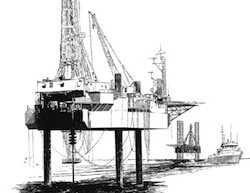
JACK-UP.
Drilling rig which jacks itself out of the water on three or
four legs.
JACKET.
The steel base structure of a platform.
JEWELLRY.
The hardware used in the make-up of rig anchring and chasing
systems.
JOYSTICK.
Single stick manoeuvring equipment interfacing a computer
with engines and thrusters.
KARMFORK.
Wire handling equipment consisting of hydraulic posts
slotted in the top to receive the pennants or chains.
KIP. A
unique oil industry measurement of tension in anchor wires.
A Kilo Pound or 1000 lb.
KORT
NOZZLE. Fabriacted tube round the propellers of tugs which
increased the bollard pull.
LASSO.
Length of wire, usually fitted with a short length of chain
in the centre, thrown over the anchor buoy from the AHTS.
LEAD TUG.
The towing vessel nominally in charge of the tow, and at the
least followed by the second tug.
LOADING
LIST. List of items to be loaded in port on a supply vessel.
LWT.
Standard US Navy Lightweight design anchor.
MANNED
SUBMERSIBLE. Submarine deployed from mother ship, usually
capable of carrying up to five personnel.
MARGINAL
WEATHER. Euphamistic term to describe weather in which the
Master must decide whether it is suitable to work.
MARINE
RISER. The tube between the wellhead and the rig. Protects
the drill string and carries the drilling fluid.
MIMIC
BOARD. A board which allows the electrical operation of
valves, and shows whether they are open or closed.
MOONPOOL.
A space in the centre of diving ships through which the bell
is lowered.
MSV see
Multi Role Support Vessel.
MULTI-ROLE
SUPPORT VESSEL. Usually semi-submersible fitted with
thrusters and moorings. Can provide accommodation, diving
services and emergency and firefighting.
OBM. See
Oil Based Mud.
OFFSHORE
INSTALLATION MANAGER. The manager of a platform responsible
for all aspects of its operations.
OIL BASED
MUD. Drilling fluid consisting of de-toxified gas oil to
which barytes and other chemicals are added.
OIM see
Offshore Installation Manager.
ONE-FOR-ONE. The practice of lifting a container out of the
stow of a support vessel and returing one to the same space.
ON SCENE
COMMANDER. The person locally in charge of a marine
emergency. Either an OIM or a military aircraft.
OSC. see
above.
OPERATOR.
An oil company who carries out the operation of an
exploration well or producing field on behalf of the
partners.
PELICAN
HOOK. A wire securing device adopted and modified by the
industry used
PENNANT.
Term for all wires used in the string between the surface
buoy and the crown of the rig anchor.
PIGTAIL.
The short wire from the underside of the surface buoy to the
first pennant.
PILE.
Offshore this usually means the tubulars used to pin the
jacket to the seabed.
PIPE
CARRIER. A type of support vessel designed to carry pipe for
the pipe-barges.
PIPE
LAYING BARGE. A barge equipped to weld lengths of pipe
together and then to feed them over the stern as a
pipe-line.
PLATFORM.
see Production Platform.
PLATFORM
SUPPLY VESSEL. Today this usually means any support vessel
not fitted with a winch, ie designed for the carriage of
cargo only.
PONTOON.
The lower horizontal buoyant structure which supports the
vertical columns of semi-submersibles.
POP-UPS.
see Towing Pins.
POTABLE
WATER. Water suitable for drinking, carried in dedicated
tanks on supply vessels.
PSV see
Platform Supply Vessel.
PULSE 8.
Early Decca positioning system which used mobile stations.
RACKING.
The action of bringing the rig anchor onto the bolster.
RESCUE
BASKET. A large buoyant ring with netting meeting above it
at a lifting point. To be hung over the side of a standby
vessel on its crane to pick up survivors.
RESERVOIR.
The oil bearing strata tapped by the hole
RIB see
Rigid Inflatable Boat
RIG CHAIN
LOCKER. Compartments beneath the winch of an Anchor Hnadler
for storage of rig chain.
RIGID
INFLATABLE BOAT. Rigid hull with inflatable rubber sides
often used as FRC.
ROLLER.
The roller on the stern of the anchor handler which allows
the wires and eventually the anchor free passage aboard.
SAFETY
HOOK. A latched hook used by rig cranes which normally avoid
hooking on to the ship's structure.
SATELLITE
WELL. A well some distance from the main platform of a
field, with a subsea completion and control and pipelines to
the main platform.
SATURATION
DIVING. Diving operations where the divers remain at the
pressure of the seabed in a pressure vessel on board the
ship.
SBV. see
Standby Vessel.
SCRAMBLING
NET. Net hung over the side of SBVs up which survivors might
be able to scramble.
SEDIMENT.
The solids which are left in the mud tanks of supply vessels
after cargo discharge.
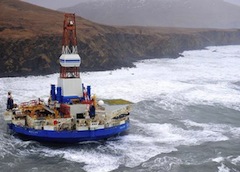
SEMI-SUBMERSIBLE. Craft, usually an exploration rig, with a
shallow draft for moving and a deep draft which gives a
stable platform and reduces wave action while drilling.
SHARK'S
JAW. Type of anchopr handling tong - usually the Ulstein
type.
SHEPHARD'S
CROOK. See J-Hook.
SLIDES.
Heavy canvas panels in the lower section through which air
is blown to assist with discharge.
SLOTTING.
See One-for-One.
SMITTLOCK.
A now totally outdated wire securing system, formerly used
for anchor handling.
SNATCHING.
Maintaining position under the rig crane using engines and
thrusters.
SOAKING.
Allowing the anchors of a rig to settle for several hours.
SPOOLING
ON. Reeling pennants from coils or drums onto the work drum.
SPOT
CHARTER. Short term hire. Ships taken short term may receive
no more than an hours notice, and the hire period ends
when-ever the oil company has finished with them.
SPRING
BUOY. Spring buoys are sometimes fitted part way down a
pennant string to keep the crown pennant clear of the
seabed.
SPUDDING
IN. The initial breaking of the surface with the largest
drill bit at the commencement of a hole.
STANDBY
VESSEL. The craft standing by offshore installations with
for the purpose of rescuing personnel from the water.
STERN
ROLLER. see ROLLER.
STEVIN
ANCHOR. Conventionally shaped but fabricated anchor often
used as a piggy back.
STEVPRIS
ANCHOR> Very large parallel fluke twin shank anchor with
good holding power.
SUBMERSIBLE DRILLING RIG. A drilling rig which is sunk to
the seabed when in drilling position.
SUBSEA
BUOY. Buoy secured to the seabed, and released by a radio
signal.
SUBSEA
COMPLETION. A well head or number of wellheads terminating
on the seabed rather than on a platform, and connected to
the platform by umbilicals.
SURFACE
BUOY. The buoy holding up the pennant string from a rig
anchor.
SWOPS
VESSEL. Tanker capable of connecting up to a suitably
installed wellhead and extracting the oil therefrom. Only
one exists.
SYLEDIS.
Position fixing system using mobile stations mainly used by
seismic ships.
TAG LINES.
Lines hanging from the ends of tubulars to steady them,
either on the ship or the rig.
TAUT WIRE.
A position fixing system used by diving ships consisting of
a heavy weight lowered to the seabed allowing the comuter to
monitor the angles of its attached wire.
TEMPLATE.
A structure lowered to the seabed through which the wells of
a production field may be drilled by a semi-submersible.
TEMPSC.
Totally Enclosed Motor Propelled Survival Craft. Rig
lifeboat.
TENSION
LEG PLATFORM. A semi-submersible platform attached to the
seabed by heavy wires tensioned against the buoyancy of the
unit.
TERM
CHARTER. A negotiated period of supply vessel hire, from one
month to 5 years, with any period in between.
TLP. see
Tension Leg Platform.
TOPSIDES.
The working part of a platform including the living drilling
and production modules.
TOWING
GATE. A gate on older anmchor handlers which was closed
under the tow wire so as to allow the wire free movement.
TOWING
POD. A large tube bolted at tow wire height into the middle
of the deck, the tow wire then being passed through it.
TOWING
SLEEVE. A nylon sleeve on the tow wire, positioned at the
point of contact with the stern to obviate wear.
TOWING
SPRING. A multi-stranded heavy duty nylon spring intened to
be fitted between the bridle and the tow wire, to reduce
shock loading.
TOWMASTER.
Expert usuallu employed by the oil company to take charge of
rig moves.
TRIPLEX
GEAR. Wire securing equipment. The most elaborate of the
types available.
TUBULARS.
Any form of pipe being carried on the deck of a supply
vessel.
TUGGER.
Small winch at the fore end of the supply vessel deck. The
name is taken from small winches used on exploration rigs.
TUNING
FORK. Twin pronged hook used to handle chain. Fitted to the
end of the work wire.
VICENAY.
Manufacturer of LWT anchor.
WATER
BASED MUD. The most basic drilling fluid using drill water
and barytes mixed on the rig.
WECO. A
hose connection used throughout the oil industry.
Victor Gibson. May 2009.
|