|
BREAKING THE
ICE
This was a short article about
the icebreaking supply ships written in 2001
The arrival of
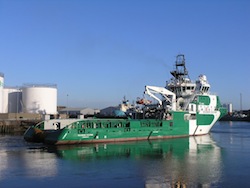
the Vidar Viking in Aberdeen during April of 2001 was something of a finale. She
is the third of a trio of Moss808s (Formerly Kmar808s) built for B&N Viking and
is in the main identical to her two sister ships the Tor Viking and the Balder
Viking. The Vidar Viking is provided with DP Class II capability, a feature
which the Company say will be provided for the other ships in time and she also
has a large storage reel on the winch housing.
The
ships are contracted to the Swedish government for icebreaking duties during the
winter and at other times can take on any commercial opportunities which are
available for large anchor-handling supply vessels.
In this way they
follow the icebreakers Fennica, Nordica and Botnica which are operated by the
Finnish Maritime Administration for icebreaking during the winter and are also
available for other work during the summer. The main difference between the
Finnish vessels and the Viking ships is the configuration of the stern. The
Finnish ships were built in the normal icebreaking design with a notched stern,
while the same facility in a bolt on addition in the Swedish ships.
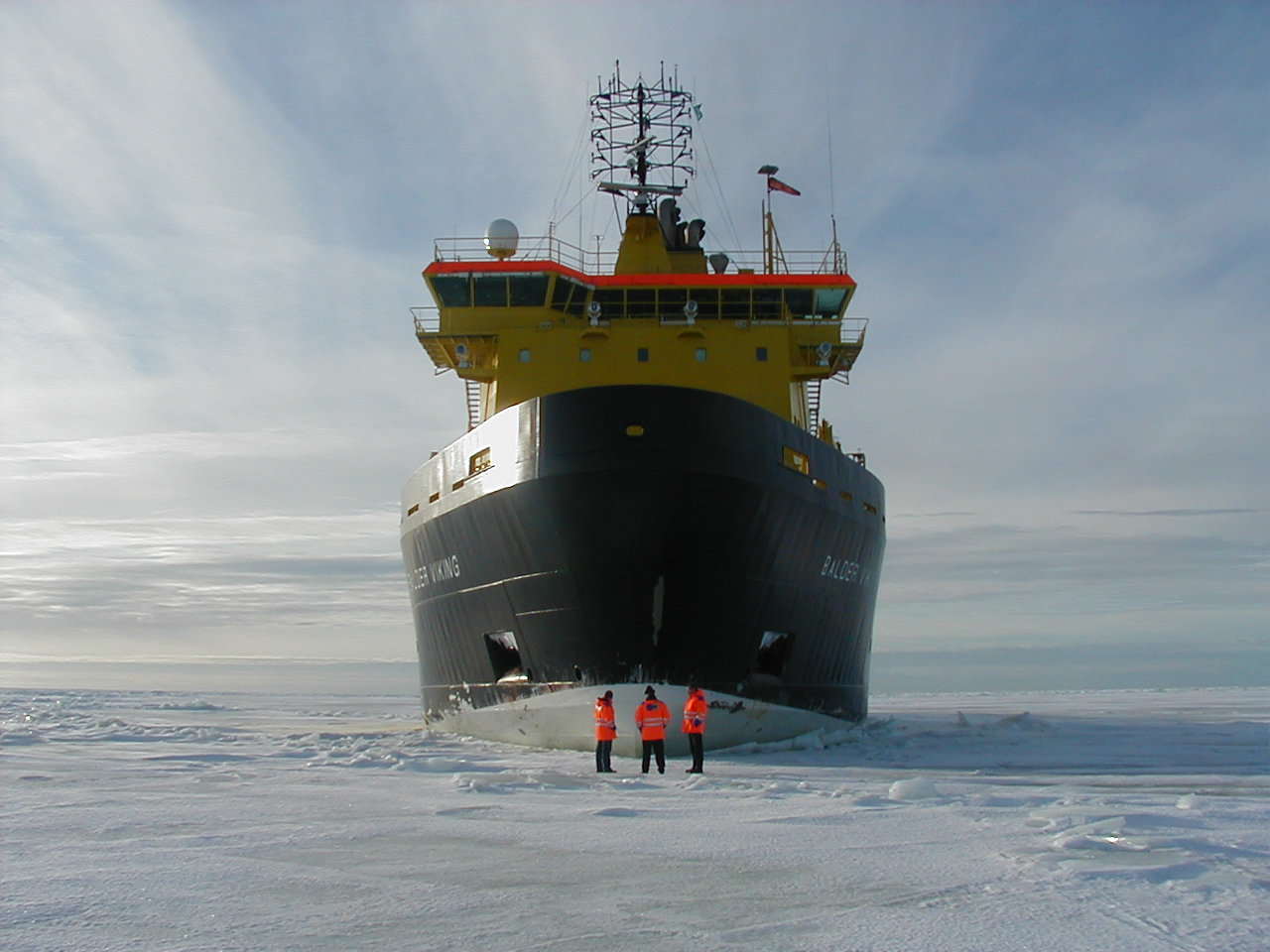
The Balder Viking at work in the ice. Photo
Bjarte Tronsden.
Commercial
icebreaking is itself an exciting and skilful activity requiring specific
features in the vessels. The Finish icebreakers of the sixties and seventies
were built for the job, usually with two propellers at the stern and two at the
bow, the latter to assist with the icebreaking. More modern designs use the
raked icebreaker bow which allows the ship to ride up on top of the ice and
break it with the ship's weight, a technique possibly pioneered by the Manhattan
the American tanker built for transiting the Northwest passage in the 1960s.. A
second feature is the ability to transfer ballast rapidly from one side of the
ship to the other providing a rolling motion which prevents the ship becoming
stuck. The Vidar Viking for instance has cross connected wing tanks and a
pumping arrangement which can create a 10 degree list in 20 seconds. The third
essential feature is the already mentioned notch stern.
Those involved in
the offshore industry tend to lose sight of the fact that normal commercial
cargo carrying vessels have very limited power available and even those with ice
strengthened hulls will be equipped with engines commensurate with the need for
an adequate transit speed combined with wonderful fuel economy. Hence, in the
Baltic winter these vessels make their way northward past the edge of the ice
under their own power until they are unable to proceed further. Often ad-hoc
convoys accumulate as smaller ships follow larger and more powerful vessels
until all will finally come to a halt. They will then call for help from an
icebreaker.
If the ice is not
too thick the icebreaker will approach the convoy from the bow, crunching though
the ice and rolling majestically to prevent it from sticking to the sides. It
will skim down one side of the convoy, then it will turn round and break the ice
up the other side, slowing and then tucking itself in ahead of the leading ship.
With luck everyone can then move forward until the open channel into the port is
reached.
In very thick ice
the third feature of the icebreaker is put to use and the vessel being rescued
is pulled into the notch in the stern and effectively dragged along bodily until
the port is reached, this process is less used that the collective freeing of
the convoys, but never-the-less it must be available.
All these craft
possibly gained their inspiration from the two ships designed by Robert Allen of
Vancouver and built for Beaudrill in Canada in 1983. These craft, the Ikaluk
and the Miscaroo were impressive in their day and, using the raked bow
principle were claimed to be able to break through 15 foot ice ridges.
The Fennica and
the other two vessels operated by the Finnish Maritime Administration spend
their summers contracted to the subsea specialists DSND for all sorts of
underwater tasks, and are favoured for activities with requiring the use of the
large A-frame on the stern, such as the prelaying of mooring systems.
In their
icebreaking mode the B&N Viking ships have the notched stern bolted on and a
Helideck fitted to the afterdeck, but once these items are removed their
effectiveness as heavy duty anchor handling and towing vessels is unimpeded.
Indeed they are provided with a wonderful set of deepwater anchor handling
equipment. Unusually the tow drum is set aft of the workdrum because it is of a
smaller diameter, but is still capable of storing two 1650 meter tow wires side
by side. The larger diameter workdrum can store over four kilometres of 83 mm
diameter wire. In all the chain lockers can accommodate 12,000 meters of 3"
(76mm) chain or half a dozen semi-submersible moorings.
The four MAK
engines arranged in a father and son layout and shoe-horned in to an engine room
in the forepart of the ship, in what has become the standard European, mode
develop over 18,000 bhp between them and offer a useful 200 tonnes of bollard
pull.
It is a
requirement when icebreaking for the officer of the watch to be able to see
ahead and astern at the same time and to facilitate this activity both the
Finnish anchor-handlers and the Swedish ships are provided with an off centre
conning position, and while it may be seen as being essential for some work,
standing at the position on the Vidar Viking gives one a curiously lopsided
feeling and there is no doubt that ships are best conned, particularly in narrow
channels and congested waters, from the centre-line.
Now that the
winter has passed all three of the Viking vessels are back in the oil business.
The Vidar and the Balder have been employed by Saipem in support of the Saipem
7000. Substantial vessels of this sort are seen as being necessary to deploy
the 40 tonne anchors of the crane barge. Thereafter they manoeuvred a barge
alongside so that a flare boom could be lifted onto the S7000. The Tor Viking
has been regularly employed rig moving since entering service and up to the
third week in April had carried out over thirty rig moves. Both the Tor Viking
and the Vidar Viking were employed by the Swedish Maritime Administration
straight from the shipyard, the Tor icebreaking for February and March 2000 and
the Vidar for February and March 2001. This year both the other ships in the
team continued their commercial activities, though it is likely that they must
be positioned so as to be able to take up their primary duty in the event of a
sudden cold snap.
One assumes that
the Viking ships will reduce the cost of keeping Sweden's port open while making
the lives of supply ship enthusiasts everywhere more enjoyable; and they
illustrate the fact that it is at last possible to design a dual purpose ship
which is totally effective, rather than less effective in both roles .
Vic Gibson
TO
RETURN TO FEATURES INDEX CLICK HERE |