|
ICEBERGS AND ANCHOR-HANDLERS
Every year
in the calving grounds of Greenland’s glaciers, 20,000 to
40,000 icebergs are born. Carried north on the currents,
they circle Baffin Bay before appearing in the North
Atlantic the following season. Fewer than 500 drift south
to menace shipping and oil installations off the coast of
Newfoundland, splintering and fracturing, breeding smaller
pieces known as growlers and bergy-bits. Everyone knows the
Titanic’s story. Let it not be lost on us that the
medium sized iceberg she struck was south of Boston. As
recently as 2002 the shrimp trawler BCM Atlantic
struck an iceberg, sinking in five minutes. Ship’s captains
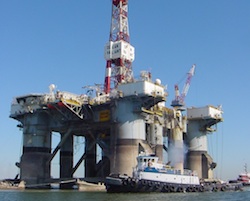
can alter course, an option not available to the Hibernia
Platform that can only remain stationary as danger
approaches.
Designed
against the impact of sea ice and icebergs up to one million
tonnes with no damage, the platform would suffer repairable
damage from a six million tonne iceberg, the largest
estimated berg capable of entering the 80 metre waters
surrounding Hibernia.
Research
carried on by the Centre for Cold Ocean Research Engineering
(C-CORE) has shown that serious damage can be caused by
growlers and bergy-bits weighing as little as 500 to 1000
tonnes. Having installed what amounts to a giant weigh
scale hung on a cliff in Newfoundland, they smash small
icebergs against the platform. Information from these tests
has not only given us an idea of how hard ice is, like
crushed asphalt, but will aid the builders in the design and
selection of materials for tomorrow’s ships.
Support vessels servicing the rigs are also in danger, not
from the big bergs, readily visible as they tower from the
ocean, but from the small growlers and round-tops, often
undetectable on radar and virtually impossible to see in the
North Atlantic waves. In some areas, sheer numbers
aggravate the problem. The drill ship
West Navion
had to deal with
over 200 bergs and deflect more than seventy while drilling
in the Davis Straight. Further south the Henry Goodrich
and the Terra Nova FPSO, capable of handling 150,000
b/d, don’t want them around. Although capable of moving to
avoid contact with an iceberg, downtime and loss of
production time makes this unacceptable. For the Terra
Nova FPSO just multiply its daily production by the
current price of oil. Hiring a tug to move the ice is cheap
by comparison.
Icebergs
don’t just bump into things, if deep enough, they gouge out
troughs in the seabed of the Grand Banks varying from 10 to
150 metres wide. Any pipelines or fibre optic cables in
their path would be gathered up like so much spaghetti.
Ships and
icebergs share one thing in common; both only need a small
deviation to avoid a collision and oil exploration off
Canada’s east coast has spawned a whole new line of work for
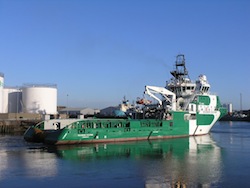
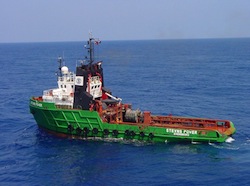
the AHTSV - iceberg towing. In its simplest form this
involves circling the iceberg with a floating line, often
eight-inch polypropylene, sending enough steel cable over
the stern to take up the slack and set the rope, then tow
the berg a sufficient distance so the current will carry it
safely past the rig. For Jeff Murrin, captain of the
Atlantic Eagle, the challenge is met with 1200 metres of
rope, 14,400 horsepower and 150 tonnes of bollard pull.
Even so, the pace is slow. An iceberg 307 metres long by
235 metres wide with 10 metres above the water required his
services. Using side scan radar, it draught was established
at 95 metres, and when the Atlantic Eagle hooked on
to it, they had 7 ½ million tons on the wire. Towing bergs
that size often takes half a day to reach one knot.
Occasionally the rope will tear loose from rotten ice and
ride over top of the berg, or the iceberg may roll over.
Small chunks of ice are moved by prop washing, repeatedly
backing close, then using the ships propeller wash to create
a man-made wave and thrust the berg away, often for a
distance of half a mile or more.
When
practical, the ship’s water canon are be used to move or
break down the ice. Atlantic Eagle has two of them
capable of delivering 3800 tons of water an hour.
A more
novel approach taken by enterprising Newfoundlanders is to
haul the ice ashore, melt it to pristine water and make
ICEBERG Vodka out of it.
All these
measures are but temporary, for Mother Nature will take over
the task as summer wears into July. We wrest riches from
the seabed at our peril and have learned to use technology
to make it safe. Towing icebergs may not be high tech but
every rig worker off the east coast of Canada sleeps easier
because Maersk and Atlantic Towing ships are on the job.
For a good
picture of this activity taking place go to the 2003 photo
contest section and scroll down to Hugh Dunlop picture of
the Maersk Gabarus towing a 5 million ton iceberg.
Ted
Caucutt.
TO
RETURN TO FEATURES INDEX CLICK HERE
|