|
THE ALARP DEMONSTRATION IN
THE OFFSHORE ENVIRONMENT
The HSE say the following in
their 2009 “Demonstration of ALARP” document which is
actually written for the nuclear industry:
The requirement for risks to be ALARP is fundamental and
applies to all activities within the scope of the Health and
Safety at Work Act. It is important that inspectors, in
whatever role, are aware of the need to ensure that
licensees meet this requirement. In simple terms it is a
requirement to take all measures to reduce risk which are
not unreasonably costly. In many cases this is not done
explicitly, but rather by the establishment and/or use of
relevant good practices and standards. The development of
good practices and standards includes ALARP considerations
so in many cases meeting them is sufficient. In other cases,
either where standards and relevant good practices are less
evident or not fully applicable, the onus is on the licensee
to implement measures to the point where the costs of any
further measures would be grossly disproportionate to the
risks they would reduce.
To elaborate on this statement, the UK regulators are really
saying that if you are following established rules, guidance
and best practice you can consider your risk in carrying out
whatever task is being reviewed as ALARP, but first of all
you have to decide what hazards are to be assessed.
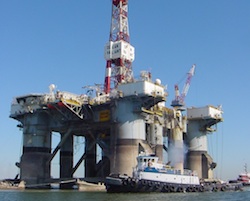
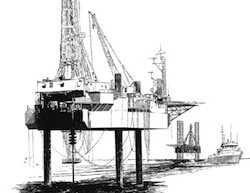
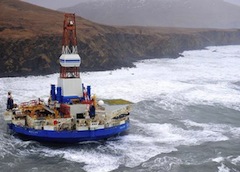
I know about mobile drilling units, so to use them as an
example, the industry has over the last 20 years pretty well
determined what semi-submersibles, jack-ups and drill ships
do and hence to what hazards they are exposed. So it is good
enough to get hold of the existing list of hazards and to
assess the risks relating to them (in safety speak the
realization of the hazards)using what-ever means seem to be
suitable. The drilling industry as a whole is very averse to
QRA (Quantitative Risk Analysis) which is the determination
of the seriousness of the risk by accessing existing
records, and doing some calculations, but it can be helpful
particularly to determine whether risks are ALARP. Hence if
an event is only likely to occur once in a million years
according to your QRA, you don’t have to make a big effort
to reduce the risks further. But if the event is likely to
occur every 100 years the requirements will be completely
different, and you will have much to do.
One of the failings of QRA is that it does not usually
result in recommendations, it just tells you how things are,
and another is that it can easily be manipulated to produce
the required results. Safety records vary depending on which
part of the world one is considering so levels of risk are
easily over or under stated. So in order to ensure that risk
are ALARP some sort of qualitative work is required. There
are a number of techniques, but one of the most effective is
probably the bowtie method. This is not an article intended
to promote any particular software, but BowtieXP works very
well.
Hence in order to ensure that risks are ALARP regular risk
assessments should be undertaken and the recommendations
resulting from them carried out. What if there are no
recommendations I hear you ask, and what is meant by
regular? The answer it that there should always be
recommendations resulting from an assessment of major
hazards, and that “regular” may be only as often as every
five years.
The UK health and safety ethos is that there is always room
for improvement, but that eventually the cost of making the
improvements will be pointless, since the reduction in risk
will be minimal. To use an example, when considering the
risk of capsize of a semi-submersible due to loss of
stability (which has happened less often than one might
think) it may not be worthwhile making major structural
changes to a rig, but it will always be worth training the
ballast control operators how to do the job. This is
considering what is known as “gross disproportion”.
So in order to ensure that one’s risks are ALARP, one has to
carry out risk assessments regularly and then carry out the
resulting recommendations as long as they will actually
result in a reduction in risk. It is an iterative process.
Victor Gibson. September 2012
TO
RETURN TO FEATURES INDEX CLICK HERE |