|
THE ELGIN
GAS LEAK
It is amazing
how events come and go in the media. I have only now, on the
15th April, got round to writing about the gas leak which
took place on 25th March at the Elgin WHP platform, which is
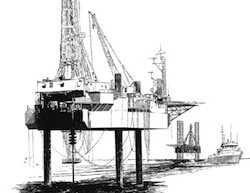
attached to the main platform by a bridge. The Rowan Viking
was alongside with its drilling package cantilevered out,
doing something, either drilling new wells or working over
existing ones. The Elgin platform had been producing 250,000
ballels per day of oil and oil equivalent, and this
contributed about 7% of the gas requirements of the UK.
Possibly in an event unrelated to the activities of the
Rowan Viking, gas started leaking at the surface, apparently
from a formation above the level at which the plug had been
set in a well which had been abandoned. This was revealed by
Total after some investigation.
In the way these things always play out, as soon as the news
was in the public domain ,a bunch of TV men arrived on
Greyhope Road in Aberdeen and set up their equipment so that
the TV presenters could be seen on screen with the Aberdeen
Harbour in the background. They remained there for a few
days, doing their one minute pieces to camera for the 24
hours news programmes, while the directors hoped that there
would be ships passing behind them. Aberdeen Harbour is of
course a long way from the Elgin Platform.
Overnight on 25th Total had left 19 people out there, one
assumes on the platform rather than on the rig, but they
were evacuated the following morning. On should remember at
this time that the gas was escaping from the wellhead
platform and nearly everyone had been evacuated – some into
a Norwegian rescue helicopter, which was the first to arrive
on the scene after the Mayday had been broadcast. So one of
the nineteen must have checked out the helideck for gas.
After all, the last thing one would want would have been a
helicopter igniting the gas at the moment of landing.
Indeed the last time all hands were evacuated due to a gas
leak, leaving the installation intact, was at the Hewett A
in 1967. This small platform suffered a gas blowout during
the drilling and completion operations. Most of the crew
evacuated to the support vessel Hector Gannet, which was
holed due to collision with the platform and sank. So they
had to be rescued again by the trawler Boston Hornet. Sadly
some of the crew of the Hector Gannet were lost.
As an interesting side-issue which would have been
considered to have been over the top cliff-hanger in
fiction, the flare was still burning after the evacuation of
everyone from the Elgin. There have been discussions as to
whether this had to be left burning to blow down the
inventory on the rig, or whether it could have been
extinguished and the blowdown could still have taken place.
Of course, all it would have taken was for the LEL, the
Lower Explosion Limit, to have been exceeded at the flare
and boom, or should that be BOOM! However, on 31st March the
flare went out, and with it interest in the emergency was
also extinguished.
The Aberdeen Press and Journal headlined the possibility
that there had been concerns about pressure in the annulus
up the four weeks before the leak made itself felt, and
doubtless there will be more of this as the investigation
into the event is carried out. But maybe most importantly
everyone was safely evacuated, and Greenpeace have struggled
to identify pollution. The reality is that the gas will
disperse and the light crude will evaporate.
As the event reached what one might call maturity a team
returned to the rig, and there are mutterings about pumping
heavy mud down the hole to sort out the problem. One should
remember now that there are all the facilities for carrying
out this task on one of the newest jack-ups in the world,
already on location, the Rowan Viking. If it is possible to
do the job then the Rowan Viking can do it.
Meanwhile Total is taking other steps. The Rowan Gorilla V
is at a location about three miles to the south, development
drilling for the Company, and there is the possibility that
it might be used to drill a relief well. Additionally the
Sedco 714, Total’s long term semi-submersible is also to be
located in the area to be available to drill a relief well
if necessary. Of course the pumping of heavy mud should take
no more than a day or two, once it is mixed in the mud pits
of the Rowan Viking, but the relief wells could take six
months to drill. According to the media, Total have also
hired the Skandi Aker a brand new well intervention vessel.
It is a bit difficult to see exactly what this ship, which
is set up for subsea work could do, although Total told the
BBC that it might provide the means of killing the well.
However it goes, one assumes that the Total management will
be keeping their fingers crossed that the Wild Well Control
guys will be able to sort the problem, and that the Elgin
can start up again. When they were out there on 6th April
they determined that there was no gas on the Elgin Platform
itself, or on the access routes to the WHP, so just a bit of
good news.
The rest of the UK oil industry will probably be keeping its
fingers crossed as well. A rapid outcome would restore some
confidence in an industry which has taken a few knocks since
Macondo in 2010, and even now as I write, Shell’s share
price is taking a bit of a dive as it is suggested that it
could have a leak in the gulf of Mexico. But time is
passing, and it is more than a week since there was last a
press release from Total. Out in the North Sea there is
still no-one on the Elgin or the Rowan Viking, the gas is
still leaking, the income of the oil company has been
reduced by millions of dollars a day, and there has been a
considerable reduction in the gas available for use in UK.
We can only wait as see what next week brings.
23rd April
2012
In the last
couple of days there has been a bit of further information
provided by Total. they say that the leak from their "G4"
well has substantially reduced, and that their well kill
activities are progressing on two fronts. The first is the
relief well which has been spudded in from the Sedco 714,
and preparation being made to make the Rowan Gorilla V
available to drill a second relief well. The second string
seems to be a well kill using the Skandi Aker, which is a
sophisticated well intervention vessel. According to Aker
Solutions this ship is capable of doing a number of things,
firstly it can carry out well intervention on subsea wells,
secondly it can be used for well stimulation, and thirdly is
can carry out well testing and can flare off hydrocarbons or
hold them on board. Indeed its only drawback in carrying out
the job at Elgin might be the fact that any internal
combustion engine can draw in gas, and run on it to the
point of destruction. The ship is said to be in Peterhead at
the moment being prepared for the task, so perhaps this
problem is being dealt with.
Postscript.
Total managed
to position the semi-submersible West Phoenix within range
of the Elgin wellhead platform and regain control of the
well using heavy mud. This is a quote from my May
newsletter-
The latest
news, on 15th May, is that the West Phoenix is in a position
to commence killing the well with heavy mud via a
temporarily installed flexible pipeline. This is known as a
“dynamic well kill” for which permission was granted by the
Department of Energy and Climate Change, on 4th May. If this
job goes according to plan the well should be back under
control in a day or two, and for those who are unfamiliar
with these processes, the work is quite different from the
attempt to kill the Macondo well in the Gulf of Mexico back
in 2010. They are going to make, or maybe have already made,
a connection to existing pipework on the deck of the
Wellhead platform, as opposed to trying to stuff a pipe down
end of a broken riser on the seabed several thousand feet
down.
As things are
now, in September 2012, it looks as if the platform may be
operational again early next year.
Vic Gibson
TO
RETURN TO FEATURES INDEX CLICK HERE |