|
THE LOSS
OF THE NORMAND ROUGH
by Kenny Polson
In May 1982 I joined the LB 423 (ex
Chotaw II). This was my first job offshore having taken
voluntary redundancy from Ben Line Steamers. The LB 423 was
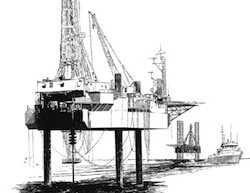
a semi-submersible pipelay /derrick barge built 1976 by
Blohm & Voss for Santa Fe. It was now owned and operated by
Brown & Root. I along with four other Brits were the
stability controllers responsible among others for
ballasting the barge and the stinger.
The LB423 was engaged in pipelay
operations in the Gorm, Tyra and Skold Fields in the Danish
Sector for DUC-DONG. We had two anchor handling tugs to run
the anchors, both were Norwegian, the Dag Viking and the
Normand Rough. Additional infield vessels were the tug
Natalie Letzer to handle the stinger and the OSA platform
ship Linetor for supply. The pipe hauling was carried out by
a number of West Indies RO/RO vessels all with names
prefixed "Inagua" and the Salvesens PSV Highland Piper.
I was on the midnight to noon on the 9th
of June 1982 and soon after arriving on the Tower we were
picking up anchors to move infield to start another pipe
line. The weather was about a Force 6 and all anchors were
recovered except the two bow anchors, these were recovered
by the two anchor handlers, the anchors decked, and
disconnected, the tow line attached to the anchor wires. The
tow commenced.
The Normand Rough reported that the
anchor on its deck, a 30,000 pound LWT, had broken its
lashings and slid across the deck due to the wooden
sheathing being torn up. This caused the vessel to list. The
crew then resecured the anchor. After a time the vessel
reported that they were taking in water, so it was decided
to take it off the tow leaving the Dag Viking to tow the
barge. The Normand Rough was pulled in towards the barge, it
then released the anchor wire and manoeuvred towards the
side of the barge to allow the crane to recover the anchor.
The Normand Rough manoeuvred in towards
the crane and was almost in position when it suffered a
complete engine failure and drifted astern, powerless. The
Dag Viking was instructed to re-attach the anchor to the
anchor wire and set the anchor. This was done and the Dag
Viking went to the aid of the now sinking Normand Rough. It
was now too deep to be successfully towed and so the Dag
Viking took the crew off. The Normand Rough sank. It was
over in a little over two hours if my memory is correct.
The loss of a fine vessel, but thankfully, no loss of life.
In a matter of weeks while still working in the area, now
with the Typhoon anchor handling in the place of the Normand
Rough, we could see a Sheer Leg Crane over the spot
recovering the vessel. The Normand Rough was salved and
became the Lorna B of Britannic Towing then International
towing of Hull.
When I was carrying out some online
research into this sinking I was fortunate to find this
link,
http://visekar.diskusjonsforum.no/visekar-about97.html
which documents the history of Solstad and its offshore
fleet and a fascinating history it is, regarding the Normand
Rough and her two sisters. All three vessels were
constructed in Marystown Newfoundland, all were the same
design,43 metres and 85 tonne bollard pull anchor handling
tugs.
All three were lost and sank, the Normand
Rough twice.
Normand Rough, launched 1979, lost June
1982 Danish Sector, refloated sold and renamed Lorna B, sank
Cook Inlet Alaska in August 1989.
Normand Rock, launched 1978, sold 1981to
Britannic Towing became the Anna B, foundered on the Feb
1988 off the Haisboro light
Normand Ross, launched 1979, sold 1984
became the Scan Partner and went to operate in the Arabian
Gulf during the Iran/Iraq war. Attacked and set on fire by
Iraqi aircraft while assisting the tanker Barcelona ,she
sank with the loss of nine crew in August 1986.
A tragic end to all three vessels.
Kenny Polson
TO
RETURN TO FEATURES INDEX CLICK HERE |