|
The
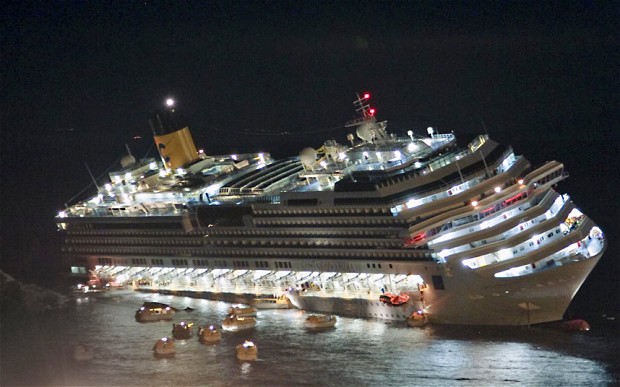
Bourbon Dolphin capsized with the loss of the lives of eight
of those on board, while carrying out anchor work at the
Transocean Rather on 12th April 2007. The
accident was investigated by the UK Health and Safety
Executive, the Norwegian maritime authorities and a
Norwegian Royal Commission, which reported on 28th
March 2008. The Royal Commission report extended to 208
pages without appendices, and was hampered by a lack of
anchor-handling expertise amongst the Commission members.
These words attempt to summarise the work of the Commission
and to point out where, in the view of the writer, an
alternative view might have been valid.
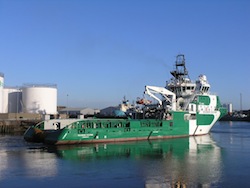
The Bourbon
Dolphin was an Ulstein A102, a design which was unique at
the time of the accident and one which remains unique at the
time of writing, the spring of 2008. The vessel was of
similar dimensions to the Rolls-Royce UT722 but was, at the
request of the future managers, Bourbon Offshore, provided
with a larger winch with more wire storage and greater pull,
giving it the ability of working in deeper water. It was
marketed as being capable of 194 tonnes bollard pull from
its 16,000 odd bhp.
This extremely
high specification made it suitable, so it seemed, for
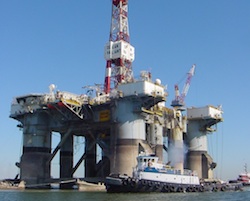
moving the Transocean Rather which was drilling a prospect
for Chevron, West of Shetland in 1100 metres of water. The
Rather was provided with a chain wire combination to allow
it to work in deep water, but to conform to the POSMOOR
requirements modifications to this system were required to
prevent anchor uplift in the worst of the prospective winter
weather, and as a consequence 916 metres of chain were added
to the rig’s own 900 metres, this being deployed from the
chain lockers of the attendant anchor-handlers.
Some members of
the Norwegian Commission found fault with this modification
to the mooring system, suggesting that pre-laid moorings
would have been more appropriate, but even in hindsight,
this does not seem like much of a plan, and is typical of
the approach taken by some investigators – decide what went
wrong first, and then make the facts fit. At the time Shell
had recently completed a well with the Transocean Rather
further to the south-west utilising the first prelaid
moorings ever to be used for an exploration well in the UK
sector. Although details of the operation were never made
generally available, the job took weeks and the marine
community in Aberdeen were aware of the difficulties. A
video taken from the bridge of one of the Gulf Offshore
UT722s, and subsequently circulated, showed a pennant wire
breaking at the roller, and snaking back with vicious force
towards the bridge windows. This alone would have put anyone
off. In fact this operation resulted in the irrepairable
damage to several of the Rather’s anchor wires, so the rig
had to visit the repair base at Invergordon before starting
on the Chevron project. This was described in the
Commission’s report as “technical problems with the
departure from the Shell field”.
At the
beginning of the job the Transocean Rather was moored with
eight anchors at what was known in the Norwegian report as
“Rosebank G”, utilising approximately 1500 metres of wire
connected to 900 metres of 84mm rig chain and 900 metres of
76mm insert chain, the latter having been deployed from the
chain lockers on the anchor-handling vessels. At the end of
the insert chain was an 18 tonne Stevpris fabricated anchor.
In common with most mooring systems four of the eight
anchors were ‘primary anchors”. These were No’s 1,4,5 and 8
– the numbering starting from the starboard bow. The
secondary anchors were No’s 2 and 3 on the starboard side
and No’s 6 and 7 on the port side. The mobile units are
generally considered to be safe in marine terms when moored
with the primary anchors and able to drill when all eight
anchors are deployed.

The rig was
fitted with a permanent chasing system, which consists of a
collar which is installed round the mooring, and attached to
a wire pennant. Normally the anchor-handling vessel will
attach its own very long work wire to the permanent chasing
pennant (PCP) and then set out for the anchor, lowering away
its own wire. This process works in any water depth, the
variant being the length of the wire on the ship.
To allow it to
work in deep water, the Transocean Rather uses a combination
of chain and wire. The chain is used to prevent anchor
uplift and the wire allows the rig to work in deep water. At
the point where the chain is changed over to wire some guys
on the rig stand on a platform below the winch, suspend and
disconnect the chain, and make the connection to the wire.
This is known as the transition. In order for the chasers to
be able to run down the wires without damaging them, they
are fitted with rollers in the lowest part, and during the
mooring of the rig at Rosebank G these rollers had been
damaged, and so an alternative technique was to be used to
recover the moorings.
The alternative
technique was to be to use vessels designated as the “main”
anchor handlers to J-hook the wire close to the rig and run
out to the secondary anchors, and then to recover the
anchors to the stern roller. A J-hook is just what it sounds
like. It is a shepherd’s crook shaped piece of cast steel
weighing several tonnes which is dangled over the stern of
the ship.
Once the main
vessels had reached the anchors and had recovered them to
the roller the assisting vessels were to be required to
grapple for the chain astern of the main anchor-handlers,
and once this was done, the main vessels were to recover the
anchors to their decks, remove them and stow the 900 metres
of chain in their chain lockers. The reason for the use of
the assisting vessel was to reduce the weight on the chain,
and so minimise the possibility of damage to the anchor.
This was in accordance with the requirements of the
anchor-manufacturer’s manual.
Once the
secondary anchors had been recovered in this way all four
vessel were to be used to lift the main anchors. Here the
tasks are exactly the same, whether the ships were
designated “main” or “assisting”. Of course the assisting
vessels were equipped to do this work.
Once all four
vessel were at the primary anchors they were to lift them
until they were at the rollers and the rig was to recover
its wire to the transition. The fifth vessel which was
provided with less wire was to connect to the towing bridle.
In this configuration the rig with all five vessels was to
transit the 2 nautical miles to the new location. If all
went well the four primary anchors would then be deployed in
opposite pairs and the rig would be moored.
Load sharing
procedures had been written for the deployment this
involved, the tow vessel being released from the bridle and
taking the weight of the chain just to seaward of the
transition. The two ships would then run out, with the rig
paying out its wire until the anchor point was reached and
then the main vessel would lower away, the grapple vessel
would be freed and the anchor would be put on the bottom.
The grappling vessel would move on – and so on. This was an
adjustment from the original procedures because the brakes
on the rig’s winches had proved to be unequal to the task of
restraining the wire against the weight of the chain and the
pull of the vessels.
Once the
primary anchors had been deployed the main anchor-handlers
would move on to the secondary anchors. The assisting
vessels could now be used to take the weight of the chain at
the rig end, and once the wire was deployed they could move
to a position astern of the main vessels and take some of
the weight while the anchors were launched, once more to
reduce the possibility of damage.

In the event
the operation commenced with only the Olympic Hercules and
Bourbon Dolphin on the location and so the Bourbon Dolphin
recovered two of the secondary anchors, and was therefore
required to run them on arrival at the new location.
The Bourbon
Dolphin was designated in the rig move procedures as one of
the “assisting vessels” and much was to be made of these
designations during the witness testimony. Later the
Highland Valour, the Vidar Viking and the Sea Lynx were
hired, the last being the least powerful solely as a towing
and grappling vessel.
Before the
vessels left Aberdeen they were briefed on the operation by
the Trident Offshore Superintendent, and according to the
report there was a disagreement between him and the Captain
of the Bourbon Dolphin about the content of this briefing.
The Captain claimed that he had disputed the capability of
the Bourbon Dolphin to run anchors in the depths of water
where the job was to take place, and with the forces
envisaged. The Trident man said that no such discussion had
taken place, and that it was going to be necessary for every
ship to run at least one anchor. This is obvious if the rig
move procedures are read. During and after the enquiry it
was often claimed that the Bourbon Dolphin was unsuitable
for the work which is had been hired to do, but if this was
so, why was it that the owners advertised it as having a
bollard pull of 194 tonnes and why did the winch have a wire
capacity of 5000 metres?
On 27th
March the Olympic Hercules and the Bourbon Dolphin started
to recover anchors, each acting as, primary and assisting
vessel, until 29th when the Bourbon Dolphin was
sent off to Scrabster for a crew change. It may be worth
saying here that the charterers of supply ships and anchor
handlers in the North Sea have come to realise that it is
much better to have a focused crew working for them, than
one which is thinking about why they are still out there
working when they really should be home on leave. Hence when
crew change time comes, if it can possibly be managed the
ships are sent off to a suitable port.
The crew change
for the Bourbon Dolphin took place before dawn on 30th
March, and took one and a half hours. The new master had not
sailed on the ship before, although it is claimed by Bourbon
that his usual command the Bourbon Borgstein, was more or
less the same. The leaving master said that he had told the
joining master that the ship should only be used as an
assisting vessel, but what-ever else was said, the hand-over
could hardly have been adequate, and this was observed by
the Commission. Bourbon themselves had hand-over procedures,
which appear not to have been followed.
The ship
returned to the field on 30th and continued to
work with the Olympic Hercules. On 2nd April the
Highland Valour, the Vidar Viking and the Sea Lynx arrived
and the work continued. It was not an easy job. Fabricated
anchors dig into the seabed, and are so effective that they
are difficult to free. The extremely powerful winches fitted
to modern anchor-handlers are capable of destroying the
anchors if not used with care. J-hooking is usually a little
more time consuming than using a conventional chasing system
because the ships have to locate the mooring, get the hook
to engage and then run out to the anchor. During the
recovery phase two ships were often required to run out and
then tension up the mooring at and close to the anchor. Even
though the anchors were all eventually recovered there was
some damage, and several J-hooks were broken. These factors,
together with some winch failures and some weather downtime,
meant that all the anchors were not recovered until 8th
April. The original plan, to lift the four primary anchors
at the same time and move the whole set-up the two miles to
the new location without recovering the chains had long been
abandoned, and so all the anchors were to be run from
scratch.
It may at this
moment be worth describing the running of one of the
anchors. Because of the winch problems at the first location
it had been decided to use two ships in two parts of the
operation. The primary vessel, with chain in its chain
locker would take the chasing pennant from the rig and pull
then end of the rig chain aboard, it would then start out on
the line towards the anchor position and the rig would
deploy its chain until all 930 metres of 84mm chain had been
run out. A second ship would then grapple the rig chain
close to the rig and the transition would take place. The
assisting vessel would release the grapnel, the primary
vessel would then connect up the additional chain from the
chain locker and run out all 915 metres. It would then be
necessary for the assisting vessel to grapple the chain
astern of the primary vessel, this to allow the anchor to be
launched. All of these activities are preliminary to the
“load sharing” part of the job. This required the rig to run
out its anchor wire and the ship to run out its workwire,
eventually putting the anchor on the seabed at the correct
distance from the rig on the correct bearing. To assist with
the positioning, the rig and the ships were provided with a
navigation system which showed the whole operation on a
computer screen. All the ships had to do therefore was keep
their image on the screen on the line until they reached the
anchor position.
The mooring
operation at the new location started in the morning of 9th
April, the ships following the process described, but before
long, with worsening weather forecast, the management
decided to send three of the vessels to Lerwick to
re-arrange their equipment, and in the case of the Bourbon
Dolphin to exchange two twelve tonne Stevpris for two
eighteen tonners. The ships arrived in port on the morning
of 10th April, and the Commission, and the others
carrying out investigations into the disaster, had the
advantage of being able to access many digital photographs.
The first, taken from a ship spotters site, showed the
Bourbon Dolphin travelling from the South harbour to the
North harbour in Lerwick on 10th April. Since
there were no changes to the load condition of the ship,
other than the replacement of two 12 tonne anchors with two
18 tonn ones, this allowed the stability experts to read the
draught and estimate the trim. Later photographs taken from
the Highland Valour shortly before the accident provided
undisputable information about the state of the deck of the
Bourbon Dolphin.
In the very
first session where witness statements were taken the First
Officer testified that on departure from Lerwick, he had
been told to write the GM in the logbook and that the figure
had been 0.29 metres. This would have raised concerns in the
mind of an experienced deck officer who was aware of the
work that the ship was about to carry out, but the First
Officer’s experience was very limited. In the event none of
the stability experts could replicate this condition no
matter how they loaded the ship, so one assumes that it was
a figure picked out of the air by either the Chief Officer
or the Captain. This in turn would suggest that the
stability computer had not been consulted prior to
departure, although this point is not raised by the
Commission.
At 0745 on 11th
April the three ships were back on the location and the job
continued. The Commission chose to look in detail at the
running of No 6 anchor since it was directly opposite to No
2. This anchor was run by the Olympic Hercules starting at
0242 on 12th April. The rig paid out its chain
and the within the hour the transition was carried out and
the Hercules then paid out the insert chain. The master of
the Olympic Hercules testified that his vessel was being
constantly set to the east by the current and during the
overboarding of the anchor he ended up 700 metres away from
the track, despite using most of the vessel’s considerable
thruster power. He felt that the current was more than 2.5
knots although this estimate is not supported by the current
data obtained during the investigation. In the end, after
some discussion with the rig, the mooring wire was paid out
which allowed the ship to gain headway and set course for
the anchor drop position. This was the penultimate anchor
and so at 1130 the Vidar Viking, which had been assisting
with No 6, was instructed to de-tension its workwire and
leave the field. The Commission took this instruction to be
an indication of an unwise attempt on the part of the
operator to save money. No 6 anchor was landed on the seabed
at 1233.
Meanwhile, the
last anchor, No 2, was being run by the Bourbon Dolphin. By
this time the weather was getting up a bit. Wind speed was
about 30 knots, and the significant wave height was said to
be about 3.5 metres. The wave height may have been a little
more, late in the afternoon. These conditions were generally
agreed by everyone on the location although there is some
disagreement about the strength of the current. There is no
doubt that if the current speed was anything like 2.5 knots
this would pose serious problems, and wind speeds greater
than 30 knots in the same direction as the current would, in
oilfield terms, make conditions “marginal”. Out in the
Atlantic to the West of the Shetland Islands the currents
are extremely variable both in strength and direction.
At 0920 the PCP
(Permanent Chasing Pennant) was passed to the Bourbon
Dolphin, and once it was secured the ship took off on a
course of 340 degrees, in the direction of the No 2 anchor
position with the rig paying out its chain. At 1000 all the
rig chain had been paid out, and the transition took place.
According to the towmaster’s log this was completed at 1015,
however the ship did not resume its course in the direction
of the anchor position until after 1200, and this resulted
in the Commission assuming that the rig chain had not been
completely deployed until 1215. Probably during the disputed
two hours the ship was connecting up the insert chain. The
insert chain was then paid out, the ship keeping on track
until about 1400, when at a distance from the rig of about
1100 metres it seemed to falter and start to drift off to
starboard. Between 1300 and 1400 the witnesses indicated
that the engineers considered that the thrusters were
overheating, and had even tried to cool one with a pressure
hose.
The watch had
changed at 1200, the Captain and one of the First Officers
being relieved by the Chief Officer and the other First
Officer, and it seems likely that the Chief Officer, who had
limited experience in the driver’s seat, was relying
entirely on the joystick, and therefore solely on thruster
power to get the ship back on the line. It may be a feature
of modern offshore ship operations that the transverse
thrust available is so great that even quite experienced
drivers are surprised when the required manoeuvre cannot be
achieved simply by pushing the joystick over. Old hands
could probably propose two or three alternative techniques
which would have brought the ship back onto the line. The
Commission however, felt that the rig should have registered
this loss of position and have provided assistance, or
abandoned the run altogether.
In the event,
the Bourbon Dolphin asked for assistance and the Highland
Valour was sent over with instructions to grapple the chain
astern of it, to take some of the weight, and therefore
allow it to move off towards the anchor position. The
Highland Valour started to grapple at about 1500 and after
some effort seemed to have made contact with the chain at
1610. Very soon after this there was a close approach
between the two ships. The testimony regarding this event is
confused, and much was made of it by the press after the
witnesses had described it, however it seems most likely
that the Bourbon Dolphin drifted astern towards the Highland
Valour, and in order to avoid collision the latter quickly
lowered away the workwire, and disengaged the grapnel from
the chain.
The rig issued
an instruction that no further attempts to grapple should
take place and the log stated that “Both vessels instructed
to move away from No 3”. At 1640 the Bourbon Dolphin was
nearly 950 metres to the east of the line and was getting
close to the No 3 anchor wire. The Commission took it as an
indication of poor communication that neither the OIM of the
rig, the man formally in charge of the rig move, or the
Barge Supervisor the senior marine person, were informed of
the near miss.
After the near
miss the Captain of the Bourbon Dolphin returned to the
bridge and it appears that he took over in the driver’s
seat, and the Chief Officer started to transfer ballast to
correct a list of about 5 degrees to port. The ship wanted
the rig to start to run out its wire, but as an alternative
the towmaster proposed that the ship should start to run out
its workwire, which was still connected to the chain. The
chain was, at this time leading between the starboard towing
pins, and was tight up against the inner pin, apparently
preventing the bow turning to port. It was reported that the
towmaster requested that this pin be lowered to allow the
chain to move to port, however he denied this. The
Commission considered that in some way the possibility
entered the thinking of the bridge team, and that as a
consequence they lowered the pin. The witnesses testified
that they “saw the chain smack over against the port outer
pin, and that they heard a loud bang”.
Shortly
afterwards the ship listed heavily to port and then, after
about 15 seconds returned to upright. The Chief Engineer
warned the bridge that the starboard engine had stopped, and
the surviving First Officer testified that he saw the winch
tension increase to 330 tonnes. As the ship listed again the
First Officer activated the winch emergency release and left
the bridge. The ship continued to list to port and at 1708
rolled over.
This moment was
caught on the mobile phone of the Transocean Rather crane
driver, and the accompanying soundtrack, in broad Scottish
and full of old English expletives, is a chilling reminder
of the distress of the event. While the soundtrack was clear
it was almost impossible to see the ship, but despite this
the Commission have chosen to rely on it for possibly its
most major finding. This was that the angle of departure of
the chain was between 40 and 60 degrees from aft, and that
while it was unlikely that the tension reached the 330
tonnes claimed by the First Officer, a tension of 200 tonnes
if the angle had been 40 degrees, or 180 tonnes if the angle
had been 60 degrees would have resulted in the margin of
stability being overcome.
After the ship
capsized the OIM immediately raised the alarm, and in
accordance with the communications documentation for the
contract, the managements of both Transocean and Chevron
were informed within minutes. The crew members who had
managed to escape from the ship were now either in the sea
or had climbed onto a rescue float or a container. The
Highland Valour approached the casualty and launched its MOB
boat at 1730. It immediately went to the container on which
three of the survivors were, and recovered them to the ship.
The ERRV (Emergency Response and Rescue Vessel) Viking
Victory which was assigned to the Transocean Rather launched
its two fast rescue craft and picked up the cook, who was
floating in the sea. The FRCs also picked up the three
survivors who were on a rescue float, as well as the body of
the Chief Officer. All the vessels then began to search for
survivors, although it was not until 1839 that the numbers
on board were confirmed as being 15.
In the hours of
darkness the search continued, although the helicopters were
detached to take the survivors to the Sheltlands, to bring
out navy divers and to start to downman the rig. The
Grampian Frontier arrived on the location to provide ROV
services and to act as a base for the divers. By 1545 on the
following day the coastguard informed the rig that the
nature of the operation had changed from a rescue to a
salvage operation. Eight of the crew of the vessel had died
including the Captain and his fifteen year old son, who had
been on board undertaking work experience.
The Commission
went on to review the salvage activities, which themselves
were problematical with a divergence of views as to what
should be done, when, and how, but they are not reported on
further in this summary.
All aspects of
the operation up to and after the capsize were investigated
in depth by the Commission, and also by Transocean, the
owners of the rig, and by Chevron the operator, who hired
the ships. The Commission discovered that the ship had had a
previous incident where it had taken a serious list when an
anchor had moved on the deck, but that this had not been
reported. It discovered that the Stability Book, which,
although it was supposed to be readily accessible to the
master, extended to more than 500 pages, only conformed with
the stability criteria because a smaller winch than that
installed was used, and the work wire was retained between
the inner towing pins, an impossible situation. The
Stability Book also failed to provide instructions on the
use of the stability tanks, which was prohibited during
anchor-handling, although the experts determined that in
fact the stability tanks had been in use. The examples of
stability conditions in the book also required more than 500
tonnes of fuel to be carried at all times, limiting the
theoretical operating period for the ship to a few days. The
master who had been relieved on at the crew change testified
that on two occasions he had requested clarification on
stability from his company, but that none had been
forthcoming. The Stability Book, despite its defects had
been approved by the Norwegian Maritime Directorate.
To many it must
therefore seems pretty clear that if the stability of the
vessel had been paramount in the minds of the crew of the
ship, and if they had been provided with the appropriate
information presented in the appropriate way, there would
not have been a disaster. Bourbon’s formal procedures should
have ensured that this happened, but even when it was
evident that maintaining the stability of the Bourbon
Dolphin would require more that the usual level of
attention, nothing was done to ensure that the master who
joined on 30th March was fully informed. If he
had been it is possible that the ship might have been
fuelled in Scrabster on 30th March and in Lerwick
on 10th April. Whether No 2 anchor would have
been run on 12th April, or whether contact with
No 3 anchor would have been avoided remains debatable, but
it is pretty certain that the vessel would have remained
upright.
Of course, any
investigation into an operation as complex as the one being
carried out by the Transocean Rather would be bound to find
many defects in the manner in which the activity was being
carried out. This is the way of the world, and sure enough
the Commission made a large number of recommendations which
were directed at the IMO, the NMD, DNV, Bourbon, Chevron and
Transocean and some to the industry in general.
Those of us who
are regularly involved in the process of safety audits and
risk assessments like to see the recommendations listed in
order of importance, from “essential, deal with today” down
to observations which may or may not be actioned at all. We
also like to see the conclusions separated from the
recommendations. Neither of these requirements are fulfilled
by the Commission which has seen it as essential to explain
the reasons for the recommendations within them. It has also
seen fit to go into great detail with some, particularly the
one dealing with the need to identify limiting angles of
departure and the forces involved, rather than instructing
an expert group to come up with the answers. As a result we
will only list the intent of the recommendations here, and
would suggest that anyone wishing to know more should look
at the actual report.
They are:
1.
Preparation of
stability rule conditions for anchor-handling.
2.
Preparation of
specific KG curves for anchor-handling.
3.
The stability
book to be improved (Effectively following current
regulatory requirements).
4.
The use of
simulator training to be encouraged.
5.
The data
contained in the bollard pull certification to be extended
to include the reduction resulting from use of thrusters.
6.
Certification to
be required for the testing and use of the winch emergency
release system.
7.
Formal training
to be required for winch operators.
8.
Consideration to
be given to the possibility of an emergency exit from the
engine room in the bottom of the ship.
9.
Rescue floats
(liferafts) should be positioned on ships so that they can
be released even if the vessel is upside down.
10.
The functionality
of the survival suits should be improved.
11.
The authorities
should evaluate the means by which emergency transponder are
released.
12.
Voyage
recorders to be introduced for rigs and smaller vessels, in
addition to the existing requirement for larger vessels.
13.
The NMD and the
classification societies acting on their behalf to improve
the implementation of the ISM code.
14.
Individual
companies to have a “live” safety management system,
implemented in day to day operations.
15.
Risk assessments
to deal with the risks to which the vessels themselves may
be exposed, as well as the risks to those working on deck.
16.
Companies are to
ensure that their crews are competent to carry out risk
assessments.
17.
Vessel specific
anchor handling procedures to be prepared by the companies.
18.
An overlap should
be ensured for masters newly joining a ship.
19.
Sufficient time
must be ensured for a proper hand over at the time of crew
changes.
20.
The difficulties
of deep water anchor-handling should be recognised, and
hence experienced personnel should always be available.
21.
Safety management
systems should require qualifications in the use of load
calculators and other programmes.
22.
Companies should
make financial resources available for the appropriate
training.
23.
Complete crew
lists should be available to duty-holders and operators.
24.
Rig move
procedures should include details of the realistic forces
involved and the understanding of vessel crews should be
ensured.
25.
Rig moves
procedures should detail weather limitations, to prevent
disagreements about initiation or suspension of operations.
26.
Rig move
procedures should be operation specific and easy to
understand.
27.
Risk assessment
should be carried out for individual rig moves.
28.
The demand for
efficiency should never be at the expense of safety (actual
words).
29.
During rig moves
the individual activities of vessels must be the subject of
continuous evaluation.
30.
It should be
mandatory that the operator ensures that a joint meeting be
held onshore before the operation commences.
31.
Operators must
ensure that risk analyses are prepared by the vessel before
they start the operation (actual words).
32.
Communications
should be in a common language over an open VHF channel.
33.
Attention zones
within which vessel should operate should be extended along
the mooring lines, and measures taken if they move outside
them.
The accident
resulted in action being taken in advance of the findings of
the Commission by several bodies. Stability guidance for
anchor-handling was issued by the IMO, and the NMD and in UK
the Marine Safety Forum set up committees to look at means
of auditing vessels before hire, means of improving rig move
procedures and a format for rig move risk assessments. It is
to be hoped that all of this activity will result in the
implementation of realistic processes which will prevent a
re-occurrence of such an accident.
But
realistically the one thing which ship-masters can do today
to keep their ships safe is to be aware of their stability
condition, and if it is not possible to determine the
condition, that is the time to stop the job.
This summary is
compiled using the report of the Commission of Inquiry into
the loss of the Bourbon Dolphin, the Rig Move Procedures
for the Transocean Rather from 213/26-1z Rosebank to 205/1-I
Rosebank and the Marine Log for the Event.
Victor Gibson
April 2008.
TO
RETURN TO FEATURES INDEX CLICK HERE |