|
SOMETHING ABOUT THE PETROBRAS 36
The world hardly held its breath as the P-36,
possibly the most advanced floating production unit in the world gradually heeled over and
on Tuesday 20th March 2001 sank beneath the waves of Brazil's Campos Basin. Ten of the rig
crew, either Petrobras employees or contractors died in the catastrophe, there was a
moderate level of pollution and the insurance industry has to fork out $500 million.
Those of us professionally involved in
offshore safety have followed events by any means possible, and have been generally
distressed not only by the event itself, but also by the scant research undertaken and the
consequent poor quality of the reporting by apparently reputable news agencies.
The phrase "As tall as a 40 story
building" appeared in almost every report and leaning over "three times as much
as the leaning tower of Pisa" was used the illustrate the angle of the structure. The
part of the rig destroyed by the explosion was described as "one of the supporting
columns" and the pontoons as "the buoyancy containers." It was also often
described as the largest oil rig in the world, and the largest semi-submersible in the
world.
All this must have been very confusing for
those unfamiliar with offshore structures since it was pretty confusing for those who are.
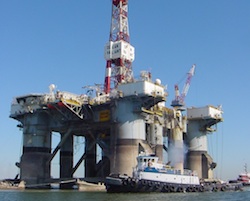
The truth is that the P-36 was a moderately sized semi-submersible oil rig which was
converted for its role in Brazil. it was about 80 meters long and a similar width and
about 50 meters from keel to deck. In common with most semi-submersibles, two pontoons -
separate hulls looking a little like submarines - supported columns which in turn
supported the deck, and the deck housed the mass of equipment required to separate crude
from gas and water. The P-36 had only four columns though they were dimensionally large
and it was in one of these that the explosion, or explosions occurred. It is rumoured that
the first explosion took place in a paint locker and that the casualties were the fire
team sent to deal with the resulting fire. It then appears that further explosions
destroyed the column.
Most modern semi-submersibles are constructed
so that in theory, even if one column ceases to provide buoyancy for any reason, the rig
will remain afloat. To achieve this the connecting hatches or doors between internal
watertight divisions must be kept closed and the apertures at deck level must also remain
closed. It is unlikely that his was the case. It is difficult for the ordinary rig worker
to appreciate that keeping hatches doors and vents closed will be of any benefit. They
will be unable to visualise an event so disastrous that part of the deck of the rig could
be submerged. If they could visualise it they would probably stay at home.
Incidentally the P-36 had one statistic which
counts against it ever being recovered from the seabed, and will ensure that its
replacement will be difficult to connect and position. It was moored in 1360 meters (about
4500 ft ) of water.
TO
RETURN TO FEATURES INDEX CLICK HERE
|