|
THE HELICOPTER ACCIDENT AT CORMORANT A IN 1992
Although written for Safety At
Sea International in 1993 this piece remains of interest to anyone concerned
with the recovery of personnel from the sea.
At 1950 on 14th March 1992 a Bristows Supa Puma with 15 passengers and two crew members
on board took off from the Cormorant Alpha platform and almost immediately crashed into
the sea. Only five passengers and one crew member survived the incident which was the
subject of an investigation by the Air Accident Investigation Branch of the Department of
Transport, and whose report was submitted to the Secretary of State for Transport in April
of this year.
To understand the reasons for the crash and the subsequent events it is necessary to
describe the environment in which the helicopter was working and the relationship between
the various offshore installations in the area.
The reason for the presence of the Supa Puma was due to the very high winds and rough
seas which had initially necessitated that the flotels Safe Gothia and Safe Supporter pull
off from the platforms which they were servicing, respectively Brent Bravo and Cormorant
Alpha. It is normal practice in the event of severe weather for the flotels,
conventionally connected by gangway to the platforms, to pull off to a safe distance, and
for crew changes to be carried out by helicopter. For this purpose there were two Bell
212s in the field on board Safe Gothia but the winds speeds in excess of 50 knots
precluded them engaging their rotors. Therefore Shell requested the use of the Supa Puma
which could operate at higher windspeeds and which would therefore be able to undertake
the shuttle operation.
Supa Puma "GH" as it is designated in the report arrived in the Brent Field
late in the afternoon and commenced the shuttle service. The weather at the time was
extreme, wind speeds of 40 to 50 knots gusting to 60 knots with wave heights up to 13
meters. Occasional snow squalls were blasting through the field making all activities more
difficult. At two locations the aircrew had the Helicopter Landing Officers carry out the
visual inspection of the aircraft normally done by the crew because of the difficulty they
were having getting out of the doors due to the high winds.
The final flight of "GH" commenced shortly before 1950 and was to take
workers from the Cormorant A to the Safe Supporter which was lying some 200 meters ENE of
the platform. The wind at the time was NNW about 45 knots gusting to 55 knots. The
commander chose to lift off from the platform and execute a starboard turn which would
have required the co-pilot to put it down on the flotel. This in his words "would
save a big loop round."
The report indicates that the helicopter took off executed the starboard turn and began
to fly downwind towards the flotel. In executing this manoeuvre it would be effectively
stopped in the air even though it was doing fifty knots over the ground. A helicopter in
forward flight requires much less power than one in the hover mode, a factor which appears
to have been overlooked by the pilot of "GH" due to his concentrating on
attempting to get a visual sighting of the Safe Supporter, and by the co-pilot who was
engaged in communications, initially with the passengers and then with the HLO on the
flotel. As a result neither of the crew appear to have carried out the instrument checks
which would have indicated to them that the aircraft was rapidly losing height, their
first warning being the AVAD chime which told them that the helicopter had reached 100 ft
and was descending. By this time even with the application of maximum power it is possible
that the aircraft would have continued to descend due the existence of the "Vortex
Ring condition," described in the report as "a state where the upflow through
the rotor is approximately the same as the rotor induced downwash, so the tip vortices
cannot move away from the rotor disc and the airflow recirculates round the rotor."
In layman's terms this condition seems to be similar to stalling in a fixed winged
aircraft, though the conditions under which it occurs are unpredictable, and the effect is
difficult to understand since the surfaces creating the lift are rotating and their angle
changing constantly.
The AVAD chimes sounded 3 seconds before impact and the only words spoken thereafter
were those of the co-pilot warning the pilot to watch his height. The passengers received
no warning of the impending disaster and there is no record of them having any knowledge
of the events which were taking place. Indeed for the first 52 seconds of the 55 second
flight everything appeared to be proceeding normally.
After the aircraft hit the water it rapidly adopted a right side down attitude then
became fully inverted before it sank. This appears the have taken only a minute or two,
during which time ten of the passengers and both crew members managed to evacuate from the
helicopter. One of the two liferafts was also deployed, it is assumed by one of the passengers.
The HLO on the deck of the Safe Supporter saw the helicopter arcing downward and ran to
the edge of the helideck by which time it was in the water. He immediately transmitted a
Mayday which was retransmitted by the Viking Approach Air Traffic Control Officer.
The HLO remained on the edge of the Safe Supporter helideck to identify any lifejacket
lights.
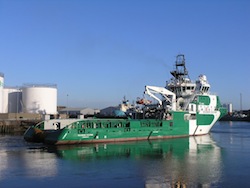
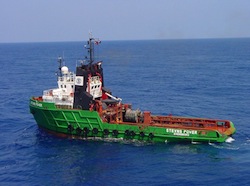
In the field was the Standby vessel Seaboard Support, though some 1 1/2 miles from the
platform rather than close up which is customary for helicopter movements. For reasons
which the report does not identify it had not been told of the flight. In the very heavy
seas it took 15 minutes to reach the scene of the crash, arriving at 2005.
The offshore supply vessels Edda Fram, Star Aries and Far Sleipner arrives at 2018,
2030 and 2110 respectively and the Grampian Monarch the standby vessel assigned to the
North Cormorant also arrived at 2110.
Both SBVs conform to the current code and are fitted with sophisticated davits and
modern fast rescue craft, however due to the weather conditions both Masters decided not
to launch their FRCs, electing to recover survivors at the low freeboard recovery areas
which are part of the required construction of these craft. The supply vessels all have
considerable freeboard which was bound to hamper any rescue efforts on their part.
Three helicopter also joined the rescue efforts, a Bell 212 from the Safe Gothia, a
Bell 214 from StatFjord in the Norwegian sector and an S-61N Coast guard helicopter. They
arrived in the field at 2028, 2059 and 2107.
The first sighting of survivors was made by the Seaboard Support which manoeuvred close
to them to attempt a rescue. They pulled one man aboard over the starboard rescue zone at
2030. He had been in the water for 40 minutes. The second man of the group was briefly
held alongside by the SBV crew but heavy seas wrenched him from their grasp. They threw
lines to the third man but he was unable to help himself and they were unable to recover
him.
The Edda Fram also managed to get close to two men in the water, and threw lines to
them. They also were unable to help themselves. The two men eventually split up and one
was recovered through the ship's pilot door. One of the crew of the Edda Fram jumped into
the water with a rope round his waist and managed to get the second man back to the ship,
however he was unconscious and found to be dead when brought aboard. Although the liferaft
had been damaged after deployment it supported the helicopter commander and two other
survivors.
The Bell 212 from the Safe Gothia located this group but while initial attempts were
being made to rescue them the liferaft overturned and the winchman was knocked unconscious
by the gas bottle. A second winchman recovered the first survivor from the liferaft at
2046 and then the helicopter commander at 2051.
The Bell 212 returned to the Safe Gothia refuelled and returned to the liferaft where
it winched up another survivor at 2115, and the Norwegian Bell 214 picked up a survivor at
2108. The survivor picked up at 2115 was the last passenger to be recovered alive. In all
the rescue vessels and helicopters recovered a total of six survivors and six bodies.
At 1330 on 15th March the MSV Stadive was in position above the reported position of
the crash, and at 1815 the wreckage was located on the seabed in approximately 150 meters
of water. The five bodies in or near the wreckage were recovered at 2300.
All but one of those who failed to evacuate the helicopter appeared to have been in the
process of doing so at the time when it sank. The fifth man was founds with the cord of
the acoustic headset wrapped round his neck, the jackplug of which had become jammed in
the seatback.
In their investigation of the crash the air accident investigation Branch were able to
interview the commander and the other survivors non of whom have a firm recollection of
events before the disaster. They did however have the recording from the cockpit voice
recorder, from which they were able to ascertain that the commander needed to empty his
bladder, and that the co-pilot was having difficulty during the brief period which the
aircraft was in the air, in hearing the pitch and roll report from the Safe Supporter.
They also enlisted the help of Eurocopter (France) and The Defence Research Agency of
Farnborough, both of whom produced mathematical models of the flight, and who concluded
that in addition to the loss of forward speed the helicopter must have suffered from the
Vortex Ring effect or a vertical gust. They also had an assessment of the survival suits
and the lifejackets carried out by the Environmental Sciences Division of the RAF
institute of Aviation Medicine.
The report ends with findings, causes and safety recommendations some of which are
worth reporting in some detail.
Some of the findings were as follows:-
"Weather conditions, including the seastate, at the time of the accident were
severe but not outside the permitted operating envelope of the helicopter."
"There were neither regulations or published criteria of seastates relating to the
viability of search and rescue operations following a helicopter crash or ditching."
"The handling pilot who was also the commander performed a rushed and hazardous
flight manoeuvre which resulted in the crash into the sea. A number of factors including
possibly some frustration and fatigue, may have led him to rush this manoeuvre."
Many of the other finding have already been mentioned in this narrative, particularly
as they relate to the commander's visual search for the Safe Supporter and the co-pilot's
communications with the flotel, both of which activities distracted them from carrying out
proper instrument checks. They also found that about a third of the crew's workload during
the final hour of the helicopters operations were taken up with administration, reducing
the mental effort available for flight planning.
They found the helicopter flotation gear wanting in that manual inflation was the only
option available, and given the nature of the crash this was impractical, and if automatic
inflation had been available the aircraft would have remained afloat longer.
No criticism of the survival suits was expressed though the life-jackets were found
wanting in that they tended to ride up the body and the final paragraph of the findings
reads as follows:-
"Other than aircraft operating limitations there are no regulations concerning
public transport helicopter operations in adverse weather. Since the accident Shell UK
Expro have introduced an adverse weather policy which gives their management guidelines on
the viability of rescue from the sea in adverse weather. This does not affect the
helicopter operators' and aircraft commanders normal responsibilities.
Shell's adverse weather policy is that "no helicopter flying will take place when
the sea state is such that rescues would be hampered. This state is measured using a
combination of wind speed and wave height."
It is obvious from the report that the investigators were concerned that no formal
guidelines exist concerning the operation of helicopters in adverse weather over the sea.
While the helicopter was capable of operating in the conditions which existed, the poor
visibility contributed to the commander's loss of concentration on his instruments, the
high winds contributed to the helicopter's lack of airspeed and the heavy seas made the
rescue extremely difficult.
Therefore, among the recommendations concluding the report they suggest that "The
Health and Safety Commission should address in it's current revue of offshore safety
legislation the need for operators of offshore installations to take into account the
effects of weather conditions on the likely effectiveness of search and rescue
facilities."
There are also a number of recommendations directed specifically at the CAA. These
include a recommendation that a high priority should be given to reducing flight crew
workload, particularly of administrative matters , and that consideration should be given
making it a requirement for helicopters operating over the sea to include a system for the
manual and automatic inflation of emergency flotation equipment.
They also require that a broader look be taken at the whole question of helicopter
safety the complete recommendation reading as follows:-
"The CAA in consultation with the offshore industry and other appropriate bodies
such as the HSE, should re-assess offshore helicopter passenger safety and survivability
in normal operating conditions using the concept of an integrated escape and survival
system in order to promulgate such regulations as are necessary to achieve it; such an
assessment should be made against both controlled ditching and an uncontrolled crash into
the sea where the helicopter inverts and sinks almost immediately."
This last recommendation may allow those in the oil industry who feel that perhaps more
consideration should be given to maximizing the chances of the helicopter's survival after
a crash into the sea, rather than discarding it and relying on the passenger's ability to
evacuate and the efficiency of the survival suits.
It should be remembered that statistically helicopter flights in the North Sea are
becoming safer, and that this is at least in part due to the millions of pounds which the
oil industry has already put into improving the monitoring of on board systems. Shell
undoubtedly spoke for the whole industry in a statement in April when they said
"Shell Expro derives no comfort from the finding that the accident was due to pilot
error," and the recommendations of the report will ensure that the search for
greater safety, reliability and most importantly "survivability" will continue.
Vic Gibson
TO
RETURN TO FEATURES INDEX CLICK HERE
|