|
OFFSHORE TECHNOLOGY AND THE KURSK
Not for the first time has the versatility and
technological capability of the offshore support fleet astounded the military - although
in this case the military were the Russian Navy and their own much more limited capability
was exposed to the world.
It only comes as a surprise to those not
familiar with the offshore oil industry and the demands it places on ships and those
crewing them, that the Navies of the world do not have the same level of technology
available and their personnel often lack the same levels of skill and experience.
Back in the 1970s when the industry in the North
Sea was in its infancy those interested in the level of support which might be provided by
the British merchant service to the Navy were extremely surprised by the
capabilities of the
supply vessel fleet. Even then the average anchor handler had about 7000 bhp available
which was the same power as that provided for a medium sized merchant ship. They could
hover on the spot for moderate periods of time and move in any direction at will, and they
had a range which would allow them to steam to the other side of the world without
refuelling.
In 1982 a number of support vessels went to the
Falklands either with the Navy or immediately after the war. Most noteworthy was the Stena
Seaspread, a diving and maintenance vessel which was taken to the Falklands to act as a
floating workshop for the warships. Its manoeuvrability was such that it is rumoured that
the warships stayed still and then the Stena Seaspread would move alongside and its
workshops and cranage were a revelation to the military. Admiralty pattern moorings were
also required for the fleet in Stanley Harbour a task which took an admiralty mooring
vessel several weeks to complete back home. The Wimpey Seahorse an 8000 horsepower
anchor-handler laid moorings in hours instead of days, amazing everybody. The admiralty
bought a few old Seaforth ships for training purposes and commissioned their own diving
ship, but it seems that neither of these projects was successful, which some attribute to
communication difficulties between the officers and the crew.
The Seaway Eagle, which we believe was
originally a cable ship, has even greater capabilities than the Stena Seaspread, and
modern positioning systems allow these craft to use GPS and place themselves within a few
meters of any position on the earth's surface.
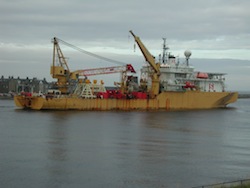 |
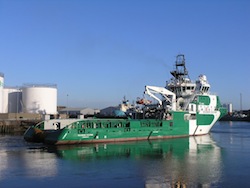
The Seaway Eagle was, we believe, origin-
ally built as a cable laying vessel which accounts for the strange bow shape. In this
picture the large construction crane can be seen. The moonpool from which the diving bell
is deployed is in the centre of the ship. This minimises the effects of the sea and swell.
The helideck is in front of the bridge on top of the accommodation.
|
Since the working limit for air divers is about
100 ft, almost all diving ships are provided with a hyper-baric habitat in which up to 12
divers can live under pressure for a considerable time. This allows on-shift divers to
work on the seabed and those off shift to rest without the problems associated with
decompression. For the Seaway Eagle placing three divers on the seabed in a precise
location and putting them to work was easy.
A more modern addition to the armoury of
offshore subsea equipment is the ROV - remotely operated vehicle - which is a small
submarine provided with thrusters and with a camera and in many cases manipulators, to
allow it to do work. ROVs are operated from the mother ships by pilots The Seaway
Eagle
has at least one of these, and it is thanks to the ROV hovering close to the divers that
the pictures of them at work on the escape hatch were available. It also looked as if the
ROV was used to release the hatch and it is most probable that once the special tool was
made for the hatch valve, it was the ROV which transported it from the surface to the
divers waiting below.
| Unfortunately lost this picture in the
change of format, and no longer have the drawing
programme to replace it. That's life on the
internet! |
This diagram hopefully shows the
relationship between the ship and the divers and the ROV. The diving bell hangs directly
beneath the mother vessel. It has an internal hatch which ensures that the pressure is
stable regardless of depth.
One diver
remains inside the bell and looks after the umbilicals to the others. These contain
breathing gas, communications and suit heating. Two divers are at work. They stay down for
several hours at a time.
The ROV is also connected to an umbilical directly back
to the mother ship. This is not a unique capability. There are possibly dozens of ships
capable of providing this precise service.
|
It seems from the reports in the press that no
matter when the Seaway Eagle had arrived after the first couple of days there would have
been nothing she and her divers could have done, and one assumes that even if they had
been successful in fixing the hatch, the submarine being carried on the Normand
Pioneer
would still have been required. One must hope that if there is ever a next time, the
Russians will be more concerned for the saving of lives than the saving of face.
TO
RETURN TO FEATURES INDEX CLICK HERE |