|
PREVENTING FIRES AND
EXPLOSIONS ON OFFSHORE INSTALLATIONS
The explosion and fire on
the semi-submersible drilling rig “Deepwater Horizon” on
Tuesday 20th April 2010, with the loss of 11 lives, and
its subsequent capsize and sinking, has prompted me to
write something about the manner in which jobs of this
sort are usually carried out, and how the related risks
are minimised. Of course we have no idea what went wrong
on the rig, but almost certainly there was a leak of
hydrocarbons from the well which ignited at deck level
What follows is not intended to suggest what might have
gone wrong on the rig. It just provides some information
for those who have an interest, but who do not have
detailed knowledge of the work.
Those who have followed the
content of my website, www.shipsandoil.com over the
years will be aware that in a previous life I was a
safety consultant and technical author with a marine
background, and part of what I used to do was to assist
my clients to develop safety cases for mobile drilling
units. I started doing this work in 1993, five years
after Piper Alpha, and have only recently given it up,
but of course I have retained much of what I have
learnt.
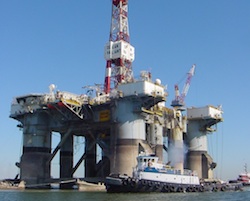
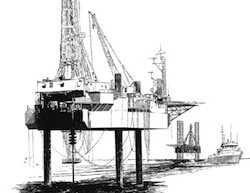
Maybe the first thing is to
identify different types of offshore installation. There
are platforms are nailed to the seabed and which stand
up on their legs above the waves, there are jack-ups
which are used for drilling the holes and which stand
above the waves on legs, but which can be lowered into
the sea until they float and then moved from one place
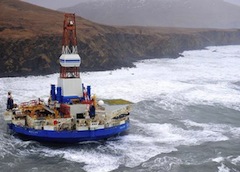
to another. And then there are semi-submersibles which
float on pontoons. The pontoons can be submerged when
they are drilling, to provide a stable platform, so that
the vertical columns and the decks on top of them are
visible, which prompts many journalists to describe them
as if they are some-how standing on the seabed.
Semi-submersibles can be anchored or dynamically
positioned, using thrusters. There are also drill ships
which look like large tankers which are also usually
dynamically positioned. It is conventional for the
dynamically positioned vessels to drill in deep water,
although rigs have been anchored in water depths of 3000
metres (Nearly 10,000 ft).
Strangely these
exploration rigs have the task of probing the earth’s
crust in the hope of locating a sufficiently large
deposit of hydrocarbons, oil, gas or a mixture of the
two, to make it worthwhile bringing it to the surface.
But oil and gas under pressure is dangerous stuff, so
they have to be able to drill into a reservoir while at
the same time keeping it under control. I’m sure we have
all seen film, either real or fictitious, of a wooden
drilling rig being engulfed in a fountain of oil and
people rushing about throwing their hats in to the air.
They had found oil, but had as yet not found a way of
containing it. There are also pockets of gas near the
surface which should be avoided as far as possible, and
ideally this is done by carrying out surveys to locate
them, and then putting the rig at a distance from them.
It is also necessary to
emphasise the difference between drilling rigs and
production platforms. Production platforms are usually
collecting points for the hydrocarbons from a number of
wells. The oil is processed and then pumped on, either
to the shore or to some other storage facility. Of
course on a production platform there is always a
quantity of hydrocarbons, the inventory, being processed
and there is therefore the possibility of a leak in the
pipework or in some form of containment. This was the
case in Piper Alpha. On a drilling rig, in ideal
circumstances, the only time there are hydrocarbons
(well fluids) at deck level is during well testing.
 Without
going into too much detail, the rig is connected to the
seabed by a large diameter pipe, known as the riser, and
at the bottom of this is the blowout preventer. The well
is drilled through this, and the resulting hole, and the
riser is filled with drilling fluid which is known in
the business as “mud”. The mud is the first line in
defence against the pressure in the reservoir. The fluid
is a mixture of chemicals, based on water or a form of
oil and is weighted with the mineral baryte. The whole
business of dealing with mud is a science in itself and
the weight must be just right, heavy enough to keep the
oil down there, but not so heavy that it fractures the
formation and disappears into the ground. Without
going into too much detail, the rig is connected to the
seabed by a large diameter pipe, known as the riser, and
at the bottom of this is the blowout preventer. The well
is drilled through this, and the resulting hole, and the
riser is filled with drilling fluid which is known in
the business as “mud”. The mud is the first line in
defence against the pressure in the reservoir. The fluid
is a mixture of chemicals, based on water or a form of
oil and is weighted with the mineral baryte. The whole
business of dealing with mud is a science in itself and
the weight must be just right, heavy enough to keep the
oil down there, but not so heavy that it fractures the
formation and disappears into the ground.
Of course it is possible
that the pressure in the reservoir will exceed the
hydrostatic head provided by the mud and so the drillers
may find the mud coming back up the hole. That or some
other sign, often known as a “kick” will result in the
activation of the blowout preventer (BOP). You will
remember that the BOP is installed at the seabed on the
top of the well, and at the bottom of the riser. The BOP
is an enormous lump of steel about fifty feet high and
weighing up to 150 tonnes. It contains a number of rams
of different sorts which can either encircle the pipe
passing through, or else in extremis cut the pipe.
Picture taken from the
first edition of "Supply Ship Operations" showing the
relationship between the rig, the riser and the blowout
preventer.
In the first case the pipe
can be encircled and the well isolated, but work can
still be done on the well. Heavier mud can be pumped
down the drill string and control be regained. However
if it seems that control will be lost the pipe can be
cut and the well completely isolated. Of course once
this is done, getting things sorted out is a complex
operation, but everyone remains safe.
This is a description in
the simplest possible terms, and there are other
circumstances where gas or oil can get to the surface
during the drilling operation, and in order to minimise
the possibility of this being ignited much of the
equipment on the deck of the rig is constructed in a way
which will minimise the possibility of ignition. There
are gas detectors positioned in all the most important
areas and these are usually monitored from the control
room. If gas is detected then things can be done, and
finally if it seems that all control will be lost it is
possible to get everyone into the lifeboats and to
evacuate the rig.
There have been many
blowouts over the years all over the world, but only a
few of them have been investigated in a way which has
resulted in the findings being available in the public
domain. Hence those helping with the development of
emergency procedures, and providing guidance for the
guys out there, have only a limited amount of
information available, and it may be that there are
still new situations which are unaddressed. It is also
true that different legislations have different
approaches to the whole business.
After Piper Alpha and the
resulting public enquiry, the whole process of offshore
safety in the UK was put in the hands of the Health and
Safety Executive, with the requirement that all offshore
installations including drilling rigs be provided with a
safety case. There is no doubt that Lord Cullen’s intent
in recommending the safety case regime was well
intentioned, with the idea of making complex structures
and activities more transparent, but even after 15 years
it is still a work in progress.
So, keeping people safe
offshore is still a difficult business. The guys out
there are at sea, and have lots of other stuff to
contend with. For me just being at sea was difficult
enough.
Vic Gibson
April 2010
TO
RETURN TO FEATURES INDEX CLICK HERE
|