|
PFEER AND
THE DACON SCOOP
This was a
contribution to the Nautical Institute magazine, Seaways,
prompted by a lot of news coverage about BALPA and the Dacon
Scoop.
At the 2009 Scottish TUC
conference, BALPA (The British Airline Pilot’s Association)
put forward a motion that the Dacon Scoop or other form of
mechanical recovery should not be the primary means of
recovery in all sea states if a helicopter ditches. This
approach was supported by Nautilus whose representative said
that “concerns over the potential for commercial pressures
to be placed on pilots or shipmasters to operate helicopters
or fast rescue craft in adverse conditions lie behind the
questions over the existing arrangements.”
Of course
people actually involved in this stuff know what it is all
about, but mariners who are working in non-oil related
activities, or in areas other than the North Sea may be
wondering what on earth is going on.
In order to
provide an understandable explanation it is necessary to
briefly cover the history of the standby vessel in the UK.
The requirement for these craft was initiated subsequent to
the loss of the jack-up Sea Gem in 1965, as part of the
Mineral Working Act, and as a result in the following years
redundant “side draggers”, the traditional deep sea
trawlers, could be seen drifting about on the location of
all North Sea installations. After the Piper Alpha disaster
its standby vessel, the “Silver Pit” was identified by Lord
Cullen’s enquiry as not being up to the task, and in the
years which followed the industry itself developed something
called “The Green Code” which set survey standards for the
standby fleet. As a direct result all the old trawlers
disappeared and were replaced by more manoeuvrable craft,
mainly old supply vessels. In 1992 the problems relating to
the recovery of personnel from the water in rough seas were
highlighted at Cormorant Alpha, when a helicopter engaged in
transferring personnel from the platform to an accommodation
unit fell into the sea with the loss of 11 lives. The master
of the assigned standby vessel Seaboard Support and the
master of the standby vessel from North Cormorant, Grampian
Monarch, considered that the weather was too rough for them
to launch their fast rescue craft, even though both vessels
were provided with modern launch and recovery equipment and
both conformed fully with the “Green Code”. It also became
evident that even though they were able to manoeuvre close
to some of the survivors, the men in the water were unable
to help themselves, and despite all efforts they drifted
away into the darkness.
In time the
voluntary code was replaced with formal survey requirements
and activities, administered and carried out in the UK by
the MCA (Marine and Coastguard Agency) In later years in an
effort to improve their status the ships were re-named ERRVs
(Emergency Response and Rescue Vessels), but although the
acronym is used formally everywhere, it has never really
caught on and they are generally still referred to as
“standby vessels”.
Of course
Piper Alpha also resulted in the initiation of the UK Safety
Case Regulations in 1995 and soon after, in the enactment of
the PFEER Regulations (The Prevention of Fire and Explosion
and Emergency Response) Regulations, and DCR (the Design and
Construction Regulations). The latter regulations remain in
place today in exactly the same form even though the Safety
Case Regulations themselves were revised and re-issued in
2006.
The PFEER
Regulations and DCR make up what is to most an obscure area
of the UK offshore legislation – that is, even more obscure
than the Safety Case Regulations. The results of these
different bits of legislation are the PFEER Assessment and
the Verification Scheme, and the development of performance
standards for activities and equipment. It appears to
outsiders that the intent of the PFEER was to capture the
bits of the former regulations which determined things such
as the number of lifeboats, and the presence of a standby
vessel, but which had been lost at the inception of the
Safety Case Regs and the arrival of goal setting standards.
Regulation 4
of the PFEER Regulations requires that:
1. The
duty holder shall take appropriate measures with a view to:
(a) protecting persons on the Installation from fire and
explosion; and (b) securing effective emergency response.
The guidance
to the regulation states that “protecting persons from fire
and explosion” covers all the measures that may be needed to
safeguard people from fire and explosions, i.e. inherent
safety by design, preventive, detection, control and
mitigation measures. Some of these “measures” might be
covered by the presence of the standby vessel which would be
in a position to rescue personnel from lifeboats or the sea
in the event of evacuation or escape.
Regulation 17
goes further, specifically covering the arrangements for
recovery and rescue of persons subsequent to evacuation or
escape from the Installation, rescue of persons near the
Installation and the taking of all such persons to a place
of safety. The guidance for this regulation effectively adds
to the list of major accidents requiring to be addressed
specifically: (i) A person falling from the Installation
during overside working and (ii) A helicopter ditching in
the sea on take-off or landing.
Since this is
a “goal setting” regulation it is up to the duty-holder of
the installation to which the safety case is applied, to
minimise the risks to their personnel, from major accidents
and in the event of such accidents occurring, to maximise
the possibility of them being recovered safe and well to “a
place of safety”. And it is necessary here to add that the
safety case regulations only apply within the 500 metre
safety zone surrounding offshore installations, which
effectively means that the risks considered in relation to
helicopters are those which are present during take off and
landing at oil rigs.

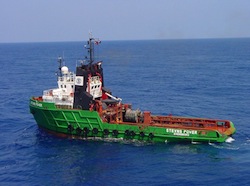
A typical
North Sea ERRV on its way to work.
So where does
the Dacon Scoop come in – and – you may ask, what is it
anyway? In considering the risks from helicopter travel,
specifically those relating to landing and take off, if the
helicopter falls into the sea it must be possible for the
passengers, who have hopefully escaped from the aircraft, to
be rescued and taken to a place of safety within the time
frame which is defined by the protective qualities of their
survival suits and of course the temperature of the water.
The means of rescue does not have to be a ship, but up to
now it always has been.
BP made a
specific effort to move away from the conventional approach
with its Jigsaw project back in 2000, proposing that a
helicopter service, supported by platform based rescue craft
,would produce the same results as the seventeen standby
vessels it then employed. Eventually the seventeen ships
were replaced by two helicopters and four very large vessels
which carry ARRCs (Autonomous Recovery Rescue Craft),
themselves sufficiently well found to reach the beach from
any point in the North Sea under their own steam.
The rest of
the North Sea operators have struggled on with – their Dacon
Scoops. Because the PFEER regulations are goal setting in
part, it is necessary for the operators of offshore
installations to be able to demonstrate that in almost
all circumstances it is possible for the standby vessel
to carry out an effective rescue in the event of a major
accident or a person falling into the sea, or a helicopter
crashing within the 500 metre safety zone. In fine weather
this may not be difficult. The research that has been
carried out seems to indicate that a protective flight suit
with the addition of a number of layers of clothing beneath
will keep a person in the water alive for two hours. Like
duvet covers, flight suits have a “clo” rating and the
objective is therefore to provide personnel with a suit with
a clo rating of 1, which will keep some-one alive
indefinitely.
Operators of
multiple installations close together use the figure of two
hours as a means of justifying “ERRV sharing” where a single
vessel may look after several rigs. These ships are usually
provided with daughter craft which can be launched to stand
by one installation while the mother craft stands by
another. This is particularly useful during helicopter
flights where the helicopter lands at both installations.
So far so
good, but when the weather turns nasty everything changes.
It has become more or less the norm that in sea states
greater than three and a half metres no-one will launch
their fast rescue craft – well almost no-one - not because
they are difficult to launch, but because they are difficult
to recover. But according to the PFEER Regulations, if a
helicopter crashes into the sea, some means of recovery
should be provided, or else the flight should not take
place. And while the simple answer would be to discontinue
flights in higher sea states, this would result in complete
chaos in Aberdeen airport, where hundreds of offshore
workers are transferred one way or the other every day.
So the
question of how to recover survivors of a helicopter crash
from the sea in adverse conditions, is answered by the Dacon
Scoop. The device is hung over the side of the ship on a
crane and the ship is manoeuvred close to the floating
survivor who is collected in the scoop. So –problem solved.
Of course in order to demonstrate that all this stuff works,
each standby vessel has to carry out validation trials
showing that it can launch its FRC and recover people from
the water within the time required by the performance
standards, all of which rely in one way or another on the
theoretical survival time of two hours. It also needs to
demonstrate that its Dacon Scoop or other mechanical
recovery device can carry out the task, and because no-one
wants to be doing this work in adverse conditions it is
necessary for the surveyors overseeing the trials to
extrapolate the results to demonstrate that if it had been
rougher, success would still have been achieved. So as far
as the helicopter pilots are concerned this device has yet
to prove itself in action, and even in trials the weather
conditions under which it is tested are not actually those
in which it is intended to be used.
But Dacon
Scoop is not the only way. One of the alternatives is the
Jigsaw vessel, and its ARRC. Since it is not necessary to
recover the ARRCs they can be launched more unpleasant
conditions than the standard FRCs, and once having rescued
the personnel in the water they can set course for the
beach. Another possible technique is that used by the Danish
ERRV operator Esvagt, although not in the UK sector of the
North Sea. Esvagt have approached the task in their own way,
and have developed FRCs and launch/recovery systems which
can be operated in very rough seas. They demonstrate this
capability by carrying out their crew changes by FRC in
virtually any weather conditions. It may come as something
of a surprise that what prevents the technique from being
used in the UK waters is health and safety legislation.
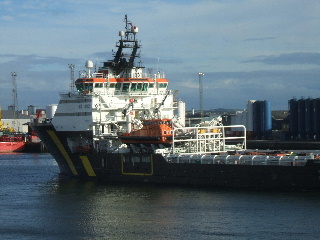
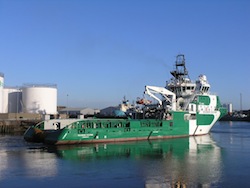
One of the
Vector Jigsaw vessels with it's ARRC visible on the port
side.
The thrust of
BALPA’s motion would therefore appear to be to reduce the
reliance on the Dacon Scoop as rescue means in adverse
conditions, but it is difficult to see whether they would
like an alternative to be made available or whether they
would like to fly only in more benign conditions, and it may
be worth remembering that this device would only be useful
in any case, if the helicopter crashed into the sea in the
immediate vicinity of an offshore installation. One of the
two helicopter crashes, which occurred earlier this year,
happened while it was on passage, and if the preliminary
report from the AAIB was correct there was a catastrophic
gearbox failure, which might have resulted in the rotor
detaching. One assumes that it just plummeted into the sea.
All the passengers and crew died. In fact more helicopter
crashes occur while the aircraft are en route than when they
are taking off or landing, and if one factors in the weather
conditions which would be required for the Dacon Scoop to be
needed one can see that it is only carried because in PFEER
terms, a crash during landing or take-off is a “foreseeable
event”, rather than being statistically likely.
Back in 1992,
after the Cormorant Alpha crash, the AAIB recommended that
some effort should be made to prevent helicopters inverting
when they hit the water, but no progress has been made in
this direction. Hence offshore personnel still have to
undergo the frightening experience of taking part in a
helicopter escape, which requires them to remain strapped
into a helicopter body while it turns upside down in the
training pool, before releasing themselves and swimming to
the surface. Many would think that if the aircraft were
provided with sufficient buoyancy to keep them on the
surface, the chances of rescue in the event of a crash would
be enhanced. Research in this direction might be more
rewarding than putting more time and money into finding an
alternative to the Dacon Scoop, which would appear to be
inevitable if BALPA have their way.
Vic Gibson
TO
RETURN TO FEATURES INDEX CLICK HERE |