|
THE LIFE OF THE OIL MARINER
"Just after the Falklands war the then
middle aged anchor handler Oil Mariner departed for the Falklands to work for the MOD. At
the time of this update of on our web page (Feb 2000) she is still there. There
follows an article written in 1992 describing her life over the first ten years. It was
intended for inclusion in a magazine which went out of business before publication. The
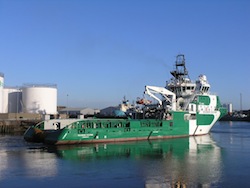
ship was known in the Falklands as the Black Pig. For a picture is of the ship in its
previous life as a North Sea anchor handler look here.
Well, that was the intended introduction.
The joy of the web is that what is written can remain current. it could almost be called
living history. We received an email from the former Chief Engineer of the Oil Mariner,
Jim McLaren who spent 11 years down there with the old ship and in that time developed a
great affection for the islands and the environment. He had several thing to say about the
article, the main one being that the Oil Mariner was never known as "The Black
Pig." The Black Pig was a former Argentinean Supply Vessel, impounded at the end of
the war and subsequently traded with little success in the area.
Jim also says that the Oil Mariner is now laid
up in New Orleans, and we learn from the Seabrokers report that the MOD have hired a
replacement in the form of the Seabulk Condor an old UT704 (A view of the next feature
would tell you that the Seabulk Condor was built in 1975 and used to be the Stad
Scotsman). Time will tell whether the MOD come to regret this action.
Meanwhile here is the original article still
with the same name - well it just sounds good! And if anyone wants to have a look
at more photographs of the Oil Mariner and its work in the Falklands they can visit Jim
McLaren's site. www.jim-mclaren.co.uk
THE VOYAGE OF THE BLACK PIG.
It is now ten years since the Falklands War. The campaign made military history,
the invasion forces sailing from the UK in numbers of British Merchant vessels, and
supported by container and cargo ships. Some of these STUFT vessels, Ships Taken Up From
Trade, became household names, the Canberra, the Uganda, the Stena Seaspread and the
unfortunate Atlantic Conveyor. Numerous other ships, ferries, cargo ships and offshore
support vessels, were known only to fellow British mariners who followed their progress,
their movements detected from occasional mentions in the subtext of news reports, and
technical data in the maritime press.
After the war the major units of the fleet sailed home, to be greeted euphorically by
the British public. However they left a garrison together with both sea and air cover on
the islands, which necessarily had to be maintained and supplied, and to assist with this
activity other STUFTs were chartered.
The MOD had been impressed with the versatility of the North Sea supply vessel, one or
two of which had been employed in a variety of rolls in the aftermath of the conflict. So
they invited tenders from supply vessel owners for a craft capable of maintaining
moorings, towing, assisting with berthing, carrying personnel, fuelling and watering other
vessels and anything else they might think of at the time. The contract was won by the OIL
anchor-handler Oil Mariner in 1983, and, some nine years later, she is still there, still
being called upon to do anything and everything, and accepting that her nickname,
"The Black Pig" has been conferred on her more from affection than antipathy.
The Oil Mariner was built at Ysselwerf in Holland in 1974, and was at the time a state
of the art North Sea supply vessel. She is powered by two English Electric Diesels giving
a total of 6700 BHP. For nine years she worked for a number of the major operators
including BP, Burmah, Texaco and others, supplying semi-submersibles and carrying out
anchor-handling operations. By today's standards she has no freeboard, her working deck is
small, her tailgate which allows the tow wire to traverse is insubstantial and her
hydraulic anchor and towing winch is painfully slow in operation. Like the majority of
British supply vessel designs of the time, the engines drive fixed pitch propellers via
clutches and gearboxes and the bow thruster is a five ton Gill Jet.
Also in line with the fashion of the time is her slim accommodation block rising out of
the forecastle, providing cramped cabins for the officers. On the main deck, in the
limited space left around the winch are the remainder of the crew cabins, two small
messrooms and the galley. During anchor-handling operations the whole area rumbles and
pulsates to the sound of the hydraulic motors which drive the winch, and the Caterpillar
diesel which drives the thruster. On the bridge there is just room at the aft end for a
seat for the driver to operate the controls, the Chief Engineer being banished to a tiny
deckhouse ahead of the winch from which he operates the work and tow drums.
Before taking up the charter the ship had it's distinctive sharp bow blunted and fitted
with rubber fendering, to allow her to push as well as pull. Later a hydraulic crane and
an A-frame were to be added.
Captain Stuart Mackay was appointed Master for the first tour of the new charter, and
it was his first task to get her to the Falklands. He joined the ship in April 1983 in
Portsmouth and found her lying alongside a small river tanker, the "Cubus". It
turned out that the Mariner was to tow this craft out to the islands where it was to be
employed as a back-up unit for the storage of aviation fuel.
The ship set sail, with the tanker in tow on 22nd April and the voyage proceeded
without major incident, apart from a tendency for the auto-pilot to signal hard aport at
erratic intervals for no apparent reason. They arrived at Ascension where they anchored on
16th May. Here they repaired the sterngate which had suffered severe chaffing from the tow
wire as a result of the frequent unplanned changes of heading. The means of making this
repair was to build up the gate with weld metal, an operation which used up all the heavy
duty welding rods on the island.
On inspection the tanker's pump room was found to be flooded due to a leaking vent on
the deck, and this was plugged with cement before the resumption of the voyage. The
satellite communication system had also become inoperative and spares were rapidly flown
out to the island from UK.
Once these repairs had been completed the voyage was resumed, but on 26th May the tow
parted in heavy seas, and it was two days before reconnection could be achieved. The
tanker was unmanned and unpowered, and it was necessary for men to be landed on it to
recover the bridle which was hanging in the water. The Captain could only watch with bated
breath as the Mate, Bob Hockham, hung over the bow, alternately being lifted high into the
air and then completely submerged as the tanker pitched in the long Atlantic swell. It was
some relief that the tow was eventually reconnected, the boarding party recovered, and
the voyage resumed.
By this time the weather was worsening and the tug and tow were being continually
lashed by high seas. Three days late the tow parted again and had to be reconnected. In a
latitude of 46S part of the bridle broke, but the remainder held, allowing the voyage to
continue by now under overcast skies, giving no opportunity for sights.
In a latitude of 51 degrees South the tow parted again, which by the ship's dead
reckoning was only 68 miles short of the islands, and 7590 miles into the voyage. There
was no fuel remaining for the inflatable boat to allow transfer of men to the tow, so
there was no alternative but to call the islands. The United Towing tug Salvageman was
sent out to help. The Salvageman captured the tanker after six days, and the Oil Mariner
went on to the Falklands where it arrived on 21st June after a voyage of 59 days.
Once in Port Stanley the Mariner received a signal from the Chief of Staff. It read
" I have followed your epic journey with much interest. The last leg, running before
a force nine gale with a port list on the lighter looked particularly hairy. But you coped
admirably, as you have done throughout your 59 day passage. Your calm professionalism and
good seamanship is a credit to the Merchant Navy. Well Done."
Once in the Falklands the ship commenced with it's new duties. They were far removed
from what the crew had been used to. Initially it fuelled the warships in Port Stanley and
San Carlos, and collected rubbish from the vessels at anchor. This was a thoroughly
unsophisticated operation, consisting of filling the deck through chutes from the larger
vessels, and then taking the resultant pile of ordure out into deep water for disposal. To
carry out the latter part of the task squads of soldiers with shovels were recruited.
The ship was also used to dispose of much of the debris left from the war. Derelict
armour and crumpled pieces of airplane all slid gently over the stern roller and
disappeared beneath the waves, as did containers full of small arms, and finally tons of
out of date ordnance. These were spectacularly detonated, to cause water spouts hundreds
of feet high.
They were also engaged to take containers of aggregates out to the West Islands where a
long range radar station was being constructed. On arrival they would go alongside the
Ocean Fleets "Lycaon" in Albermarle Harbour. The larger vessel would crane the
containers off the supply ship onto her helideck, after which Chinooks would skyhook them
to the top of the mountain.
Since there was very little in the way of recreation for the military the Mariner was
also engaged to carry out cruises with small groups of soldiers to places of interest
including the outlying settlements. The then Governor-General and his wife also took the
opportunity of taking part in one of these cruises.
The Mariner was also the official conveyance of the Queen's Harbour Master when he
needed to go round the Russian and Polish trawler fleets to collect harbour dues, and was
further involved with these large factory trawlers when they called for assistance due to
injuries to the crew. Stewart Mackay well remembers bringing in a badly injured Russian
seaman in the early hours of the morning, and the sadness felt by the whole crew when they
later found that he had died. Although the tasks involving the Eastern block trawler fleet
tailed off as the Falkland Islands council began to carry out their own administration
using new and sophisticated harbour launches, in 1988 the Mariner was called to the aid of
a Polish cargo ship, helping three Polish fishing vessels fight the blaze for ten hours.
Despite their efforts four Polish crew members died in the blaze.
A high, or low, point, depending on which way you look at it was target towing. For
this operation a gunnery observation crew was embarked on the ship which then went to sea
towing a target a quarter of a mile astern. From some far distant point the warships
loosed off salvoes of shells, and the positions of the waterspouts were relayed back by
the observation crew. The crew of the Mariner took no comfort from the fact that they
themselves were the aiming point for these exercises.
During this time crew changes were a long business. Not for the Mariner's staff a quick
flight to Aberdeen and a taxi ride to the harbour. They embarked on a VC10 from RAF Brize
Norton and then caught the Uganda for the nine day voyage from Ascension to the islands.
The crew being relieved them made the same journey in the opposite direction. Captain John
Rankin, still one of the Masters of the ship describes those early journeys. "The
enforced cruise without input or comment concerning the passage became the worst element
of those early tours, despite the hospitality of the RFA and MN personnel." Today, as
do many ship's crews the world over, they board a big jet and stagger out many hours
later, having glimpsed their ship as the aircraft descends to the new Falklands airport.
At the end of 1983 the Mariner was involved in setting up the Falkland Islands Port and
Storage System or FIPASS. To make the port six North Sea barges were sent out on a
submersible ship, floated off and towed into position. They were then secured to piles and
linked to the shore by a causeway. This essentially temporary port is still in position
and one of the Mariner's duties is to assist vessels to berth alongside it and to leave
it.
During 1985 she assisted in the positioning of an SPM, installed so that the variety of
STUFT storage tankers employed since the war, would no longer be necessary, and of course,
once the SPM was in position it became one of her tasks to carry out the usual assisting
role. Preparing hoses, passing lines and generally nursing the calling tanker through all
the problems of mooring to an offshore buoy. In addition, due to concerns about possible
pollution from the offshore facility the ship was equipped with skimmers, booms.
dispersant and spaying equipment, and the Masters were sent on an anti-pollution course.
As well as all the other duties so far described the Oil Mariner has a primary function
to maintain the Admiralty Moorings which are scattered round the various sheltered waters
in the Shetlands, and also at South Georgia. Most of us have probably glanced through the
Admiralty Manual of Seamanship in the past, and will dimly recollect the diagrams of the
various types of mooring available. At the outset of the charter both the Masters were to
spend time at the Admiralty Moorings School at Rosyth and had these dim recollections
turned into live knowledge which they were to use to advantage in subsequent years.
The annual voyage to South Georgia takes place during the Southern summer, and the
Mariner checks and repairs the moorings at Grytviken, at Leith Harbour with its derelict
whaling stations - the scene of the first British/Argentinean confrontation - and at
Stromness. On these voyages the ship must cope with massive sections of Antarctic ice
which drift casually about, released by the warmer weather, and with totally unpredictable
winds which can whip up to gale force in minutes, from any direction, and which bring with
them hail or snow storms which can reduce visibility to zero.
In December 1990 the RFA support vessel Gold Rover had the misfortune to lose it's
rudder, and it was decided that the Oil Mariner should tow it to Montevideo for repairs.
Apart from being already on charter to the MoD she was by far the closest tug of any size
to the location of the damaged vessel, though those in charge of the operation appear to
have looked longingly at higher horse-power vessels which would have cost large sums to
relocate. This, it seems, is a sign of the times. In the 1970s in the North Sea hundreds
of rig moves were made using under 8000 BHP in a single hull. Today the operators and
insurers appear to be unhappy with less than 20,000 BHP divided between two ships.
However, back to the Gold Rover. Suitably moderate weather conditions to allow the tug
and tow to clear the islands without incident were predicted for 29th November, so, at
1010, with the Alexander Towing tug "Indomitable" at the stern the tow
commenced.
Once in clear water the Indomitable was released, and the two vessels began to react to
each other in their new relationship. Despite the fact that the Gold Rover had streamed a
drogue buoy on five to six shackles of her stern anchor cable, she still sat well out on
the quarter from the Mariner. This is a familiar situation for all tug-masters. The wire
trails away over the quarter, and every-one is forced to adjust to the tow being somewhere
other than behind the towing vessel, where logic dictates that it should be. On 2nd
December in increasingly strong stern winds the Gold Rover began to shear from one quarter
to the other. In view of this situation John Rankin, the Master at the time, hove too
overnight and continued the following day.
The voyage continued without incident and the tow was anchored off the River Plate on
8th December. The Mariner restored the Gold Rover's stern anchor and waited for the
Uruguayan Naval vessels which were to take over the operation.
The following day they arrived and quickly decided that it would be better for the
Mariner to take the Gold Rover further up the river, to a point where the harbour tugs
could take over. Eventually at 2100 on Sunday the Gold Rover anchored once more, and the
Mariner was released to return to the Falklands. She arrived on 14th December, the crew
deriving immense satisfaction from the completion a the job, for which they had appeared
to be anything but first choice.
Those familiar with North Sea supply vessels may find it surprising that the ship has
operated successfully without major mechanical problems in such a distant and isolated part of the world.
This success is in part due to the military air bridge between Brise Norton and
Stanley, in part due to the reliability of the ship's plant, and in part due to the
extremely long service of some of the ship's staff, who have become totally familiar with
all her idiosyncrasies. She is administered from OILs Marine Operations Office in
Aberdeen, but only a few of those working there remember the ship leaving the UK. Hence,
in the last nine years she has only been actually seen by the Superintendents who conduct
occasional inspection visits in the Falklands, and supervise the drydockings carried out
every two to three years in South America.
These have taken place in Montevideo apart from the last one which was carried out at
Punta Arenas. As long as groups of huts on the Antarctic subcontinent are discounted, this
is the Southernmost port in the world. The Punta Arenas drydock was the occasion of the
ship's third special Lloyds survey which it passed with flying colours, and also for a
complete rebuild of the English Electric prime movers. These compact V16s, which it is
rumoured were originally developed to power railway engines, had done a few more hours
than is recommended before carrying out this task. In fact, 38,000 more, so there was some
concern at what would be found when they were taken to bits. No-one need have worried.
Internal wear was minimal, and after the refurbishment the engines are considered to be
good as new.
After the completion of this major overhaul the ship returned to the Falklands and
resumed her normal duties. She went down to South Georgia in the Southern summer and
checked out the Admiralty moorings, and she continued to fuel the visiting warships and
the Castle Class Patrol Vessel.
Today she is still working there, berthing and unberthing passing National
Environmental Research Council Vessels, assisting the Maersk Gannet and the Grey Rover to
become attached to the SPM, supporting a variety of diving operations, acting as a crane
vessel for small craft, berthing the weekly container ship and acting as a hostile for
simulated missile attacks. Her job remains that of doing whatever there is to be done, and
so far nothing has proved beyond her.
The MoD are almost certainly planning the summer moorings programme for 1993, the OIL
management is probably planning for the next special survey in Punta Arenas in about 1997,
and the ship's Masters are vaguely considering their retirement in about 2002. Beyond that
who knows, but it seems that as long as the British remain in the Falklands the Black Pig
will be pottering about helping them out.
Vic Gibson
TO
RETURN TO FEATURES INDEX CLICK HERE
|