|
THE COSTA CONCORDIA REPORT.
Time flies and it is now
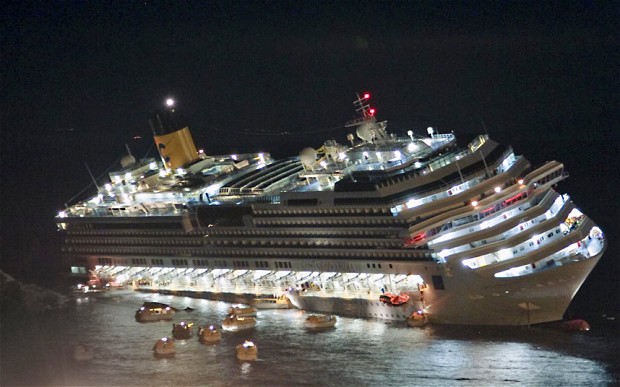
eighteen months since the Costa Concordia disaster. And the
other day the report by the Italian Marine Casualties
Investigative Body was released. One assumes that it must
have appeared in Italian and then translated into English.
Now I don’t speak Italian so why should I expect the report
to be published in English? Well, as far as I know English
is the generally accepted international marine language, and
more of that later. However the report has been translated
into a version of the language which makes the result at
best obscure. Indeed I wondered if they had used Google, but
surely it is a bit too technical for that. The result of
this translation is that the report in some areas is open to
interpretation, and as a result my summary of it is
completely my own view and has no legal standing whatsoever.
The first item of interest in the report is the vessel
details, which tell us that the ship is 247 metres long, and
35 metres wide, with a passenger capacity of 3780. Also it
has two main engines connected to electric generators ,
which in turn power electric motors to power two fixed pitch
propellers. It has three large bow thrusters and three large
stern thrusters. The ship was built in 2006 in the
Fincantieri Shipyard. Although not mentioned, I assume that
there were two rudders, and also not mentioned was the
emergency generator of which much is made later.
The next item is the safe manning certificate which says
that the ship requires a crew of 75. They would be made up
as follows: 7 deck officers and 10 deck ratings, 8 engineer
officers, 5 electricians and 8 lesser engine staff, a purser
a radio operator, doctor and a nurse. Actually if you add
these number up they only come to 42, leaving an
unidentified 33 crew members. One assumes that they are
probably catering staff, including one cook at least. The
one man a British registered ship cannot sail without.
The ship was on a regular run, starting at Savona, making
the port from which it departed before the accident,
Civitavecchia, the last port of call, not the first port of
the cruise as we all though initially.
The accident resulted in the 32 people dead or missing and
157 people injured, of which according to the report 20
required hospital treatment.
It appears from the narrative in the report that the master
had given instructions that the ship is to head for Giglio,
maybe for the benefit of the Chief Purser, the Catering
Services Manager and the ‘Metre’ (actual position unknown),
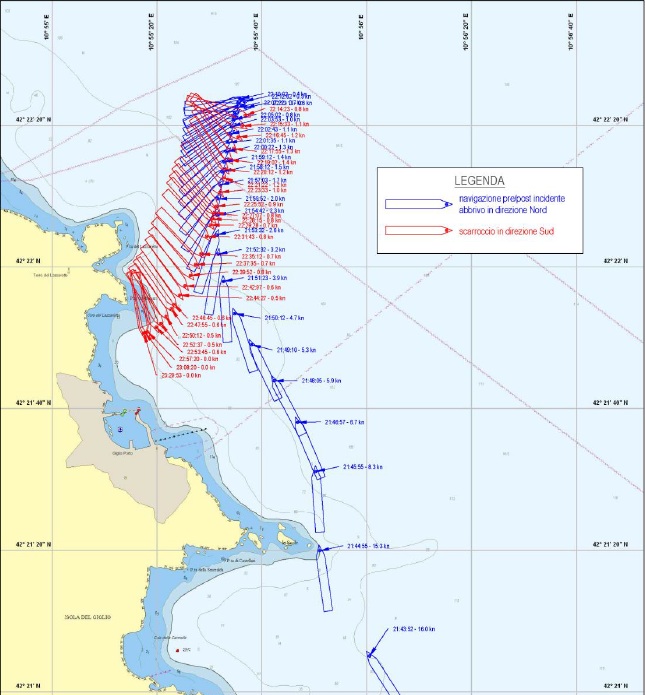
and at 2103 the ship takes up a course of 279º towards the
island.
At 2134 the Captain arrives on the bridge and instructs the
helmsman to put the steering into manual (from autopilot one
assumes), and shortly afterwards the 1st Officer gives
instructions in course headings to take the ship starboard.
Although this is not specifically expressed in the report
one assumes that the alteration was to take the ship clear
of the North end of the island.
At 2138 the Captain is on the telephone to some-one asking
about the safe distance off the island. (the investigation
was unable to name the person being called).
2139 with the ship on a heading of 290º the Captain takes
over the watch, although later narrative in the report seems
to indicate some uncertainty in this area.
2140. The Captain orders an increase in speed to 16 knots
and for the course to be altered ‘easy’ to 310º.
At about 2141 only seven minutes after the Captain’s arrival
on the Bridge he begins to give a succession of helm
instructions firstly to turn the bow away from the island
(so it seems, although the translation is confusing) and
then to port to stop the stern hitting the rocks. It appears
that during every change of course the ship moved laterally
towards the rocks, and since the Captain sent the Second
Mate to the port wing, he was aware that there was a risk of
grounding. Finally when giving orders to put the rudders to
port the helmsman makes an error and puts them to starboard,
but corrects himself and goes hard aport, the correction
taking eight seconds.
At 2145 the Second Officer warns that the ship has gone
aground, and there is a loud crash. Judging by the
photographs and the description of the damage, the grinding
of tortured metal must have gone on for about ten seconds,
and it would only be the distance from the location of the
impact and the enclosed design of the bridge which might
have reduced the bridge team’s understanding of the full
extent of the disaster. The ship continues to move
northwards, and within a minute is blacked out.
At 2146 the emergency generator starts up and provides power
for 41 seconds. Within a minute the ship is blacked out, but
during that time the master has given a number of helm
orders ending up with the rudders hard to starboard. And the
ship continues to move northward, the speed gradually
decreasing.
By 2152 it is evident that serious flooding of a number of
compartments has taken place and this has resulted in the
failure of the main engines and almost all other systems.
The emergency generator which has operated briefly is
attended by an Electrician who finds that the automatic
switch, which will start up the generator on main power
failure, is disengaged, and applies a screwdriver to the
switch. But a cooling system failure, as far as I can tell
the reason for which has never been identified, results in
the generator stopping.
At 2155 the passengers are reassured by the PA system that
all is well, and not to worry, and that ‘the technicians are
working to restore the functionality of the ship’.
At 2158 The Captain makes telephone contact with the company
Fleet Crisis Co-ordinator and says according to the report
that the ship hit a rock with the left side towards the
stern, reports the dynamics of the casualty, adds that the
propellers were not affected and is being assessed for
damages, also announces that the ship is in blackout and
that water is entering the stern that has reached the main
electrical panel.
Obviously this was an optimistic report and in no way really
flagged up the level of the crisis, and the technical staff
back in the headquarters suggest that the ship be taken to
anchor by the use of the bowthrusters.
At 2207 there is a conversation between the Civitavecchia
Harbour Operations Room and the ship, which refers only to
the blackout and that the situation is under control. By
this time it is evident to the 1st Officer and the Deputy
Chief Engineer that there are probably at least four
compartments flooded. In addition the Italian Search and
Rescue services have received several calls from the
relatives of passengers on the ship who have been in contact
to tell them that there is something wrong.
By 2212 with the rudders still hard to starboard the ship’s
forward motion has virtually ceased and maybe as a result,
not explicitly stated in the report, the list changes from
ten degrees to port to a list to starboard. The staff in the
emergency generator room have found that they cannot
maintain power using it due to the virtual failure of the
cooling system, and that therefore there can be no provision
of power to pumps, steering or other normally available
systems powered from the emergency switchboard.
At 2218 the Captain communicates with the company Crisis
Centre again to tell them that several compartments are
flooded and that there is no real power available from the
emergency generator. The report suggests that the captain
believes that there are only two compartments flooded and
that therefore the ship can survive. Hence he has not made
contract with the SAR services. Not only that, at this point
the passengers have not been alerted to the emergency.
By 2228 the Captain has asked for the assistance of a tug,
and has made a more realistic report to the company. It is
evident that the water level is still rising in the lower
compartments of the ship, and by now some of the catering
areas have been flooded.
At 2230 the Chief Engineer suggests to the Captain that the
ship should be abandoned.
At 2233 the ‘General Alarm’ is raised, followed by a PA
announcement (I think the report says ‘ads are then issued’)
to reassure the passengers that all is under control.
Despite this reassurance some passengers have apparently
already got into the lifeboats.
Possibly the next really salient point in the report is that
at 2240 the ship is resting on the bottom, and at that time
a distress message is broadcast using Inmarsat C.
By 2247 an SAR patrol vessel and a helicopter have been
launched, and at that time the Captain orders the dropping
of the starboard anchor, and then when it stops the release
of the port anchor. The Captain has also told the Coastguard
Operations Room that he is continuing to manoeuvre the ship
towards an anchorage, even though he has no engines, no
rudders and the ship is aground.
Whatever else, the grounding of the ship opposite Giglio
harbour was phenomenally lucky. As the salvagers have found
only a few metres to seaward and it would have turned over.
At 2251 the report states the following: Master informs the
bridge to raise abandon ship order, and then urges it, but
when asked to make the announcement he points out that it
should be said, "Let passengers on shore." rather than that.
You can see that there might be a bit of trouble
interpreting the content of the report just from this
statement, even though we think we know what they mean.
At 2257 there are lifeboats in the water, and the ship makes
contact with the ‘SO’ maybe a misprint, they could mean the
Coastguard Operations Room and says they are evacuating as a
precaution.
At 2311 the starboard list may be between 20 and 30 degrees
and the Captain in his last call to the company crisis unit
describes the situation as being less serious than the
reality.
Up to now most of the content of the report has been taken
from the VDR, the Voyage Data Recorder, but at 2332 even the
Second Master who was left on the bridge to co-ordinate the
evacuation, has left, so from this point one assumes that
either witness statements have been used, or else
transcripts of communications from the shore. And at 2338
all control of the evacuation having been abandoned, there
were still 300 passengers and crew on board. They were still
trying to escape, or disembark if you were following the
Captain’s view, and those who had jumped into the sea were
being picked up by SAR patrol boats.
At 0042 with about 80 people still on board the Captain
reveals to the Coastguard Operations Room that he is on
shore, and over time and after further communications at
0146 the report says that the OR contacts the Master
ordering him again to go back on board and provide a
situation report. This ordering back on board was broadcast
around the world at the time and the succinct phrases used
were soon to be found on tee-shirts and being used as ring
tones.
The rescue efforts continue with crew from one of the patrol
boats going aboard to sort it all out and at 0617 the report
says that the rescue operations connected with the
evacuation of the persons on board were declared complete.
The remainder of the report could be considered to be
assessment and analysis. Quite a lot of it against the
requirements of the ISM Code. For instance the safe manning
certificate apparently suggests 78 people. Actually we might
by now be becoming confused because we have already seen two
number for safe manning, and does it matter since the crew
list submitted 16th May named 1023 crew members. The crew
was made up of 38 nationalities, of which 149 were Italian.
And the language to be used on the ship was officially named
as being Italian.
So there were problems with Italian being the named
language, since quite a few of the crew did not apparently
understand it. The helmsman was Indonesian and in extremis
the Captain spoke to him in English. According to crew
members most instructions were given in Italian and English.
American passengers testified that during the emergency
several crewmembers were unable to speak English. But we
have to ask, why should they? The official language was
Italian, so that is what the passengers should have been
able to speak.
In addition to the crew problems with language, the report
also details the problems with the emergency qualifications
of those who were in charge of the lifeboats and the
liferafts. And the answer seems to be that those in charge
of the lifeboats had mostly been qualified at some time to
be in charge, but that the certificates held by many of them
were out of date, and in the main most of the liferaft guys
were unqualified. I’m having a job to stick to the script
here, since I heard a BBC report where native English
speakers from the crew and the passengers were interviewed.
There is then a quite lengthy discussion on the adequacy of
the chart being used, and there is a photograph of the
actual chart which had been recover from the ship. They
should apparently have used chart 119 with a scale of
1:20000 rather than a chart with a scale of 1:100000, and if
you look at the photo no wonder the Captain called some-one.
There only three soundings on the side of the island along
which the ship was to pass. But of course this would hardly
have mattered if he had passed at a safe distance.
And now we move on to watchkeeping and navigation, and I am
going to include the full introductory paragraph in order to
illustrate the problems anyone would have in trying to
understand what was going on. And I am beginning to think
that the Italian investigators meant this to be
unintelligible. How else could it have been. Even I know an
Italian who is completely bilingual and could tell them
where the problems were. And by reading on I have found that
the word ‘guard’ is probably a mistranslation of the word
‘watch’ in Italian.
The navigation area must be monitored visually with the
navigation instruments and must be evaluated every dangerous
situation.
The officer on duty on the bridge is responsible for the
conduct of navigation, that is to perform according to the
schedule of the voyage, even in the presence of the master
on the bridge. It 'the same Master who must explicitly take
the guard on the bridge pointing to the officer on duty.
The guard must be structured so that it can be ensured the
safety of navigation.
Similar service should be carried in the car unless the
vessel is not certified UMS (unattended machinery spaces)
that the machine is "periodically unattended."
The "Costa Concordia" is in possession of the record class
AUT-CCS then there is a guard in the "central control
station".
The organization of the guard is deducible from the
"planning board of the guard."
The report goes into considerable detail on the final few
moments before the grounding, showing photographically the
actual rudder positions obtained against the headings or
angles required by the master. It also suggests that the
main reason for the grounding was the fact that the ship had
passed the point at half a mile off when a large alteration
to starboard should have been ordered.
As usual in any investigation the investigators find many
thing are amiss in the operation of the object, of what-ever
sort, and the Costa Concordia accident was no exception.
They found that the report of passenger and crew numbers was
incorrect, and wrongly reported several times. They found
that even though the Abandon Ship drill had been carried out
on departure from Savona, other passengers had joined later,
but no subsequent drills had been undertaken. And it also
found that despite the close approach to the shore, and the
number of personnel on the bridge, no formal process had
been set up for what was effectively a manoeuvring
operation.
There-after, rather unusually the report considers the means
by which the grounding could have been avoided, and although
I found it quite difficult to understand, it appeared that
the simulations carried out indicate that had the last order
to starboard been avoided then the ship would have passed
clear of the rocks. This view is certainly born out by the
fact that finally the captain ordered hard to port to clear
the stern, but of course the helmsman put the rudders over
to starboard.
Of course we are already aware that subsequent to the
grounding things did not go according to plan. The plan
actually is the ‘Decisional Support System’ provided by the
company in accordance with SOLAS requirements. It seems that
neither the ship’s staff, or the Company itself followed
their own guidance. Even at 2221 when the DPA (Designated
Person Ashore), who had been contacted by the Captain,
called the CMD (Probably the Crisis Management Director, but
not names in the glossary of terms), that person accepted
the responsibility although according to the company
requirements it should have been a different person. And
only at 2300 was the Crisis Committee formed.
Indeed the report goes on to list all the failings in the
emergency process, which were considerable, and all in all
it was luck that so many boats got away virtually under the
individual command of the crew members who were in charge of
them. If I understand it correctly they are commended for
their efforts. The report then goes into some detail about
what happened to the ship ending up with it grounding
outside the harbour at Giglio, all of it intended to refute
the Captain’s public declarations that it had been his
intention to ground the ship to save the personnel on board.
Indeed it appears that the Captain was actually trying to
prevent the ship from grounding by having the anchors let
go.
Of course the extent of the damage directly caused by that
big rock sticking through the side of the ship was
considerable, and connected four large compartments, and
therefore exceeding the capabilities of the ship to remain
afloat (Two compartment damage). The fact that the
watertight doors were closed is hardly material. At various
points the report states that no consideration was made to
attempting to pump out these compartments, but of course
even if such a course of action had been considered there
was no power so no pumping would have been possible. The
failing on the Captain’s part, according to one of the
subsections, was that he did not have sufficient knowledge
of his own ship. The investigators also commissioned a
separate stability report to assist with their understanding
of the accident, of which we casual readers do not really
need to know the details. You could probably say that it
confirmed our suspicions that the ship would have sunk had
it not fortuitously gone aground.
There are pages and pages in the report given over the
analysis of the operation, and non operation of the
emergency generator, and in an attempt to understand what
went wrong simulations were carried out on an similarly
equipped ship. It is important to understand why the
emergency generator did not work as required, and as far as
I can tell, no real conclusions were made. It could have
been that the submergence of the ship to shore connection
could have prevented the switching system working, and as
far as I could see they found no reason for the generator
overheating.
So we move on to the summary and the recommendations. In the
summary the Master and the deck officers are collectively
blamed for the grounding, and for most of the failings in
the evacuation process, in which the management ashore are
also included, specifically the Designated Person Ashore.
The recommendations are divided up in various ways, and I
will try to summarize them. You may need your copy of SOLAS
to hand.
Proposals Accepted by the Flag Administration
1. The information required by SOLAS regulation III/27 and
European Directive 98/41/EC should be integrated with the
indication of the nationality of each passenger. This would
help communications, in case of accident, between SAR
Centres and Administrations whose citizens are on board.
2. The voyage plan requested by SOLAS regulation V/34 should
be made available by the master to the Company prior to the
ship's departure and be kept available until the next DOC
audit.
3. Instructions to passengers: the following measures should
be implemented:
a) at their embarkation, passengers are to be provided with
a brochure containing all the essential emergency
information; these brochures are to be available in the Flag
language and in the languages spoken by the passengers on
board;
b) in addition to what is prescribed by SOLAS regulation
III/19.2.2, safety information is to be available through
the ship's TV system, both in cabins and in conspicuous
points in the public areas, at the embarkation and
throughout the voyage;
4. The muster of passengers as per SOLAS regulation
III/19.2.2, is carried out at the ship's departure from the
home port; where embarkation takes place in different ports,
separate and dedicated musters are to be performed for
passengers embarking in those ports.
Improvements caused by the Ratification of the MLC
Convention (August 2013)
There are a variety of statements made in relation to the
audit and validation of manning agencies, but it was unclear
to me whether these items were suggested as possibilities or
will be in place if the convention is followed properly.
What the Company did as a direct result of the Casualty
A guest safety drill is to be performed before the departure
of the ship from the embarkation port, and those guests
identified as not participants are re-invited to another
event organized on-purpose (We understand the intent of this
I think).
The Company also creating a new Maritime Development &
Compliance Dept, which reports directly to the CEO.
The Company implemented an advanced system to manage and
monitor fleet route the "High Tech Safety Monitoring System"
(HT-SMS), involving both on board and ground staff. The
system enables the Company to monitor position and course of
the entire fleet in real time.
The Company is creating a dedicated "F.O.C." Fleet
Operations Centre in Genoa HQ to monitor and manage any
alarm generated by the system.
The “Crisis Management Preparedness Plan Operational &
Reporting Procedure” is to be replaced by a brand new E.S.U.
[Emergency Support Unit] Manual, prepared by a working team
lead by another new role, the Crisis Management Director who
reports directly to the President.
Implementing the training of Deck Officers, through a
mandatory policy adopted by Carnival Corporation on 1st
September 2012. These courses are as follows:
- Bridge Resources Management (BRM - two levels);
- ECDIS-NACOS (two levels);
- Ship Handling;
- Stability.
Recommendations as a result of the Investigation.
1. The recommendations may, according to the investigation,
result in a need to revisit some SOLAS requirements (See the
report for these).
2. Vessels should be double-skinned for protecting the
watertight compartments containing equipment vital for the
propulsion and electrical production.
3. The limiting of the down flooding points on the bulkhead
deck to be discussed in the light of Part B-2 of Chapter
II-1of SOLAS 74, as amended .
4. The provision of a computerized stability support for the
master in case of flooding.
5. An interface to be provide between the flooding detection
and monitoring system and the on board stability computer,
taking into consideration regulations II-1/8-1 and 22-1 of
Chapter II-1of SOLAS 74 as amended.
6. The following issues need to be discussed for possible
improvements of the existing requirements:
a. discontinuity between compartments containing ship's
essential systems (such as propulsion sets or main
generators sets).
b. more detailed criteria for the distribution and type of
bilge pumps.
c. relocation of the main switchboard rooms above the
bulkhead deck.
c. relocation of the UHF radio switchboard above the
bulkhead deck.
7. Consider increasing the emergency generator capacity to
feed also the high capacity pump(s) mentioned in the
previous paragraph.
8. Consider the provision of a second emergency diesel
generator located in another main vertical zone in respect
to the first emergency generator and above the most
continuous deck.
9. Consider the provision of an emergency light (both by UPS
and emergency generator) in all cabins in order to directly
highlight the life jacket location.
10. Bridge management should consider aspects such as the
definition of a more flexible use of the resources (that may
be tailored for responding to ordinary, critical, emergency
conditions), an enhanced collective decision making process
and "thinking aloud" attitude.
11. Bridge Team Management course for certifications renewal
should be mandatory by the 1st January 2015.
12. Principles of Minimum Safe Manning (resolution
A.1047(27) as amended by resolution A.955(23)) should be
updated to better suit to large passenger ships.
13. Muster list, showing the proper
certification/documentary evidence necessary for crew
members having safety tasks to be provided.
14. The inclusion of the inclinometer measurements in the
VDR.
15. For new ships, it would be useful to require an
evacuation analysis to be carried out at the early stage of
a project (ref. regulation II-2/13-7.4, SOLAS 74 as
amended), extending in mandatory way the above regulation,
actually limited to ro-ro passenger ships.
16. Regarding the embarkation ladders: with the ship listed
at an angle exceeding 20°, it was demonstrated that
traditional embarkation ladders were more useful. Therefore,
it may be necessary to consider whether the minimum number
of embarkation ladders (one) on each side should be
increased.
17. The final recommendation relates to the provision of an
SAR vessel and divers, probably in Italian waters.
(It should be noted that I have summarized these
recommendations, and in some cases interpreted them, so if
you are seriously interested in them you should access the
original report.)
I realized that not only have I summarized what happened to
the ship, I have also reported on the report. I can only ask
a question. Is this report absolutely suitable for
international scrutiny, considering the seriousness of the
event?
TO
RETURN TO FEATURES INDEX CLICK HERE |