|
THE LOSS OF THE OCEAN RANGER
I find that,
despite the fact that on many occasions, I have used the
Ocean Ranger accident as an example of how a minor incident
can turn into a catastrophe, during my 20 odd years and a
safety consultant, I have not included a description of it
on the website. This is an extract from my book ‘Supply Ship
Operations’, and even today as I sit in my office enjoying
the morning sunshine in the foothills of the Sierra
Guadarrama north of Madrid, when I reread these words, I
still feel the distress that I felt the first time I read
the report of the Canadian enquiry into the accident.
INTRODUCTION (from Supply Ship Operations)
The histories of the seafaring nations of the world are
filled with the records of marine incidents, some of which
have entered the national memories of the counties within
whose boundaries they occurred or where the vessels were
registered, and some of which have changed the way marine
commerce is conducted. In Canada the loss of the Ocean
Ranger is imprinted on the national consciousness, and has
altered the manner in which offshore operations are carried
out. In Britain the disaster at Piper Alpha has similarly
affected the regulatory approach to offshore operations, and
those of us who are more than 25 years old can recall where
we were when we first heard the news. It is also likely that
the loss of the Bourbon Dolphin will make a similar
impression on the Norwegian nation, despite a far lower loss
of life than either of the two events already mentioned, and
is certain to focus considerable attention on the task of
rig moving over the next few years.
Other incidents will not appear on the radar. They will be
recorded in the marine periodicals and may get a brief
mention on the local news but their moment will pass. An
investigation may take place and the results may also be
reported in the trade press, and then silence. It is
possible that the investigations may cause changes to the
rules under which ships and rigs operate, but if they do,
the changes will be slow and virtually unnoticeable.
Yet a third group of incidents will change nothing except
for the lives of the families of those who are lost. Sadly
these incidents are in the majority.
THE OCEAN RANGER ACCIDENT

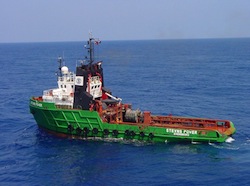
The Seaforth
Highlander (From Shipspotting)
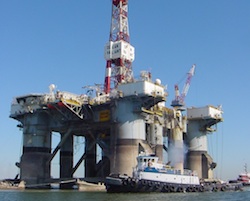
The Ocean Ranger was an extremely large and relatively
well-found semi-submersible which, in the spring of 1982,
was drilling for Mobil on the Grand Banks off the coast of
Newfoundland. It had eight columns. The corner columns from
which the moorings were deployed were larger than the
intermediate columns. Importantly to the enquiry, each of
the columns contained three chain lockers which were empty
when the rig was moored, the rig being provided with a
chain/wire mooring system. When on location all the chain
would be on the seabed, and the wire would be connected to
it. Also key to the events which followed, the Ballast
Control Room was situated in the aftermost intermediate
column on the starboard side, below the level of the main
deck.
No ships at all were involved in the disaster prior to its
occurrence, but it was a marine event, caused by a
combination of poor design, bad practice and lack of
knowledge. One of the many failings detailed by the enquiry
was the curious diversity of responsibility for the rig.
During the enquiry a number of former masters of the Ocean
Ranger were interviewed and they testified that they had
responsibility for marine matters without the authority to
properly discharge their duties. The masters had no crew
directly under their control and even the ballast control
operators took their orders from the tool-pusher, the senior
drilling person on the unit. The report on the sinking
stated that “He had no knowledge of the ballasting system or
the principles of stability. And yet the ultimate authority
and responsibility for the safety of the rig and its crew
rested in his hands”.
The initiating event in the disaster was the weather, which
turned from unpleasant to apocalyptic over the days up to
15th February 1982. On the previous evening the wind speed
was about 70 knots and the rig was heaving alarmingly. Other
rigs in the area, the Sedco 706 and the Zapata Ugland were
both hit by large waves. The Sedco 706 was engulfed at about
1900 and the report says that the wave dislodged a small
shed which was welded to the deck in the area of the drill
floor, a point about 60 feet above the sea when the rig was
at operating draft. The Zapata Ugland was also struck by a
large wave which washed over the helideck.
On the Ocean Ranger a large wave broke the port glass and
flooded the Ballast Control Room, dousing the ballast
control board. For those unfamiliar with the function of
this equipment, the board is used to electronically control
the valves and pumps which operate the ballast system on
semi-submersibles. During the drilling activities, which
involve the movement of drill pipe and liquids, as well as
containers and other objects, the ballast control system is
used to transfer water between tanks, mainly in the
pontoons. Water may also be taken on or pumped out in order
to change the draught.
The problem therefore, for the Ocean Ranger, was that when
the control board was doused in water, valves in the
pontoons started to open and close randomly, to the distress
of the control room operators. They knew that they had a
problem but they did not know how to solve it. Like many
ballast control systems, the one on the Ocean Ranger was
provided with solenoids which changed the electrical power
into hydraulic power. A switch on the board would activate
the solenoid which would open or close to allow hydraulic
pressure to be exerted on the valve actuator, or to be
removed, usually allowing the valve to close. Realising that
they had to do something, someone inserted a set of brass
rods into the solenoids, apparently thinking that the valves
would be closed, but instead the valves were opened. This
allowed water to flow freely between the tanks, and since
the ballast tanks in the Ocean Ranger were distributed along
the lengths of the pontoons all the water ran from aft to
forward. The rig gradually trimmed by the head until the
chain lockers filled up, and then in the dark at three in
the morning on 16th February the rig disappeared from the
radar screens of the ships in the area.
The involvement of support vessels in this tragedy was
limited to their activities as standby vessels. They were
not standby vessels in the sense that we now know them, but
were supply vessels assigned to the task. There were two OSA
ships, the Boltentor and the Nordertor standing by the Sedco
706 and the Zapata Ugland, and the Seaforth Highlander
standing by the Ocean Ranger. At five past one on the day of
the disaster, only two hours before the sinking, the Mobil
foreman requested that the Seaforth Highlander come to close
standby, and a few minutes later the other rigs dispatched
their standby vessels towards the distress. The Nordertor
was 20 miles away, the Boltentor eight miles away and the
Seaforth Highlander six miles away. In 60-foot waves one
should remember that any movement of a ship in a specific
direction, rather than just maintaining a heading to reduce
the possibility of structural damage, is something of a
feat.
The report states that during the approach to the rig the
Seaforth Highlander made ready the equipment it had
available which might assist in the rescue. This,
pathetically, consisted of a cargo net, a grappling hook, a
boat hook, two heaving lines and two lifebuoys fitted with
lines.
There was some inconsistency in the evidence from those
directly involved as to what happened next, but the enquiry
decided that the Master of the Seaforth Highlander saw a
flare at about 2.14 as the ship was approaching the rig, and
that this flare had been fired from a lifeboat.
At 2.21 the Seaforth Highlander reported the sighting of
another flare, had seen the lifeboat and was proceeding
towards it. At about this time the Mobil Superintendent back
in the base port advised the Mobil drilling foreman on the
Sedco 706 to tell the ship’s masters not to attempt to
attach the lifeboats by lines because, eerily for those of
us who have just read the previous report, he had heard of
an incident in the Gulf of Mexico where a lifeboat had
capsized under tow. However, the ship’s masters did not
recollect having received such an instruction.
The Seaforth Highlander approached the lifeboat and decided
to place the ship stern to wind with the lifeboat astern of
the ship. In this way he would be able to maintain the
heading, and would not be at risk of running the lifeboat
down; a possibility if he had tried to carry out the rescue
head to wind. The witnesses said that the lifeboat was also
head to wind apparently under power. The Seaforth Highlander
now stern to the seas was manoeuvred closer to the craft and
the seas breaking over the after deck were freezing
instantly and making it difficult for the crew to do
anything useful in their less than adequate protective
clothing.
Just after 2.30 the Seaforth Highlander reported that the
lifeboat was alongside. The crew on the deck managed to
throw lines which the survivors in the lifeboat managed to
attach, and at this time a number of men emerged onto the
port side. It seems reasonable to assume that others had
undone their safety belts, and had stood up, and obviously
the bailing activities which had been going on now ceased.
These changes probably contributed to a loss of stability
and as a result the lifeboat rolled slowly over, throwing a
number of men into the sea. The overturned lifeboat was
close to the port side of the ship, and to reduce the
possibility of injury to those now in the sea the Captain
stopped the port engine. As a result the ship began to drift
away from those in the water, although the deck crew made
valiant attempts to recover them, with some considerable
risk to themselves since the seas were still breaking over
the deck.
Meanwhile the other ships arrived. The Boltentor was asked
to assist in the recovery of the lifeboat, and the Nordertor
was sent to monitor the rig itself, the Nordertor reporting
the loss of the radar echo of the rig at three o’clock. Then
all three vessels took up the task of searching for
survivors or bodies in the sea, but the report of the
enquiry notes that “sea conditions and inadequate retrieval
equipment frustrated all efforts to recover bodies”.
During the final but unsuccessful attempts to recover the
lifeboat, the Captain of the Nordertor observed that there
were about twenty bodies inside. Several floated out through
a hole in the bow, and one was washed onto the deck of the
ship. Over the following days the search continued for
bodies, the fleet now enhanced by a number of other vessels,
and by 20th February a total of 22 bodies had been
recovered. Not one person, of the 83 man crew, was saved.
TO
RETURN TO FEATURES INDEX CLICK HERE
|