|
JACK-UP MOVING – AN
OVERVIEW
Maersk Contractors
recently announced that they have ordered what they call an "ultra
harsh environment jack-up" from Hyundai Heavy Industries in Korea,
with delivery scheduled for late 2002. This is the second rig of this type
to be constructed for Maersk, the first is also to be delivered in 2002.
They will have a leg length of 205 meters enabling them to work in water
depths of 150 meters (495 feet). In the North Sea such a jack-up could
work as far north as the Brent Field.
Obviously these rigs are
on the cutting edge of development. There are hundreds lesser jack-ups all
over the world drilling holes and being moved from location to location
with never a mention about their activities in the marine or oil industry
press, dazzled as every-one is by the glamour of the deepwater mooring
operation. Jack-up moving is less glamorous than semi-submersible moving
and sometimes requires no anchor-handling, but that is not to say that it
does not have its own difficulties or, just because the operation requires
less powerful craft the level of expertise on the part of the mariners and
rig movers is less.
In fact, even though
moving jack-ups over long distances may not be as glamorous as towing
semi-submersibles it would certainly appear to be more dangerous. While
World Offshore Accident Database, commonly known as WOAD, only records one
semi as having sunk when under tow, it shows that many jack-ups have been
lost while afloat. In at least one case one has sunk when the distance to
be travelled was less than 40 miles. During some tows even if the rig has
not been lost they have shed bits, particularly legs.
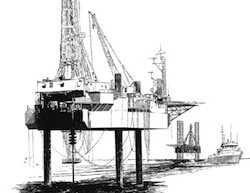
Jack-ups are not really
marine structures. They are most secure when they are standing on the
seabed with the hull fifty feet or so above the waves, looking a bit like
a triangular coffee tables. Making the change from being a secure
structure, impervious to the effects of wind and waves to being a marine
object – now an upside down coffee-table with the legs sticking up
hundreds of feet into the air – is difficult. Particularly difficult is
the actual moment of transition and the Operations Manuals of these
objects always specify the environmental criteria under which it can take
place. Wave heights of more than one meter are normally unacceptable. In
addition the warranty surveyors will normally only give towing approval if
the weather conditions for the whole tow will be acceptable due to the
area of the world where it is to take place, the routing of the tow takes
advantage of weather routing or jacking down positions are identified not
mere than 24 hours apart, if the tow in close to land.
In addition to the
problems of ocean towing created by the configuration and the low
freeboard of jack-ups, which is really a whole subject on its own, there
are numerous operationally difficulties which those moving jack-ups must
routinely face.
Oilfields in benign
shallow water environments such as the Arabian and Mexican Gulfs usually
consist of numerous individual wells each with its own small unmanned
platform complete with helideck. Pipelines are then run on the seabed from
each of the small platforms to a large central platform where the oil from
the field is processed and then pumped onwards to the shore. Much of the
work in these areas is related to work-overs where the rig has to make a
close approach to the platform, jack up until it is above it, and then
slide the drilling package out on the cantilever so that the well can be
re-entered.
Jack-ups may be required
to work in shallow waters, most extremely off the coast of the Indian
subcontinent in drying heights. In these areas the location must be
approached on a rising tide and the work completed before the tide falls
to the point where the vessels carrying out the move would go aground. Off
the coast of Saudi Arabia water there are complete oilfields consisting of
fifty odd small platforms all in water depths varying between a maximum of
10 meters and a minimum of two or three meters. Jack-ups which are
specially selected for their minimal draft deployed in these fields and
they are put in position and supplied by support vessels with similarly
low drafts.
Fortunately for those
working in this particular area of the world, one of its advantages is the
firm sandy bottom which is an almost universal feature. The sand allows
makes to process of getting a jack-up close to a platform particularly
straightforward.
Part of the process in
the Middle-east is for a diving ship to be allocated to the operation.
Prior to the arrival of the rig the diving ship will go to the position
where the rig is to jack up and deploy a couple of air divers who will
survey the seabed to make sure that there are no solid objects in the area
where to rig's spud cans will touch the bottom. Once they have determined
that the bottom is clear they will be directed to the platform in their
inflatable boat, which of course is unmanned. They climb up to the level
on the platform which is level with the main deck of the rig and wait.
As the rig approaches the
platform the legs are lowered until they touch the seabed. This stabilises
it while allowing controlled movement to take place. At this point the rig
is stern on to the platform usually with a single towing vessel on the bow
and one on each of the aft corners. The rig mover orchestrates the
direction and power of all the ships to cause the rig to move very slowly
backwards towards the platform, to the point where a tape measure may be
thrown over to the divers who catch the end so that the precise distance
off may be measured.
One of the features
offshore in the Arabian Gulf are collection platforms, or as they are
known in Saudi Arabia, GOSPs (Gas Oil Separation Platforms). These are
large platforms, in middle eastern terms, which have accommodation and
also some processing plant. Such structures require maintenance and in the
Middle east this is carried out by a hotchpotch of ships and rigs and self
propelled jack-ups.
One of the more onerous
activities is moving maintenance jack-ups into position in the close
proximity to GOSPs, which are often T shaped. It is sometimes necessary to
get the jack-up into the corner of the T which requires considerable
dexterity, and sometimes very strong nerves on the part of the
Shipmasters. One technique is to pull the rig in on a short wire until the
towing vessel is right up against the platform, assisted by two other
ships which are tied alongside. Once the bow of the towing vessel is close
to the platform, the legs are put on the bottom and the towing vessel
released.
Some of the legs of the
jack-up are then raised and one of the attendant vessels is attached to
the end furthest away from the platform and is used to pull the rig round
through 180 degrees. This somewhat unorthodox approach gets the end of the
rig into the right position without it having to be towed there.
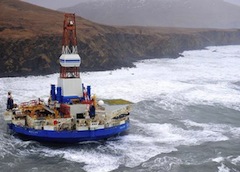
In the North Sea the
technique used is likely to be different. Firstly it is uncommon for the
legs to be put down before the rig is actually positioned, since it is
generally recognised that stressing the legs in a manner than vertically
is not good for them. This is a point well illustrated by the damage to
the legs of the Ensco 101, which was apparently caught by the tide in the
River Tay with at least one leg still attached to the river bed. It had to
be immediately taken out of service for repairs.
Hence when approaching a
platform in the North Sea the rig is oriented with its stern towards the
platform and then held in position while the legs are put jacked down.
When the hull is just in the water and the legs are taking the weight, the
tugs will run the stern anchors either side of the jacket. The legs will
then be lifted again and the rig pulled into the precise position required
using its own winches. Once it is in position the legs can then be lowered
again and the tugs can recover the anchors.
Some operators have
adopted an alternative technique which has a number of benefits. The rig
is positioned a little off the location as before, but instead of the
anchor-handlers running the rig anchors, they lay an anchor over their
stern and then run in towards the aft corners of the rig paying out their
work wires. They are then secured from the bow to the rig. The rig in now
in a position to raise the legs again and it is pulled into position by
the anchor- handler's work winches. The technique therefore avoids the use
of the rig mooring equipment which is always pretty lightweight and
sometimes poorly maintained.
What kind of vessels
therefore, are used for this task, taking into account the fact that the
towing requirements are often quite different from the positioning
requirements. It can be a real disadvantage if too much power is used when
placing a rig in the correct position, and an incautious pull on one
corner while the rig is afloat can spin it like a top.
There is a natural
tendency for the industry to relegate older craft to the jack-up job and
in some places and for some rigs they are entirely suitable. In shallow
waters the old American AHTS in particular are favoured, despite the fact
that many of them are twenty years old. They are built to what used to be
called the KISS principle (Keep It Simple Stupid) and therefore are
firstly unlikely to break down and secondly are unlikely to require highly
skilled technical help from the other side of the world. These old ships
have fixed pitch propellers, two small engines connected by short shafts
and probably five auxiliary engines, every one exactly the same, one
driving the Smatco winch on the afterdeck, one the bowthruster, one
driving the pumps and two the generators.
However, no matter how
reliable these old ships they will shortly be falling to pieces, a fact
that is well recognised by the industry. The average age of the Tidewater
fleet is 17 years and their management are now desperately trying to
update their tonnage by building and buying new ships. But they, like many
other owners are opting for the more glamorous end of the market.
It is possible that some
suitable designs are coming off the drawing boards at Rolls-Royce Ulstein,
although no-one is actually daring to produce a ship with the 4000 bhp odd
which is actually required for positioning small jack-up in calm shallow
waters. Even small marine diesels develop around 12,000 bhp today and it
seems likely that the Swire Pacific UT720s are pigeon-holed by most in the
UK as being suitable for jack-up moving.
In reality they are
probably vastly overpowered for most jack-up related tasks. In order to
fulfil the same requirement world wide Swires are building four
Rolls-Royce Ulstein 710s, which they say will principally support their
West African Middle East and Far East operations. These ships will have
10,800 BHP available provided by 2 engines. Rolls-Royce Ulstein have also
developed a variant of the UT719, the UT719-2 which looks as if it might
also fit the bill.
When it comes to the
"ultra harsh environment jack-ups" with their 500 foot legs,
things may be approached differently. To start with it is unlikely that
they will be able to move with the legs completely retracted into the
hull, and the more leg there is extended the more power is required to
make headway. A medium sized jack-up with fifty feet of leg extended
downwards may require as much as 20,000 bhp to move even at a two or three
knots, and slow transit speeds can cause all sorts of complications
particularly when it comes to weather windows. In the North Sea, jack-ups
can sometimes wait for weeks for the right conditions, and being caught
out afloat in the wrong place can be disastrous.
So it could be said that
the 10,000 to 12,000 bhp vessel might be ideal for towing in the North Sea
since the required 20,000 bhp would be provided by two vessels. Many of
the sinkings of jack-ups while under tow have taken place when a single
vessel was used for the tow, most famously the Rowan Gorilla I off Canada
when being towed by the Smit London and the West Gamma when being towed by
the Normand Drott. At the subsequent enquiry into the sinking of the West
Gamma, the Captain of the Normand Drott said that the rig crew would have
been less at risk "if the UK practice of using two tugs and an
auxiliary vessel had been used".
While the moving of
jack-ups appears to be of lesser importance than the moving of
semi-submersibles there are about four times as many of them and although
it is claimed that some very deep water moves can be undertaken by a
single vessel, it is very difficult to move a jack-up with less than two
ships and most rig movers prefer three. So, however you look at it, no
matter how mundane, jack-up moving looks like a growth industry.
Vic Gibson Originally
in the Offshore Support Journal in Feb 2000.
TO
RETURN TO FEATURES INDEX CLICK HERE
|