|
COLLISION
RISK MANAGEMENT
This was a short article about
a collision in 2000. Despite further developments, including the provision of
Collision Risk Management Guidance by UKOOA which itself was prompted by a HSE
2002 document, nothing much has changed.
In January 2000 the UK Health and Safety Executive, who have
the responsibility for ensuring that all activities on offshore installations in
the British sector of the North sea are operated safely, published a report
entitled "Effective Collision Risk Management for Offshore Installations".
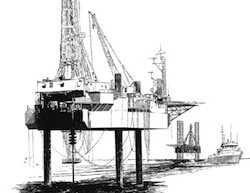
The problem, as the HSE sees it, is that ships may crash
into the North Sea's platforms and damage them sufficiently to cause them to
fall over, or in the case of semi-submersibles cause them to sink. There is
little thought given to the vessels which may be the cause of the misfortune,
and which also may sink. The report considers cargo and passenger vessels going
about their normal business, or "passing vessels", and support vessels with a
purpose inside the 500 meter zone, or "visiting vessels".
No installations have sunk, or fallen over, as a result of a
collision with a ship. And the last vessel to sink as a result of a collision
with an offshore installation was the Vulcan Service on Christmas Day 1990.
The weather was poor and the Vulcan Service was working with
a jack-up in the Southern North Sea. The ship was old enough to lack a complete
double set of tanks round the hull, being single skinned in the area of the
forward cement room.
The rig had a small quantity of cargo to be dispatched to
the shore, and despite the unfavourable weather asked the ship whether she would
be prepared to work. It was obvious to all concerned that if she took the lifts
she would then be dispatched to the shore and would be able to have Boxing Day
lying alongside in Great Yarmouth. There was therefore an inducement to carry
out the service.
The Vulcan Service came alongside the rig and was pushed up
against one of the legs by the weather. The teeth on the leg cut through the
hull opening the cement room to the sea and three hours later the ship sank.
Since the sinking of this vessel there have been a number of
other contacts between ships and jack-up legs; and each time the ships have been
cut open, although fortunately damage has been limited to a single side tank.
The striking thing about the HSE report, designated OTO
-1999 052, is that it identifies the same problems for the support vessels as
were evident in 1990. High on any supply ship master's wish list is a
requirement for "installation overboard lines to be designed so that they cannot
cause the alongside vessel to be sprayed or engulfed in liquids or bulk
powders". The fact that these words can be quoted directly from the report
indicates the lamentable lack of appreciation of the problems faced by support
vessels by the designers and operators of offshore installations after nearly
fifty years supposed collaboration.
In some areas the situation is deteriorating. The report
calls for "sufficient marine experience on the installation, or at least
locally, so that the marine issues and concerns can be fully understood by the
OIM (Offshore Installation Manager) before and during a close proximity vessel
operation". Professional mariners are becoming the exception rather than the
rule both on offshore installations and in the offices of operators and drilling
contractors.
Unmanned platforms, which in theory do not need supply, are
increasing in numbers. At times they still need support and as a result ships
must be sufficiently close to allow cargo to be picked up by the single short
jib crane usually installed. Of course any workforce present has been airlifted
in for a specific activity and therefore there is pressure on the shipmaster to
discharge his cargo even if his already close approach is made more risky by the
need to come in on the weather side in adverse conditions.
Any criticism of the operation of offshore installations by
support vessel owners would probably result in retaliatory invective, citing
errors on the part the bridge watch which have resulted in contacts between the
ship and the rig. Mistakes are made - but surely it is the job of the designer
owner and operator to ensure that possibility or errors are reduced and that the
results are minimised.
Vic Gibson
TO
RETURN TO FEATURES INDEX CLICK HERE |