|
A GOOD PROSPECT OF RECOVERY
If anyone is uncertain about what
Emergency Response and Rescue Vessels are supposed to achieve on the UK Continental Shelf, there follows an article
written for a UK marine magazine in 1998. It was called - "A GOOD PROSPECT"
In the 1950s "a good prospect" might have been a
mother's opinion of her daughter's boyfriend, but in the 1990s the phrase has almost
fallen into disuse except to those whose job it is to ensure conformance to the PFEER regulations.
The "good prospect" is that of being recovered from
the sea having fallen into it, been forced to escape into it from an offshore installation
or having been dunked into it by a falling helicopter. The PFEER - Prevention of Fire and
Explosion and Emergency Response – Regulations came into force on 20th June 1995.
They are bolted on to the Safety Case Regulations to emphasise those aspects which may not
have already been completely clear or to ensure that certain "arrangements with
suitable persons" are put in place to guarantee the previously mentioned "good prospect."
The usual way of making an arrangement with suitable persons is
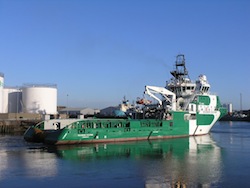
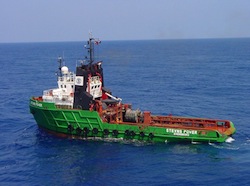
to provide a Standby Vessel, and the regulations in addition require performance standards
for standby vessels which will ensure their ability to recover people from the sea under predetermined conditions.
The standard which most affects those working in the North Sea
is the ability of the Standby Vessel to rescue people from the sea if the helicopter
crashes during take-off or landing. Roughly speaking a North Sea helicopter is capable of
landing or taking off from an oil rig in wind speeds of up to 55 knots. It is likely that
such windspeeds would result in seas which would be too rough, in the opinion of the
standby vessel master, for him to launch his fast rescue craft. When the helicopter
crashed at Cormorant Alpha in 1992 the windspeed was about 55 knots, and neither of the
standby vessel masters on the scene was prepared to hazard his crew by launching his fast
rescue craft, despite the extreme urgency of the situation.
The PFEER regulations have been in force for over two years but
the duty-holders - those responsible for the offshore installation safety cases - were
given some grace to get their act in order and to develop their performance standards, including those for Standby vessels.
Both UKOOA – the UK Offshore Oil Operator's Association and
IADC the International Association of Drilling Contractors developed performance standards
for the length of time they would expect personnel to be in the water before being rescued.
Also in 1995 the HSE published OTO Report 95 038, The Review of
Probable Survival Times for Immersion in the North Sea. This report spelt out in some
detail something that was already known to medical experts associated with the marine
industry, that except in flat calm conditions there is much more chance of people in the
water dying of drowning rather than hypothermia. This report indicated that in the North
Sea in winter there was a limited chance of anyone dressed in a standard helicopter
survival suit lasting for more than 30 minutes in the sea.
The likely results of entry into the sea were detailed by
Surgeon Rear Admiral Frank Golden (retired) at the Offshore Evacuation Escape and Rescue
Conference held in Aberdeen in April. Subsequent to entry into the water a body will turn
face into the wind, because the feet act as a sea anchor. This results in seas lapping
over the face, causing at least some intake of water. Any intake can serious lessen the chances of survival.
This information and a new caution on the part of the Standby
Vessel masters caused some helicopters not to fly from Aberdeen on windy days during last
winter. The terminals were full of restless oil rig workers dressed in survival suits
waiting for the weather to calm down so that they could be offered a good prospect of recovery should their helicopters fall into the sea.
Meanwhile the Operators have been extending the operating
envelope of the Standby Vessels by fitting the Dacon scoop. This is a semi-rigid net held
out from the side of the standby vessel, scooping the survivor up without hazarding the
crew. Of course in line with the performance standards requirements such systems must be
tested, this one by throwing multiple sets of dummies into the sea to simulate a
helicopter crash and then have the standby vessel pick them up. Results have, it is
alleged, been extremely varied and have depended as one might expect, on the expertise of
the standby vessel master and the manoeuvrability of his ship. However despite any
possible drawbacks many ships are now equipped with this device.
Another approach which might shorten the time to pick-up despite
the fact that many standby vessels now look after more than one installation, is the
concept of the mother and daughter craft. The daughter craft is a substantial vessel built
along the lines of a standard FRC but much larger, with a fully enclosed cabin with full
facilities. The daughter craft can stand by installations at some distance from the mother
craft, thereby providing two for only a little more than the price of one. There are some
mariners who have doubts as to the suitability of this alliance. The daughter craft
weights several tonnes making it difficult to launch and recover even under ideal
conditions, and so possibly increasing the risks to the ships crew.
There is one more approach which is taken by the Danish standby
vessel company Esvagt, and which was proposed by Ovin Carlsson managing director of that
company at the same conference – this is to exercise no matter what the weather. This
approach has resulted in Esvagt carrying out detail tests to ensure that the fast rescue
craft davit is placed in the optimum position on the ship, that the FRC is specially
designed and does not weigh more then 1200 kilos and is provided with a special hook which
can be easily operated by one man with one hand. Their outboard engines are diesels, and
can be restarted even after being submerged in water. This approach has resulted in Esvagt rescuing 68 people over the last 16 years.
As unpalatable as it may sound, the technique of practice, and
therefore familiarity may be the only one which can sensibly be used in the North Sea. The
other choice may be to accept that having small ships out there in any weather is in
itself an unacceptable level of risk, and that an alternative means of marine rescue must
be found. After all, as some-one remarked, a Standby boat doesn't follow the QE2 everywhere it goes.
Victor
Gibson
TO
RETURN TO FEATURES INDEX CLICK HERE
|