|
THE GROUNDING OF THE COSTA CONCORDIA
I had to
get my world atlas out to identify the precise location of
Giglio, the island into which the Costa Concordia crashed
inadvertently during its cruise this weekend (14th January
2012)
Every week this ship, carrying three thousand passengers and
1000 crew departed from Civitavecchia, a port about twenty
miles north of Rome, and made its way northward to the port
of Savona and then Marseilles and then Barcelona, Palma
Majorca, Cagliari and Palermo before returning to its home
port. This itinerary allowed the ship to sail overnight
between these places and be in a different spot every day. A
number of excursions were offered at prices ranging from €50
to €99., and the price for the whole trip apparently started
at about £1000 – discounted in 2012 to £465. And it may be
important to say yet again, that the Costa Concordia made
this trip every week.
So those with a professional interest in the state of
merchant shipping will be yet again considering the dangers
of operating ships with 4000 people on board, without really
any well defined emergency procedures or, so it would
appear, adequate controls over their construction and
operation.
In 2007 the Sea Diamond carrying 1600 passengers and crew
sank close to the Greek island of Santorini during a six day
cruise round the Greek islands. There were many local craft
on hand and all passengers and crew were evacuated with the
possible loss of only two of lives. Also in 2007 a small
cruise ship equipped to work in the Antarctic sank after
being damaged by ice. The passengers and crew were
successfully evacuated to Chile.
In November 2010 the Carnival cruise ship Carnival Splendor
broke down off the Mexican coast with 4500 passengers and
crew on board, losing all services including the toilets
which were vacuum powered. The ship was towed back to port
and an American aircraft carrier, the USS Ronald Reagan,
dropped emergency supplies to it.
So what’s going on? And will people continue to patronize
Carnival cruises considering they now have a better chance
of being involved in a serious incident on board one of
their ships than being struck by lightning, or winning the
lottery.
Of course one of the problems with cruise ships is passenger
expectation. If one is going to be safe on board ship, and
avoid running into things or going aground you should take a
course directly into deep water from one’s port of
departure, and then keep many miles from the nearest land.
The recommended distance is probably between five and ten
miles so that, in the unlikely event of a breakdown, your
engineers will have plenty of time to sort out the problem.
In addition being several miles from the nearest land allows
the navigators to make mistakes without the result being
catastrophic. But the passengers don’t like that. They want
to be so close to the shore that they can see people waving
to them from the beach. So close that they can see the
sunlight glinting off the glasses on the tables of the
dockside tavernas. This sort of approach is adrenalin
fuelling stuff, and so the navigators are generally ready to
oblige.
So, when the Costa Concordia left its home port, it headed
north with the intention of passing between the island of Giglio, and the Italian mainland. The channel is about five
miles wide. But two miles off does not give the passengers
much of a view, so doubtless the ship was churning its way
along the coast, sweeping deckchairs off the beach with its
wash, when it grounded on what the captain claimed was an
uncharted rock. It did not have to do any of that. It could
have headed straight out into the channel between Italy and
Corsica, but the passengers would not have had much of a
view.
The captain of the Sea Diamond similarly claimed that the
reef it hit was about 100 metres from the position indicated
on the chart, but this claim was rejected by the Greek
authorities. Anyway 100 metres is a moderately sized ship’s
length. It should have been further away from the shore than
that unless it was intending to go alongside somewhere. In
this case it was claimed that the crew on the bridge of the
ship were watching a football match, but surely not! In the
case of the Costa Concordia it looks from here as if they
just miscalculated the approach.
But why did they both sink? Surely we have reached a point
in ship construction that passenger ships capable of
carrying thousands of people are more or less invulnerable
to damage. Isn’t it about time the claims made for the
Titanic – that it was unsinkable – are fulfilled for large
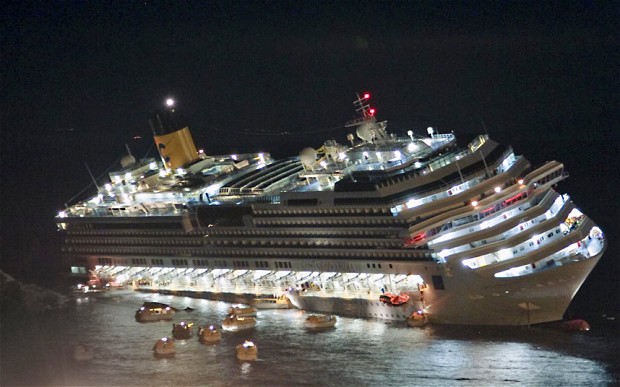
ships – of any sort? The photographs of the Concordia show
that the gash along the hull is actually out of the water as
the ship lies on its side just outside the port on the
island. This seems to indicate that it did not sink due to
an ingress of water but due to a loss of stability, and such
a suggestion is born out by the fact that passengers have
said that almost immediately after the impact the ship took
on a twenty degree list, making the lifeboats difficult to
launch.
Of course ship construction and machinery installation is
governed by the rules developed by the International
Maritime Organisation (IMO) but any changes to the rules
take years to enact, and are often opposed by those with
partisan interests. Attending IMO meetings is apparently a
little less rewarding that watching paint dry. In addition
those who build and operate ships are not motivated by any
moral sense. They will follow the rules precisely, and ship
designers who can find flaws in the wording, to allow for
financial savings, may well be rewarded.
Was this the case with the Carnival Splendor? This ship
was provided with two engine rooms which was supposed to
make it safer. Should there be a fire in one engine room the
other would still be available to provide power to the
propulsion which was electrically driven, the engines
themselves operating generators. But when there was a fire
in one of the engine rooms the result was a total loss of
all systems. Everything stopped, including all the domestic
facilities. The ship became dead in the water. The
passengers began to be seasick, and one can only imagine
what the problems where when the toilets stopped working
under those circumstances. One should not underestimate the
debilitating effects of seasickness, and had the weather
been rough at least some of the 4000 odd people would have
become seriously ill.
There have recently been calls for the size of bulk carriers
of all sorts to be limited, because of the possible effects
of a grounding or collision on the environment, and unless
designers can start actually building the unsinkable cruise
ship, should their size be similarly limited? Answers on a
postcard please – from Giglio.
17th Jan.
Well, it
just shows how wrong you can be. There I was thinking that
the navigators wanted to show the passengers the coast, and
actually it turns out that the Captain may have wanted to
show the ship to someone on the island. News today indicates
that the ship deviated from its normal course which was more
or less through the middle between the mainland and the
island of Giglio, and ran alongside the coast before
grounding. The captain, who was in court today claimed that
be had then steered the ship to a point where, rather than
sinking into deep water, it would remain at least partially
above the water.
Unfortunately rather than the three deaths initially
confirmed as darkness has fallen over the site it has been
stated that there are still 29 people missing, and further
bodies have been discovered. It also seems that fuel may be
leaking from the tanks to the surface, so there is action
being taken to stem the flow and a salvage company is
considering further action.
Things also
don't seem to have gone well during the evacuation, although with
more than 4000 people to rescue things can't have gone too
badly. However, an Englishman on the radio today said that
late in the evening there was a tannoy which told everybody
not to worry, there had been a generator failure, but
never-the-less people began to assemble on the upper decks as
the ship slowed down and finally came to a stop.
No-one has
actually said whether there was an emergency announcement
and there have been no reports of a mayday being sent using
any form or radio or telephone system. But early on it was
rumoured that the captain had left the ship by lifeboat at
about 1.30 am while others did not manage to get off until
4.30 am. This by the way seems to indicate that the ship
took a lot longer to end up horizontal and mainly submerged
than first reports indicated, and could well be why nearly
everyone got off.
20th
January
Has no-one but me noticed that
there is a bloody great rock sticking out of the hull of the
Costa Concordia? Perhaps it was the top of the pinnacle
which they had the bad luck to hit. This might be born out
by the fact that actually this was not the first time the
Costa Concordia had passed very close to Giglio. Lloyds List
say that they have assessed AIS data (I didn’t know this
could be done) and have determined that in August 2011 the
ship passed the island at a similar distance, apparently in
celebration of some event on the island. The course appears
to have been exactly the same, so maybe the ship was lighter
in the water, or the tide higher. The deviation in August
had been authorized by Costa. Someone soon is going to start
asking about passage plans.
Unfortunately although searches are still going on in a
limited way, there are still twenty-one people missing and
eleven confirmed deaths.
Meanwhile the revelations in the Italian press go on. Now,
apparently, the coastguard were calling the ship and asking
what was wrong, because they were receiving calls from
concerned relatives, who had themselves been receiving calls
from passengers. The response was apparently that there had
been a generator failure, and that there was nothing
seriously wrong. This was the message also being relayed to
the passengers – even though by this time the ship had been
holed.
Also there have been transcripts broadcast of an argument
between the captain and a senior coastguard official, which
suggest that the captain was speaking from the shore while
there were still hundreds of people on the ship. The
official said “Get the f**k back on board”. There have been
t-shirts manufactured with the phrase on the front. The
captain later said that he accidentally fell into a
lifeboat!
And the most extraordinary revelation concerns a Moldovan
girl who has appeared on their TV saying that the captain
was a hero and that his actions had saved many lives. Of
course this has resulted in people asking who the hell she
is, and an Italian investigative journalist has said that
she was not on the passenger list, but that she had dined
with the captain in one of the restaurants, and that much
wine had been consumed.
25th January
This event is beginning to drop
out of the media spotlight, but there are a few articles
here and there, as other crew members from the Costa
Concordia are interviewed by the investigators from the
Italian court. In addition further bodies have been found so
there are now sixteen people confirmed dead, but they seem
to be sticking with the twenty missing, suggesting that
there were unregistered people on board.
The Moldovan lady, reported as
having had dinner with the captain, was apparently a dancer,
but the reports I have read have not said whether she was a
dancer on the ship.
The captain has claimed that
the company encouraged him in the past to make close
approaches to land in order to entertain the passengers, and
this seems pretty likely as I suggested in my original
article. The third mate has been interviewed and he has
suggested that the captain may have been distracted by the
presence of guests on the bridge, who included the head
waiter, who cam e from the island. The captain has
apparently said that he turned too late, and that he was do
the job by eye, and so the ship hit the rock which seems to
have been sticking out of the sea, and to have been featured
on tourist maps, never mind charts.
One can therefore imagine the
captain doing the daredevil approach, requiring him to turn
away at the last moment, and that he had succeed in doing
this in the past. So as he turned away the ship grazed the
rock, seemingly breaking a bit off, which is still visible
sticking out of the side. The damage resulted in seawater
leaking into the engine room, or maybe one of the engine
rooms. And in my view the water in the engine room may have
provided the free surface effect which resulted in the ship
listing and then turning on its side. It would probably have
ended up upside down had it not been in shallow water.
More on this story later!!
3rd February 2012
On 2nd February the Italian
authorities interviewed the Moldovan dancer Domnica Cemortan
(25) - or should it be (25!), who as it turned out was on
the bridge of the Costa Concordia, as a guest of the
Captain, when it ran aground on the edge of the island of
Giglio. According to the press who have reported on this
event, she has said that she was "in love" with Captain
Schettino (52) or (52!!). Without wanting in any way to
suggest that the captain is anything less that a babe
magnet, in my experience young east european ladies, are
very attentive and charming to we older west european men
when the opportunity occurs.
The relationship between
Domnica and the captain appears to have been validated by
the rescue divers, who are reported top have found "items of
clothing and lingerie" in the captain's cabin. Well, what do
you know?
Meanwhile the search for
further bodies has been terminated due to possible risks to
the divers, which is not surprising. It is difficult enough
to find your way around a ferry, brightly lighted and the
right way up, never mind finding one's way around 100,000
tonne cruise liner on its side, under water and in the
dark. Currently the bodies of 17 people have been found, and
there are a further 15 people missing.
12th April
By now the fuel has been pumped
out of the ship, the bodies of all the missing people except
fot two have been recovered, and the plans are being made to
take the hull away. According to the media there have been a
number of plans submitted and the one which is likely to be
accepted is that which takes the ship away in one piece. The
preparation for it may take up to a yea, so the story will
not be over until this time next year.
Vic Gibson
TO
RETURN TO FEATURES INDEX CLICK HERE |