|
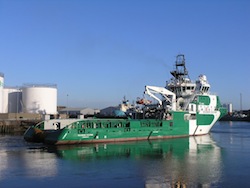
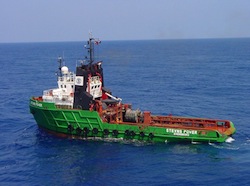
Goodbye Far Turbot.
Recent S&P
lists have reported the sale of the Far Turbot to the Far East. Just
another ageing yet still useful anchor handler starting out on the next chapter
of her life. There is however one chapter that her new owners should know about.
Between 1995 and 2003 she swapped the harsh environment of
the North Sea winters (and later in the period the summers too) for the
relatively calmer waters of the Dover Strait when she was chartered through
United Towing to the MCA as the Coastguard ETV. Her area stretched from the
Thames Estuary and north eastwards down to Beachy Head, an area including the
narrow and congested TSS between the UK and France. She patrolled these waters
to respond to incidents posing a risk of pollution. A surprising number of
ships break down in the traffic lanes for anything from less than half an hour
to several days. Years ago salvage tugs would maintain salvage station in the
area but that era has long gone. The difference here being that she was
permanently chartered to carry out a similar role and would often be despatched
to stand by the ship – just in case. It is interesting listening to the
coastguards at the Channel Navigation Information Service at Dover trying to
convince the ships master that the tug was being sent just as a precaution with
(at that stage) no cost implications. Between patrols she would ‘park-up’
usually off Folkestone, The Downs or Margate Roads and before long became a
familiar part of the local maritime scene. Known affectionately as Fat
Herbert or Fartabout she would often attend local maritime events
on her days off – usually coinciding with the routine testing of her 7200 m3/hr
fire monitors, always guaranteed to impress the punters! I heard an elderly lady
once point to her at anchor off Margate and say to her friend ‘ooh look, there’s
our tug’ – being a taxpayer she had a point.
Her roles included assisting in SAR operations when needed
and her crews were always eager to get involved with exercises with the local
rescue services. I am coxswain of the lifeboat here at Margate and once or twice
a year we would ‘book’ her for a Sunday morning exercise. They had a weighted
dummy which they would put it in an un-accessible location simulating an injured
crewmember, usually the shaft tunnel if she anchored. With the aid of our
largest stretcher (can’t make it too easy) our crew would have to extract
‘deadfred’ onto the tugs deck then onto the lifeboat. To add to the realism the
tugs crew were instructed to act as though they didn’t speak English. After a
while of course we became familiar with the ships layout so on one occasion we
arrived alongside and when asked where Fred was, the smiling crew pointed up to
wheelhouse where he was unceremoniously draped over the railings on the monkey
island. Once bagged up however we talked the tugs crew into using the ships
crane – that exercise was all over very quickly! For a change on one occasion I
asked the master if they would like to have a go at towing us. He looked at our
12m Mersey class lifeboat and obviously comparing it with a rig anchor said that
if we needed assistance he would haul us over the stern roller onto his after
deck. I didn’t fancy that very much but then he didn’t like the idea of us
trying to tow him – perhaps he knew I always carried a camera on board. On the
social side we would exchange a pile of Sunday newspapers for a box of hot
Chelsea buns; there were seldom any left for our launchers back ashore.
I had the good fortune to be invited to spend three days
aboard her one very windy February to experience life on board. In lifeboat
circles we often say tongue-in-cheek that you can’t beat a good shipwreck for
crew morale but apart from a scare with a broken down LPG carrier no-one came to
grief at all. One of her regular duties was to identify ships that broke Rule 10
of the colregs. The usual offence was not crossing the lanes at right angles –
they were called ‘rogues’ while those who did not follow the mandatory reporting
procedures were labelled ‘zombies’ On my second night on board we were tasked to
identify a ship that had broken the rules when leaving The Scheldt and had not
called in as required when entering Dover’s patch – we had a Zombie and a Rogue
all in one! When not in panic mode the tug would operate on two of her four main
engines so around twelve knots was her maximum speed. Our customer was however
making 25 knots so the vectoring to get us to be going in the same direction as
her as she sped by had to be very precise – we had to get close enough after all
to read her name with the ships searchlight (or wake someone up perhaps!) as she
sped by, but of course closing the gap as you are being overtaken is not
particularly recommended!. The OOW said that they often broke off the chase if
they thought they would freak the other ship out. When about two miles away a
quick flash at her with our searchlight had the desired effect and all of a
sudden she was very eager to talk. She was a reefer bound for Colombia and after
putting them in contact with the coastguard we scurried back to the safety of
The Downs. I had witnessed an intriguing exercise in precise navigation, but one
that I imagine is not carried out in modern simulators perhaps?
In the hard-nosed world of commercial salvage where profit
is the name of the game it is often overlooked that such operations often
involve the saving of life. It is easy to gather statistics of lives lost at sea
but harder to interpret the often grey definition of having saved a life. The
Far Turbot (and of course other ETVs’ before her and since) regularly have a
hand in saving life at sea, sometimes in an indirect form. A few years ago
following a beautiful summers Sunday morning with a fresh south-westerly breeze
all hell broke loose when a front passed through the area. The wind flew out to
the north and within half an hour was gusting to 50 to 60 knots. A tip - try not
to be off the north Kent coast on these occasions. It wasn’t long before we were
called to assist several small craft caught out by the sudden change of weather.
A local commercial fishing boat had been attending a ship anchored in the Roads
and had cast off when the weather changed. A large wave swamped her, partly
flooding below decks to the extent that the skipper thought she was about to
founder. This was a Mayday situation and when we arrived he was slowly making
way head to wind. He was understandably reluctant to leave the wheel to inspect
below and although low in the water the situation was relatively stable. Plan A
was to get him to turn the boat downwind whereby he could run back to Ramsgate
or take a tow from us. The sea conditions were some of the worst we had seen
however and the skipper would need all his skill and more importantly confidence
to judge the timing of his manoeuvre. From his forward wheelhouse windows all he
would have seen would have been a constant succession of steep breaking walls of
water. As we did not know the effect on his now compromised stability the turn
would not be easy for him. Meanwhile Fat Herbert had been anchored in the
Roads and was also now on scene. The readers of this column will of course know
all about the manoeuvring capabilities of an anchor handler and – I think
without anyone realising what was happening - her master obviously had a plan!
He positioned his vessel beam on to the seas and directly ahead of the slowly
approaching fishing vessel, in effect blocking his path but using an element of
sideways movement to match his progress. Now put yourself in the wheelhouse of
the fishing vessel. Instead of the constant walls of water in front of him he
was now faced with a different even bigger wall, this one red with a giant white
‘F’ on its side. The provision of this lee gave him the opportunity he needed to
turn the boat around. The panic was over; our colleagues from Ramsgate arrived
to escort him back home while we went off to escort one of our own fishing
vessels back to harbour. When we got back I telephoned Captain Dave Forster on
the tug and in my ignorance, eager to learn asked if he used the joystick during
the manoeuvre. No he said – the bow thruster wasn’t working!! Without anyone
knowing, on that day she had played a part in perhaps saving a man’s life. They
would not have been paid for that job of course, but they wouldn’t mind that.
Klyne Tugs of Lowestoft eventually took over the contract
and when the Far Turbot left our waters for the last time we presented
her (together with United Towing) with a commemorative RNLI plaque thanking her
for her company over the years. The world of ship preservation is as tough as
the world of commercial salvage so I imagine one day she will be humiliatingly
hauled up a beach somewhere and cut up. If the plaque remains on board perhaps
someone will read it and say ‘I wonder what that was all about’
Peter Barker TO
RETURN TO FEATURES INDEX CLICK HERE |