|
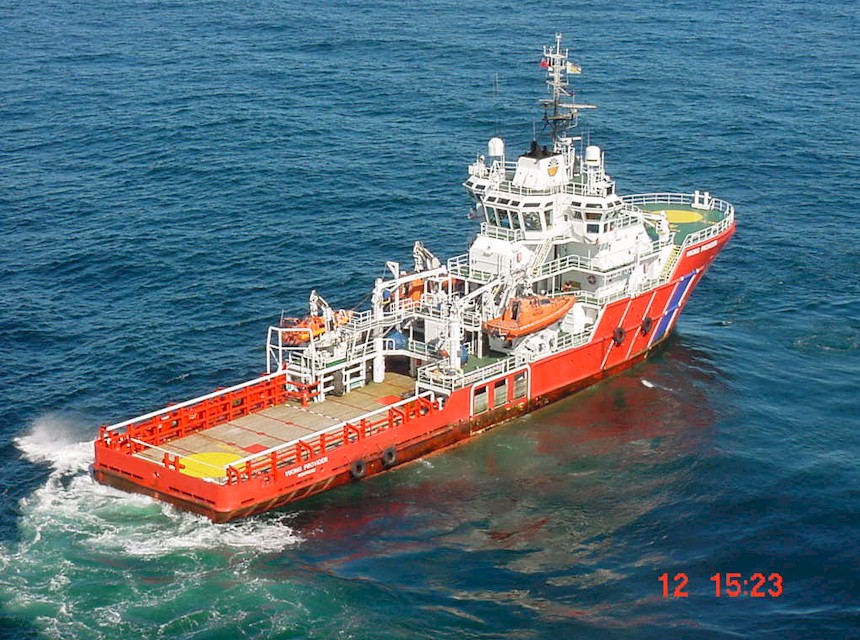
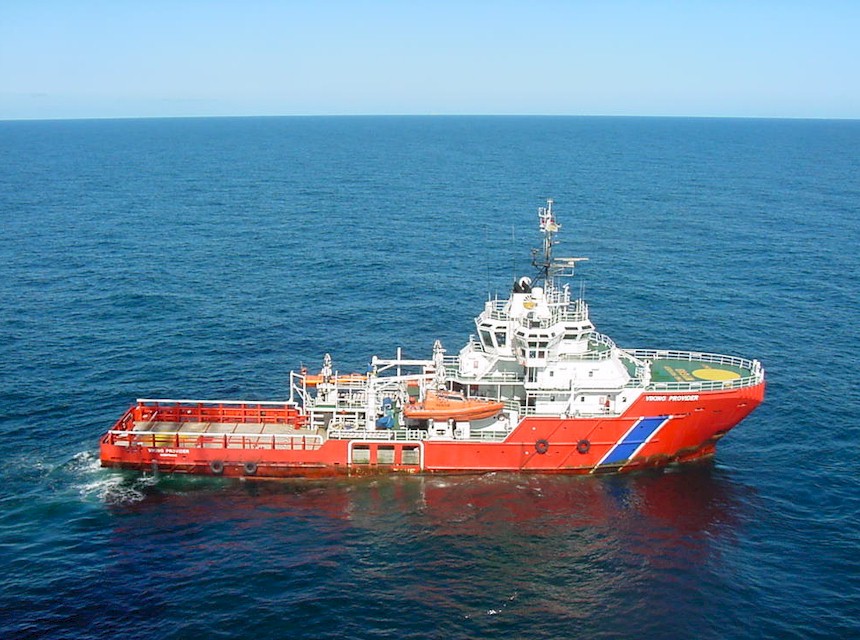
The Viking Provider was added to the Viking Standby
fleet on 13th May 1999 only 12 months after the order was placed for its
construction at the German yard of Husumer Schiffswerft.
The ship is an IMT Sea Supporter 1800 class vessel
designed by IMT Marine Consultants of Montrose. Co-incidentally Viking's
office is in Montrose and the ship is registered in the port.
The Viking Provider has been taken on long term charter
by Elf Exploration for use on the Elgin, Franklin and Shearwater Fields.
It is the latest manifestation of the efforts being made by the oil
companies to provide standby vessel support in a manner which is likely to
conform the UK PFEER Regulation 17. Regulation 17 states that in the event
that personnel end up in the sea due to a catastrophic event, a helicopter
crash or falling overboard, they must be provided with "a good
prospect of recovery."
The ship is known in the publicity literature as a
"multi-function support vessel" which means in the case of the
Viking Provider that it can carry a limited amount of deck cargo and a
quantity of fuel and potable water to the field when it carries out its
crew change voyage. Additionally it can be used for interfield transfers.
Its two MAK engines develop a total of 4800 kW which
gives it 63 tonnes of bollard pull, however it is not provided with either
a winch or a roller. Instead it has a substantial staghorn in the middle
of the deck aft and a towing hook fitted at the aft end of the
accommodation. The staghorn is to enable it to tow lifeboats should such
be necessary and the towing hook is to allow it to take a drifting vessel
in tow by means of the latter's insurance wire.
The ship is 68 meters long 14.5 meters wide and has
substantial freeboard. The covered in forecastle which results in an open
deck space for use as a helicopter winching area gives it a muscular look
which is enhanced by the blunt fendered bow, provided in case it is
required to push anything.
Standby vessels which support more than one
installation are frequently provided with daughter craft principally
because there are usually a number of activities which take place on oil
rigs known as "overside work", during which it is considered
that the personnel engaged in the work are at risk of falling into the
sea. Such work may only take place if there is provision on hand for
immediate rescue and so two installations are so engaged at the same time
the mother ship can stand by at one while a daughter craft stands by at
the other. The Viking Provider has two daughter craft each deployed and
recovered with motion compensated davits. These craft manufactured by
Norsafe and designated Munin 950 were the subject of a separate article in
the last edition of OSJ. They look as if they would be more at home in
Monte Carlo than in the North Sea, however in addition to good looks they
fulfil the essential requirement of providing the two crew with a
comfortable environment in which they can remain for hours if necessary.
As well as the two daughter craft an additional
conventional FRC is provided and should the weather be sufficiently rough
to prevent the launching of any of this equipment the ship has a Dacon
Scoop on both the port and starboard sides. The Dacon Scoop is yet another
item of equipment which is now commonly fitted to standby vessels, to
allow overside work on board the installation even in poor weather
conditions. The scoop can best be described as a semi-rigid net held out
from the side of the ship by a hydraulic crane. The principle is that the
ship should steam slowly towards the person or persons in the water so
that they are eventually caught in the net. The crane then lifts the net
up and the person is recovered on board. This activity may be one where a
smaller standby vessel might be an advantage since it would probably be a
terrifying experience to have the Viking Provider bearing down on you in a
five meter swell.
To assist with this particular activity and other slow
speed manoeuvres the ship is provided with a Holland Roer variable speed
azimuthing thruster which can be lowered from the hull on location. Such
thrusters are becoming common on all types of support vessel but are
particularly suitable where the vessel is required to proceed forward
slowly on a precise course. The thruster can be controlled from either of
the bridge wing control stations giving the Master the best possible
chance of keeping persons in the water in sight while manoeuvring the ship
so that they can be collected by the scoop.
In order to fulfil yet another standby vessel function,
that of plotting approaching vessels to make sure that they are not going
to run into any of Elf's platforms, it is provided with 3 ARPA radars,
which form part of the comprehensive bridge console. This is positioned
centrally in the forepart of the bridge, the windows being so arranged
that from the seat at the console the watchkeeper has an excellent view
forward and to port and starboard with no blind spots. This essential
requirement was in the past more or less ignored by many naval architects
but is now, to the relief of all watchkeepers, becoming accepted practice.
|

_small.jpg)

.JPG)